Howell Jessica, Samani Amit, Mannan Binish, Hajiev Saur, Motedayen Aval Leila, Abdelmalak Rebecca, Tam Vincent C, Bettinger Dominik, Thimme Robert, Taddei Tamar H, Kaplan David E, Seidensticker Max, Sharma Rohini
Department of Medicine, The University of Melbourne, St Vincent's Hospital, Melbourne, VIC, Australia.
Disease Elimination Program, Macfarlane-Burnet Institute, Melbourne, VIC, Australia.
Therap Adv Gastroenterol. 2022 Sep 30;15:17562848221100106. doi: 10.1177/17562848221100106. eCollection 2022.
The impact of nonalcoholic fatty liver disease (NAFLD) on overall survival (OS), treatment response and toxicity in patients with hepatocellular carcinoma (HCC) treated with sorafenib is unknown. We examined the impact of NAFLD on survival and toxicity in an international cohort of patients receiving sorafenib.
Clinical and demographic data were collected from patients consecutively treated at specialist centres in Europe and North America. The impact of NAFLD on OS, sorafenib-specific survival and toxicity compared with other aetiologies of liver disease using multivariable Cox-proportional hazards and logistic regression modelling was assessed.
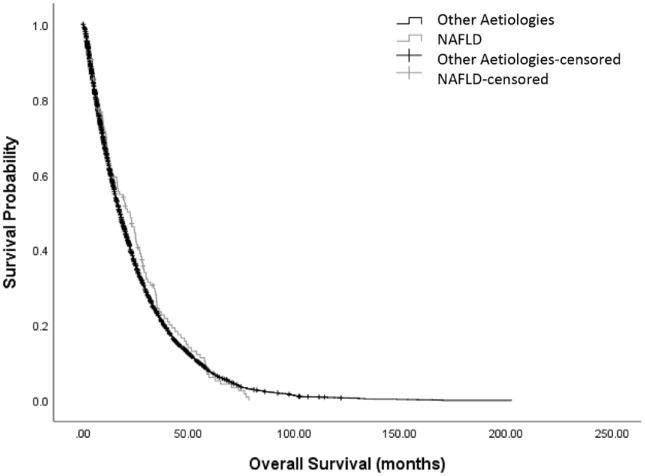
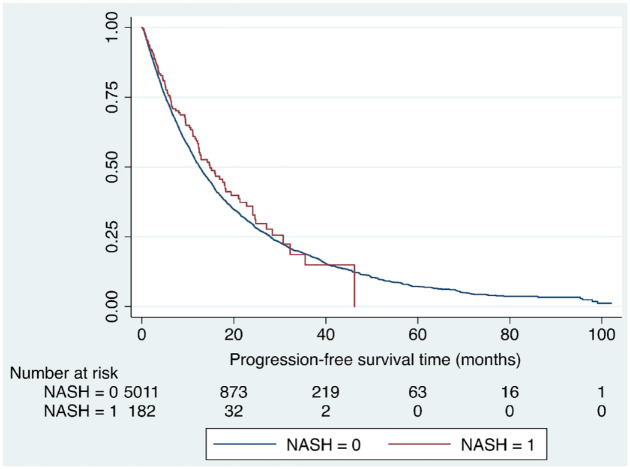
A total of 5201 patients received sorafenib; 183 (3.6%) had NAFLD-associated HCC. NAFLD-associated HCC patients were more likely to be older women (median age 65.8 63.0 years, < 0.01 and 10.4% 2.3%, < 0.01), with a median body mass index (BMI) of 29.4. After controlling for known prognostic factors, no difference in OS in patients with or without NAFLD was observed [hazard ratio (HR): 0.99, 95% confidence interval (CI): 0.84-1.18, = 0.98]. NAFLD-associated patients had more advanced stage HCC when they commenced sorafenib [Barcelona Clinic Liver Class (BCLC) C/D 70.9% 58.9%, < 0.01] and were more likely to be commenced on a lower starting dose of sorafenib (51.4 36.4%, < 0.01). There was no difference in sorafenib-specific survival between NAFLD and other aetiologies (HR: 0.96, 95% CI: 0.79-1.17, = 0.96). Adverse events were similar between NAFLD and non-NAFLD HCC groups, including rates of greater than grade 2 hypertension (6.3% 5.8%, = 1.00).
Survival in HCC does not appear to be influenced by the presence of NAFLD. NAFLD-associated HCC derive similar clinical benefit from sorafenib compared with other aetiologies.
非酒精性脂肪性肝病(NAFLD)对接受索拉非尼治疗的肝细胞癌(HCC)患者的总生存期(OS)、治疗反应及毒性的影响尚不清楚。我们在一个接受索拉非尼治疗的国际患者队列中研究了NAFLD对生存期和毒性的影响。
收集欧洲和北美专科中心连续治疗患者的临床和人口统计学数据。使用多变量Cox比例风险模型和逻辑回归模型评估与其他肝病病因相比,NAFLD对OS、索拉非尼特异性生存期和毒性的影响。
共有5201例患者接受索拉非尼治疗;183例(3.6%)患有NAFLD相关的HCC。NAFLD相关的HCC患者更可能是老年女性(中位年龄65.8对63.0岁,P<0.01;10.4%对2.3%,P< 0.01),中位体重指数(BMI)为29.4。在控制已知的预后因素后,未观察到有无NAFLD患者的OS存在差异[风险比(HR):0.99,95%置信区间(CI):0.84 - 1.18,P = 0.98]。NAFLD相关患者开始使用索拉非尼时HCC分期更晚[巴塞罗那临床肝癌分期(BCLC)C/D期:70.9%对58.9%,P<0.01],且更可能开始使用较低起始剂量的索拉非尼(51.4%对36.4%,P<0.01)。NAFLD与其他病因之间的索拉非尼特异性生存期无差异(HR:0.96,95%CI:0.79 - 1.17,P = 0.96)。NAFLD和非NAFLD HCC组的不良事件相似,包括2级以上高血压发生率(6.3%对5.8%,P = 1.00)。
HCC患者的生存期似乎不受NAFLD存在的影响。与其他病因相比,NAFLD相关的HCC从索拉非尼中获得的临床益处相似。