Shrivastava Manisha, Shah Nehal, Navaid Seema, Mishra Shweta
Department of Transfusion Medicine and Blood Bank, All India Institute of Medical Sciences, Bhopal, Madhya Pradesh, India.
Department of Physiotherapy, Bhopal Memorial Hospital and Research Centre, Bhopal, Madhya Pradesh, India.
Asian J Transfus Sci. 2022 Jan-Jun;16(1):22-35. doi: 10.4103/ajts.AJTS_154_18. Epub 2022 May 26.
The objective of this study was to assess the changes in knowledge concerning quality management system (QMS) among the participants before and after attending a QMS training.
After obtaining the ethical approval, a retrospective study was designed to evaluate the effectiveness of QMS. Fifty participants from district blood banks of three different states participated in the study organized at two different periods. After obtaining informed consent, the participants were subjected to set of questionnaire containing 45 questions (35 multiple choice and 10 subjective questions) as pretest on quality standards and were again subjected to posttest questionnaire containing the same set of questions after 5 days of workshop. Twenty minutes were granted to solve the questions. Each question was given one mark. There was no negative marking. An assessment of knowledge gained during training was evaluated by comparing the scores of pre- and post-assessment.
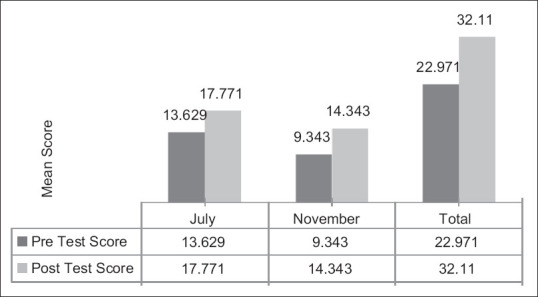
Of the total 50 delegates, 29 were trained in the month of July (Training I) and 21 were trained in the month of November (Training II). There were 96% ( = 48) males and 4% ( = 2) females. In both the training sessions, that is, Training I and II, the mean scores of objective questions in pretest were 13.629 ± 6.58 and 9.34 ± 5.74, and after the training, the posttest scores increased significantly to 17.77 ± 7.05 and 14.34 ± 7.09, respectively. Paired Student's -test was applied which showed statistically significant increment in knowledge ( = 0.001).
There was a significant positive change in the knowledge of the participants after attending QMS workshop.
本研究的目的是评估参与者在参加质量管理体系(QMS)培训前后关于质量管理体系知识的变化。
在获得伦理批准后,设计了一项回顾性研究以评估质量管理体系的有效性。来自三个不同邦的地区血库的50名参与者参加了在两个不同时间段组织的研究。在获得知情同意后,参与者接受了一套包含45个问题(35个多项选择题和10个主观题)的关于质量标准的预测试问卷,并在研讨会5天后再次接受包含相同问题集的后测试问卷。给予20分钟来回答问题。每个问题得1分。不存在负分。通过比较预评估和后评估的分数来评估培训期间获得的知识。
在总共50名代表中,29名在7月接受培训(培训I),21名在11月接受培训(培训II)。有96%(n = 48)为男性,4%(n = 2)为女性。在两个培训课程中,即培训I和培训II,预测试中客观题的平均分数分别为13.629±6.58和9.34±5.74,培训后,后测试分数分别显著提高到17.77±7.05和14.34±7.09。应用配对学生t检验,结果显示知识有统计学上的显著增加(P = 0.001)。
参加QMS研讨会后,参与者的知识有显著的积极变化。