Division of Cardiology, Department of Medicine, David Geffen School of Medicine at UCLA, Los Angeles, California, USA.
Department of Anesthesiology and Perioperative Medicine, David Geffen School of Medicine at UCLA, Los Angeles, California, USA.
Physiol Rep. 2022 Oct;10(19):e15412. doi: 10.14814/phy2.15412.
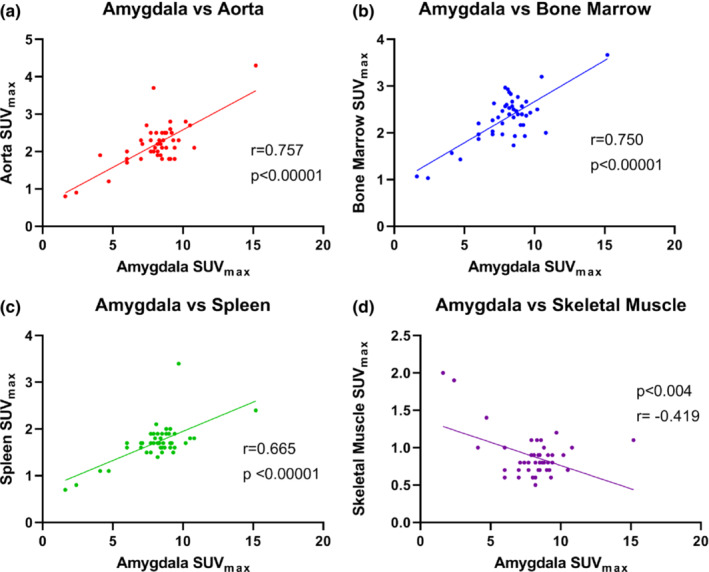
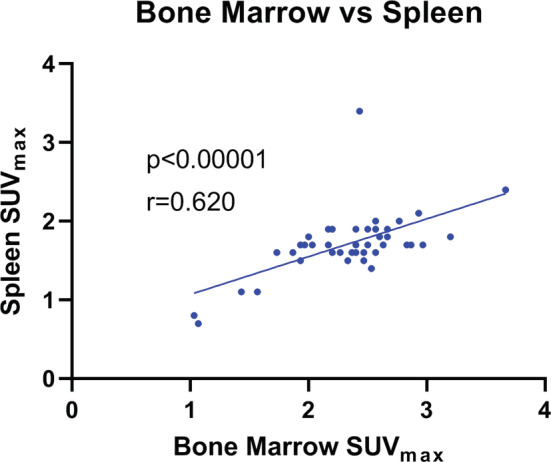
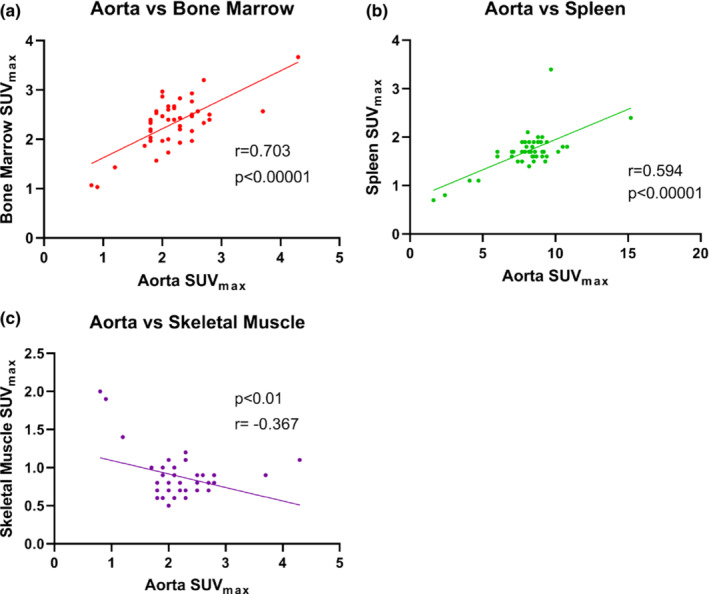
Amygdala activity in context of the splenocardiac model has not been investigated in healthy, young adults and has not been compared between nonsmokers, electronic cigarette users, and smokers. The purpose of the current study was to determine whether fluorodeoxyglucose positron emission tomography/computer tomography (FDG PET/CT) scans would demonstrate positively correlated metabolic activity in the amygdala, bone marrow, spleen, and aorta, elucidating activation of the splenocardiac axis in otherwise healthy young people who use tobacco products compared to nonusers. Moreover, the study was conducted to evaluate whether electronic cigarette users and tobacco smokers have similar levels of inflammation compared to nonusers. In 45 healthy adults (mean age = 25 years), including nonsmoker (n = 15), electronic cigarette user (n = 16), and smoker (n = 14) groups, metabolic activity in the amygdala, spleen, aorta, bone marrow of thoracic vertebrae, and adjacent erector spinae skeletal muscle was quantified through visualization of radioactive glucose ( FDG) uptake by FDG-PET/CT. The maximum standardized uptake value for each region was calculated for correlation analyses and comparisons between groups. In correlation analyses, metabolic activity of the amygdala correlated with metabolic activity in the aorta (r = 0.757), bone marrow (r = 0.750), and spleen (r = 0.665), respectively. Metabolic activity in the aorta correlated with FDG uptake in the thoracic vertebrae (r = 0.703) and spleen (r = 0.594), respectively. Metabolic activity in the spleen also correlated with FDG uptake in the bone marrow (r = 0.620). Metabolic activity in the adjacent erector spinae skeletal muscle (our control tissue) was not positively correlated with any other region of interest. Finally, there were no statistically significant mean differences in metabolic activity between the three groups: nonsmokers, electronic cigarette users, and smokers in any target tissue. Amygdala metabolic activity, as measured by FDG uptake in FDG-PET/CT scans, positively correlated with inflammation in the splenocardiac tissues, including: the aorta, bone marrow, and spleen, underscoring the existence of a neural-hematopoietic-inflammatory axis in healthy, young adults.
在健康的年轻成年人中,杏仁核活动在脾心模型的背景下尚未得到研究,并且在不吸烟者、电子烟使用者和吸烟者之间也没有进行比较。本研究的目的是确定氟脱氧葡萄糖正电子发射断层扫描/计算机断层扫描(FDG PET/CT)扫描是否会显示出杏仁核、骨髓、脾脏和主动脉代谢活性呈正相关,从而阐明在使用烟草制品的健康年轻人群中,脾心轴的激活情况与非使用者相比。此外,还进行了该研究以评估电子烟使用者和吸烟者与非使用者相比是否具有相似的炎症水平。在 45 名健康成年人(平均年龄为 25 岁)中,包括不吸烟者(n=15)、电子烟使用者(n=16)和吸烟者(n=14),通过 FDG-PET/CT 观察放射性葡萄糖(FDG)摄取来量化杏仁核、脾脏、主动脉、胸椎体骨髓和相邻竖脊肌骨骼肌肉的代谢活性。为了进行相关性分析和组间比较,计算了每个区域的最大标准化摄取值。在相关性分析中,杏仁核的代谢活性与主动脉(r=0.757)、骨髓(r=0.750)和脾脏(r=0.665)的代谢活性分别相关。主动脉的代谢活性与胸椎体(r=0.703)和脾脏(r=0.594)的 FDG 摄取分别相关。脾脏的代谢活性也与骨髓(r=0.620)的 FDG 摄取相关。相邻竖脊肌骨骼肌肉(我们的对照组织)的代谢活性与其他任何感兴趣区域均无正相关性。最后,在代谢活性方面,不吸烟者、电子烟使用者和吸烟者三组之间在任何靶组织中均无统计学上的显著差异。FDG-PET/CT 扫描中 FDG 摄取测量的杏仁核代谢活性与脾心组织中的炎症呈正相关,包括主动脉、骨髓和脾脏,这突显了健康年轻成年人中存在神经-造血-炎症轴。