Morić Bernardica Valent, Šamija Ivan, Sabolić Lavinia La Grasta, Stipančić Gordana
Department of Pediatrics, Sestre Milosrdnice University Hospital Center, Zagreb, Croatia.
Department of Oncology and Nuclear Medicine, Sestre milosrdnice University Hospital Center, Zagreb, Croatia.
Ann Pediatr Endocrinol Metab. 2022 Dec;27(4):300-307. doi: 10.6065/apem.2244022.011. Epub 2022 Oct 6.
To examine the characteristics of ambulatory blood pressure (ABP) including blood pressure variability (BPV) and its association with albuminuria in type 1 diabetic (T1D) children and to identify potential predictors of high-normal albuminuria and microalbuminuria.
ABP monitoring was performed in 201 T1D children and adolescents (mean age, 14.7±3.8 years) with T1D duration over 1 year. The level of albuminuria was assessed as the albumin/creatinine ratio (ACR) and patients were further classified as low-normal, high-normal or microalbuminuria.
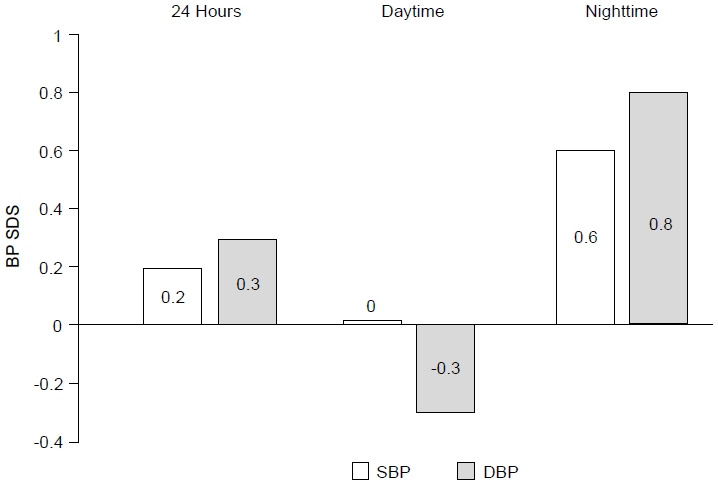
Fifteen T1D children (7.5%) were hypertensive using office blood pressure (BP) and 10 (5%) according to ABP. T1D subjects had elevated 24-hour systolic BP (SBP) and diastolic BP (DBP) (+0.2 and + 0.3 standard deviation score [SDS]) and nighttime SBP and DBP (+0.6 and +0.8 SDS) compared to reference values. Patients with microalbuminuria had significantly higher 24-hour, daytime and nighttime DBP compared to normoalbuminuric subjects. There was a high percentage of nondippers (74.1%). Nighttime diastolic BPV was significantly higher in subjects with high-normal compared to low-normal albuminuria (p=0.01). A weak correlation was found between ACR and daytime DBP SDS (r=0.29, p<0.001 and nighttime DBP SDS (r=0.21, p=0.003). Age and nighttime diastolic BPV were predictors of high-normal albuminuria while nighttime DBP was a strong predictor for microalbuminuria.
T1D children have impaired BP regulation although most of them do not fulfill the criteria for sustained hypertension. There is an association between diastolic ABP and diastolic BPV with rising levels of albuminuria pointing to a clear connection between BP and incipient diabetic nephropathy.
研究1型糖尿病(T1D)儿童的动态血压(ABP)特征,包括血压变异性(BPV)及其与蛋白尿的关系,并确定高正常蛋白尿和微量蛋白尿的潜在预测因素。
对201例T1D病程超过1年的儿童和青少年(平均年龄14.7±3.8岁)进行ABP监测。蛋白尿水平通过白蛋白/肌酐比值(ACR)评估,患者进一步分为低正常、高正常或微量蛋白尿组。
根据诊室血压(BP),15例T1D儿童(7.5%)为高血压,根据ABP则有10例(5%)。与参考值相比,T1D受试者的24小时收缩压(SBP)和舒张压(DBP)升高(分别升高0.2和0.3标准差评分[SDS]),夜间SBP和DBP升高(分别升高0.6和0.8 SDS)。与正常蛋白尿受试者相比,微量蛋白尿患者的24小时、日间和夜间DBP显著更高。非勺型血压者比例较高(74.1%)。与低正常蛋白尿受试者相比,高正常蛋白尿受试者的夜间舒张压变异性显著更高(p=0.01)。ACR与日间DBP SDS(r=0.29,p<0.001)和夜间DBP SDS(r=0.21,p=0.003)之间存在弱相关性。年龄和夜间舒张压变异性是高正常蛋白尿的预测因素,而夜间DBP是微量蛋白尿的强预测因素。
T1D儿童存在血压调节受损,尽管他们中的大多数不符合持续性高血压的标准。舒张期ABP和舒张期BPV与蛋白尿水平升高之间存在关联,表明血压与早期糖尿病肾病之间存在明确联系。