Department of Paediatrics, University of Cambridge, Cambridge, UK.
Diabetes Care. 2010 Feb;33(2):366-71. doi: 10.2337/dc09-1152. Epub 2009 Nov 16.
Familial predisposition to hypertension has been associated with the development of diabetic nephropathy in adults, but there are limited data in adolescents. Our aim was to assess whether parental ambulatory blood pressure (ABP) was associated with ABP and albumin excretion in young offspring with type 1 diabetes.
Twenty-four-hour ABP monitoring was performed in 509 young offspring (mean +/- SD age 15.8 +/- 2.3 years) with type 1 diabetes, 311 fathers, and 444 mothers. Systolic (SBP) and diastolic blood pressure (DBP) measurements during 24 h, daytime, and nighttime were calculated. Three early morning urinary albumin-to-creatinine ratios (ACRs), A1C, and anthropometric parameters were available for the offspring.
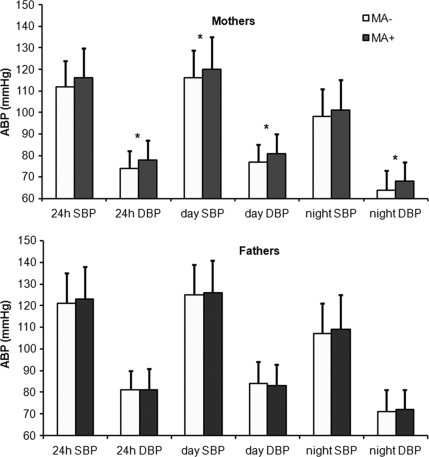
All paternal ABP parameters, except for nighttime SBP, were independently related to the offspring's ABP (24-h SBP beta = 0.18, 24-h DBP beta = 0.22, daytime SBP beta = 0.25, daytime DBP beta = 0.23, and nighttime DBP beta = 0.18; all P < 0.01). Maternal 24-h DBP (beta = 0.19, P = 0.004), daytime DBP (beta = 0.09, P = 0.04), and nighttime SBP (beta = 0.24 P = 0.001) were related to the corresponding ABP parameter in the offspring. Significant associations were found between the offspring's logACR and maternal ABP. The association with 24-h DBP (beta = 0.16, P = 0.02), daytime DBP (beta = 0.16 P = 0.02), and nighttime DBP (beta = 0.15 P = 0.03) persisted even after adjustment for the offspring's ABP. Mothers of offspring with microalbuminuria had higher ABP than mothers of offspring without microalbuminuria (all P < 0.05).
In this cohort, parental ABP significantly influenced offspring blood pressure, therefore confirming familial influences on this trait. In addition, maternal ABP, particularly DBP, was closely related to ACR in the offspring, suggesting a dominant effect of maternal genes or an effect of the intrauterine environment on microalbuminuria risk.
高血压的家族易感性与成人糖尿病肾病的发生有关,但在青少年中数据有限。我们的目的是评估父母的动态血压(ABP)是否与 1 型糖尿病年轻患者的 ABP 和白蛋白排泄有关。
对 509 名 15.8±2.3 岁的 1 型糖尿病年轻患者、311 名父亲和 444 名母亲进行了 24 小时 ABP 监测。计算 24 小时、白天和夜间的收缩压(SBP)和舒张压(DBP)。为患者提供了三个晨尿白蛋白/肌酐比值(ACR)、糖化血红蛋白(A1C)和人体测量参数。
除夜间 SBP 外,所有父亲的 ABP 指标均与子女的 ABP 独立相关(24 小时 SBPβ=0.18、24 小时 DBPβ=0.22、白天 SBPβ=0.25、白天 DBPβ=0.23 和夜间 DBPβ=0.18;所有 P<0.01)。母亲的 24 小时 DBP(β=0.19,P=0.004)、白天 DBP(β=0.09,P=0.04)和夜间 SBP(β=0.24,P=0.001)与子女的相应 ABP 参数相关。在子女的 logACR 与母亲的 ABP 之间发现了显著的相关性。即使在校正子女的 ABP 后,与 24 小时 DBP(β=0.16,P=0.02)、白天 DBP(β=0.16,P=0.02)和夜间 DBP(β=0.15,P=0.03)的相关性仍然存在。与子女无微量白蛋白尿相比,子女微量白蛋白尿患者的母亲血压更高(均 P<0.05)。
在该队列中,父母的 ABP 显著影响子女的血压,因此证实了家族对该特征的影响。此外,母亲的 ABP,特别是 DBP,与子女的 ACR 密切相关,这表明母亲基因的主导作用或宫内环境对微量白蛋白尿风险的影响。