Department of Pathobiological Sciences, School of Veterinary Medicine, University of Wisconsin-Madison, Madison, Wisconsin, USA.
Pan Genome Systems, Madison, Wisconsin, USA.
Microbiol Spectr. 2022 Oct 26;10(5):e0307522. doi: 10.1128/spectrum.03075-22. Epub 2022 Oct 6.
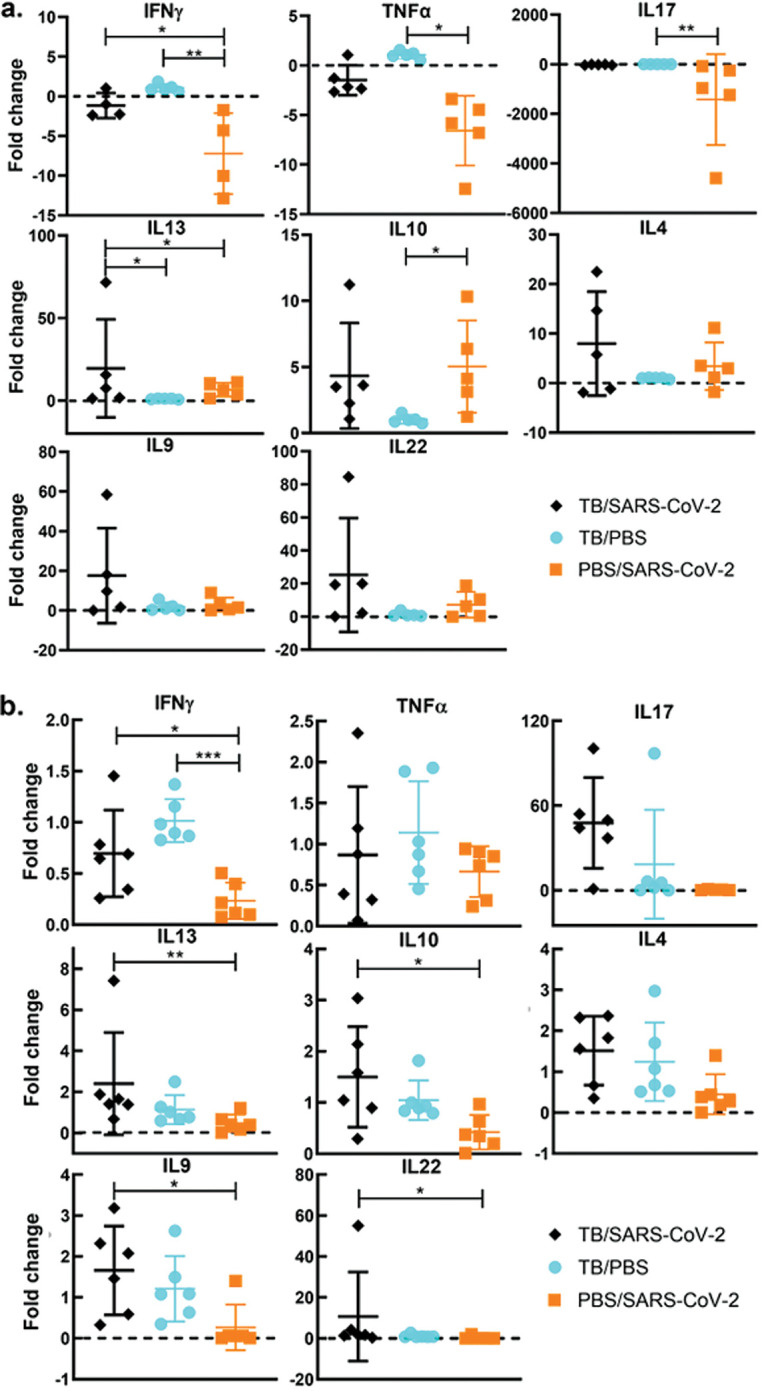
An estimated one-third of the world's population is infected with Mycobacterium tuberculosis, with the majority being vaccinated with Mycobacterium bovis BCG. Severe acute respiratory syndrome coronavirus 2 (SARS-CoV-2) remains a threat, and we must understand how SARS-CoV-2 can modulate both BCG immunity and tuberculosis pathogenesis. Interestingly, neither BCG vaccination nor tuberculosis infection resulted in differences in clinical outcomes associated with SARS-CoV-2 in transgenic mice. Surprisingly, earlier M. tuberculosis infection resulted in lower SARS-CoV-2 viral loads, mediated by the heightened immune microenvironment of the murine lungs, unlike vaccination with BCG, which had no impact. In contrast, M. tuberculosis-infected tissues had increased bacterial loads and decreased histiocytic inflammation in the lungs following SARS-CoV-2 superinfection. SARS-CoV-2 modulated BCG-induced type 17 responses while decreasing type 1 and increasing type 2 cytokines in M. tuberculosis-infected mice. These findings challenge initial findings of BCG's positive impact on SARS-CoV-2 infection and suggest potential ramifications for M. tuberculosis reactivation upon SARS-CoV-2 superinfection. Prior to SARS-CoV-2, M. tuberculosis was the leading infectious disease killer, with an estimated one-third of the world's population infected and 1.7 million deaths a year. Here, we show that SARS-CoV-2 superinfection caused increased bacterial dissemination in M. tuberculosis-infected mice along with immune and pathological changes. SARS-CoV-2 also impacted the immunity of BCG-vaccinated mice, resulting in decreased interleukin-17 (IL-17) levels, while offering no protective effect against SARS-CoV-2. These results demonstrate that SARS-CoV-2 may have a deleterious effect on the ongoing M. tuberculosis pandemic and potentially limit BCG's efficacy.
据估计,世界上有三分之一的人口感染了结核分枝杆菌,其中大多数人接种了牛型结核分枝杆菌卡介苗。严重急性呼吸综合征冠状病毒 2(SARS-CoV-2)仍然是一个威胁,我们必须了解 SARS-CoV-2 如何调节卡介苗免疫和结核病发病机制。有趣的是,无论是卡介苗接种还是结核分枝杆菌感染,都没有导致 SARS-CoV-2 在转基因小鼠中与临床结局的差异。令人惊讶的是,早期结核分枝杆菌感染导致 SARS-CoV-2 病毒载量降低,这是由鼠肺免疫微环境增强介导的,与卡介苗接种不同,卡介苗接种没有影响。相比之下,在 SARS-CoV-2 超感染后,结核分枝杆菌感染的组织中肺部细菌负荷增加,组织细胞炎症减少。SARS-CoV-2 调节了卡介苗诱导的 17 型反应,同时降低了感染结核分枝杆菌的小鼠中的 1 型和增加 2 型细胞因子。这些发现挑战了卡介苗对 SARS-CoV-2 感染的积极影响的初步发现,并表明 SARS-CoV-2 超感染后结核分枝杆菌再激活的潜在后果。 在 SARS-CoV-2 之前,结核分枝杆菌是导致传染病死亡的主要原因,估计世界上有三分之一的人口感染了这种疾病,每年有 170 万人因此死亡。在这里,我们表明 SARS-CoV-2 超感染导致感染结核分枝杆菌的小鼠中细菌播散增加,同时伴有免疫和病理变化。SARS-CoV-2 还影响了卡介苗接种小鼠的免疫,导致白细胞介素-17(IL-17)水平降低,而对 SARS-CoV-2 没有保护作用。这些结果表明,SARS-CoV-2 可能对正在发生的结核分枝杆菌大流行产生有害影响,并可能限制卡介苗的疗效。