Department of Clinical Epidemiology, Leibniz Institute for Prevention Research and Epidemiology, BIPS, Bremen, Germany.
Department of Medicine St. Joseph-Stift Bremen, Bremen, Germany.
Clin Transl Gastroenterol. 2023 Jan 1;14(1):e00535. doi: 10.14309/ctg.0000000000000535.
We aimed to describe cumulative colorectal cancer (CRC) incidence after screening colonoscopy stratified by tumor location, age, and sex as well as CRC detection rate at first repeat colonoscopy.
Using the German Pharmacoepidemiological Research Database, we included persons with screening colonoscopy and assessed cumulative CRC incidence after baseline screening colonoscopy with snare polypectomy (cohort 1) and without polypectomy (cohort 2). We also determined the CRC detection rate at first repeat colonoscopy by time since screening colonoscopy.
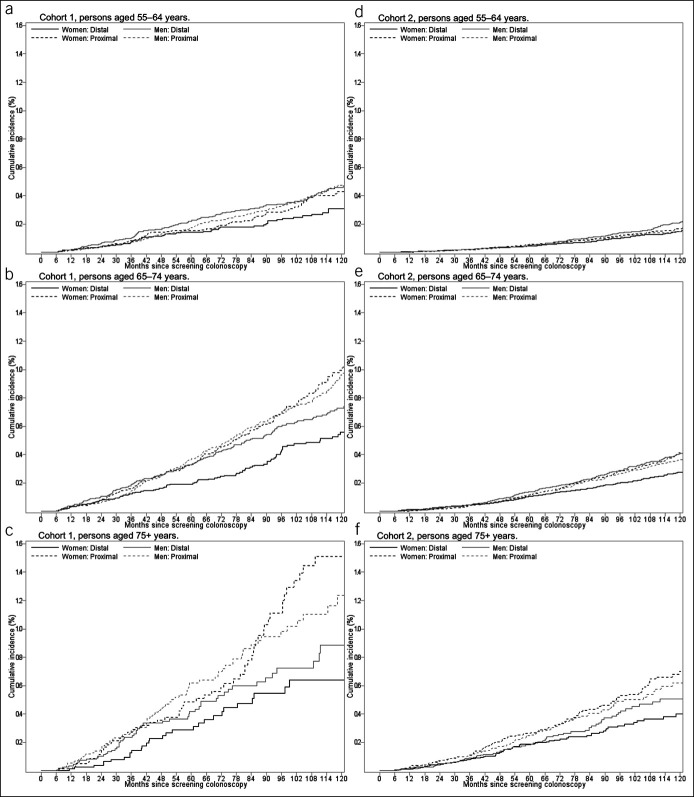
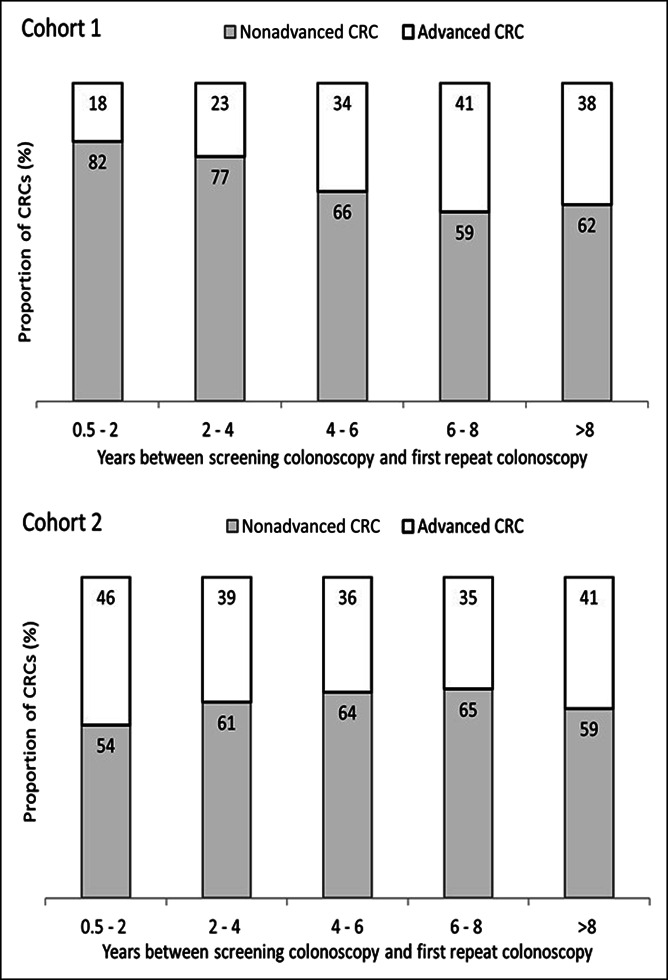
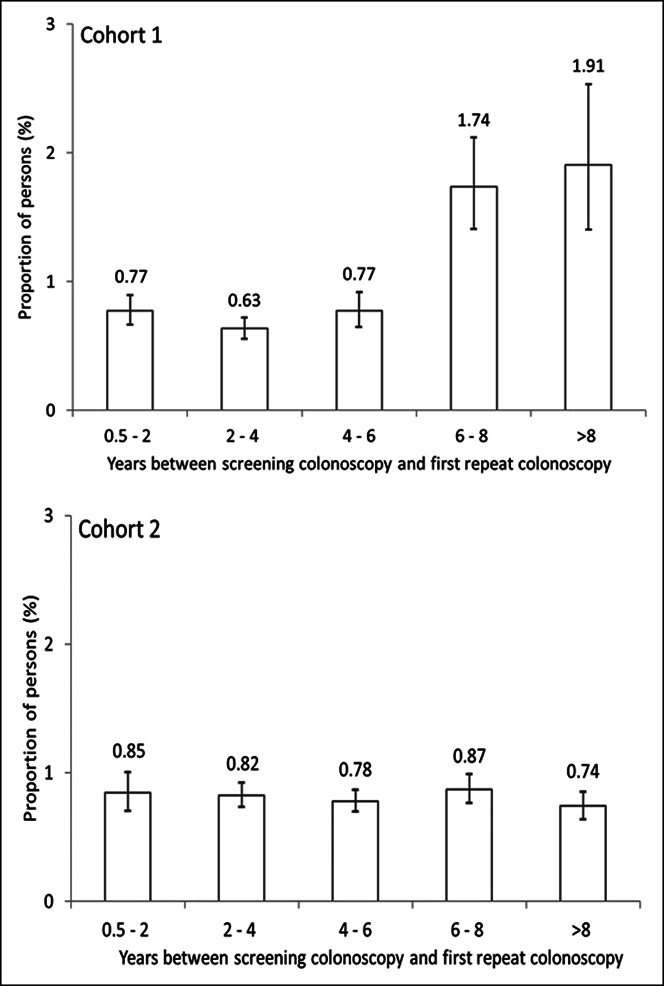
Overall, 1,095,381 persons were included. The 10-year cumulative CRC incidence was 1.5% in cohort 1 and 0.6% in cohort 2. The proportion of proximal CRC increased with age: In women of cohort 1, 47% of CRCs in the age group 55-64 years were proximal (men: 42%) while in the age group 65-74 years, this proportion was 55% (men: 49%). In cohort 2, similar patterns were observed. In cohort 1, the CRC detection rate at first repeat colonoscopy among persons examined within 6-8 years after screening colonoscopy was more than twice as high compared with those examined within 4-6 years (1.7% vs 0.8%).
Among persons followed up after screening colonoscopy, we observed a steadily increasing predominance of proximal CRC, and this shift showed distinct patterns by age and sex. Because our study suggests higher CRC detection rates among persons with a later repeat colonoscopy, the role of delayed surveillance and the benefit of a reminder system should be explored.
本研究旨在描述经筛查性结肠镜检查后,按肿瘤位置、年龄和性别分层的结直肠癌(CRC)累计发病率,以及首次重复结肠镜检查时的 CRC 检出率。
我们使用德国药物流行病学研究数据库,纳入接受筛查性结肠镜检查的患者,并评估基线筛查性结肠镜检查后接受圈套切除术(队列 1)和未接受息肉切除术(队列 2)患者的 CRC 累计发病率。我们还根据筛查性结肠镜检查后时间,确定首次重复结肠镜检查时的 CRC 检出率。
共有 1095381 人纳入本研究。队列 1 的 10 年 CRC 累计发病率为 1.5%,队列 2 的发病率为 0.6%。近端 CRC 的比例随年龄增加而增加:在队列 1 的女性中,55-64 岁年龄组中 47%的 CRC 位于近端(男性为 42%),而在 65-74 岁年龄组中,这一比例为 55%(男性为 49%)。队列 2 中也观察到类似的模式。在队列 1 中,与 4-6 年内接受检查的患者相比,6-8 年内接受检查的患者首次重复结肠镜检查时 CRC 的检出率高出两倍以上(1.7% vs 0.8%)。
在接受筛查性结肠镜检查后的随访患者中,我们观察到近端 CRC 的比例持续增加,且这种变化在年龄和性别上具有明显的模式。由于本研究表明,延迟重复结肠镜检查患者的 CRC 检出率较高,因此应探讨延迟监测的作用和提醒系统的益处。