Center for Primary Health Care Research, Lund University, Skåne University Hospital, Jan Waldenströms Gata 35, 205 02, Malmö, Sweden.
Department of Clinical Microbiology, Center of Diagnostic Investigations, Copenhagen University Hospital, Rigshospitalet, Denmark.
Sci Rep. 2022 Oct 6;12(1):16763. doi: 10.1038/s41598-022-21295-0.
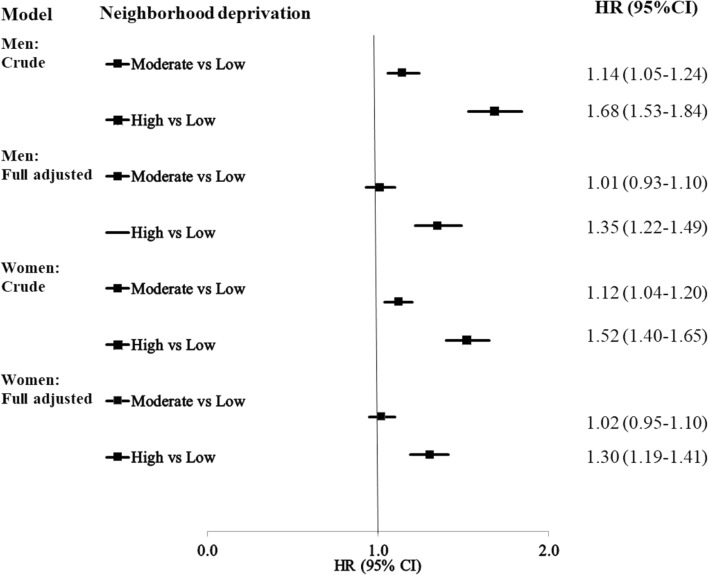
The aim was to study the potential effect of neighborhood deprivation on incident and fatal coronary heart disease (CHD) in patients with bipolar disorder. This was a nationwide cohort study which included all adults aged 30 years or older with bipolar disorder (n = 61,114) in Sweden (1997-2017). The association between neighborhood deprivation and the outcomes was explored using Cox regression analysis, with hazard ratios (HRs) and 95% confidence intervals (CIs). Patients with bipolar disorder living in neighborhoods with high or moderate levels of deprivation were compared with those living in neighborhoods with low deprivation scores. There was an association between level of neighborhood deprivation and incident and fatal CHD among patients with bipolar disorder. The HRs were 1.24 (95% CI 1.07-1.44) for men and 1.31 (1.13-1.51) for women for incident CHD among patients with bipolar disorder living in high deprivation neighborhoods compared to those from low deprivation neighborhoods, after adjustments for potential confounders. The corresponding HR for fatal CHD were 1.35 (1.22-1.49) in men and 1.30 (1.19-1.41) in women living in high deprivation neighborhoods. Increased incident and fatal CHD among patients with bipolar disorder living in deprived neighborhoods raises important clinical and public health concerns.
目的在于研究邻里剥夺对双相障碍患者新发和致死性冠心病(CHD)的潜在影响。这是一项全国性的队列研究,纳入了瑞典所有年龄在 30 岁及以上的双相障碍患者(n=61114)。采用 Cox 回归分析探讨了邻里剥夺程度与结局之间的关联,计算了风险比(HR)及其 95%置信区间(CI)。将双相障碍患者居住在高或中剥夺程度的邻里与居住在低剥夺程度邻里的患者进行比较。结果显示,邻里剥夺程度与双相障碍患者的新发和致死性 CHD 之间存在关联。与居住在低剥夺程度邻里的患者相比,居住在高剥夺程度邻里的双相障碍患者新发 CHD 的 HR 分别为 1.24(95%CI 1.07-1.44)(男性)和 1.31(1.13-1.51)(女性),经潜在混杂因素校正后。男性和女性居住在高剥夺程度邻里的致死性 CHD 的相应 HR 分别为 1.35(1.22-1.49)和 1.30(1.19-1.41)。这表明,居住在贫困社区的双相障碍患者新发和致死性 CHD 增加,引起了重要的临床和公共卫生关注。