Oh Jooyoung, Lee Hye Sun, Jeon Soyoung, Kim Dooreh, Seok Jeong-Ho, Park Woo-Chan, Kim Jae-Jin, Yoon Chang Ik
Department of Psychiatry, Gangnam Severance Hospital, Yonsei University College of Medicine, Seoul, South Korea.
Institute of Behavioral Sciences in Medicine, Yonsei University College of Medicine, Seoul, South Korea.
Front Oncol. 2022 Sep 20;12:980197. doi: 10.3389/fonc.2022.980197. eCollection 2022.
Although previous studies demonstrated no association between depression and tamoxifen in patients with breast cancer, there is still a limited amount of long-term follow-up data. This study aimed to evaluate the relationship between endocrine treatment and the risk of depression.
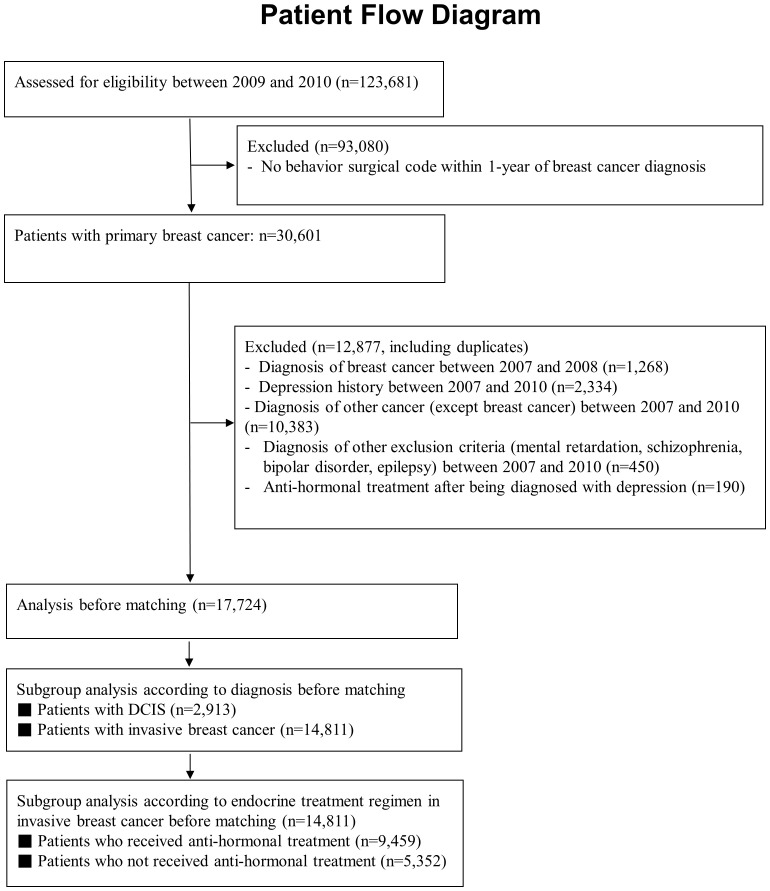
This nationwide population-based cohort study used data obtained over a 14-year period (January 2007 to December 2021) from the Korean National Health Insurance claims database. All female patients with breast cancer were included. We examined the incidence of depression in patients who underwent endocrine treatment, and those who did not undergo endocrine treatment constituted the control group.
The data from 11,109 patients who underwent endocrine treatment and 6,615 control patients between 2009 and 2010 were analyzed. After performing matching for comorbidities and age, both groups comprised 6,532 patients. The median follow-up were 119.71 months. Before and after matching was performed, the endocrine treatment was not a significant risk factor for developing depression (0.7295 and 0.2668, respectively), nor was it a significant factor for an increased risk for suicide attempt (=0.6381 and =0.8366, respectively).
Using a real-world population-based cohort, this study demonstrated that there is no evidence that the endocrine treatment increases the risk of depression.
尽管先前的研究表明乳腺癌患者的抑郁症与他莫昔芬之间没有关联,但长期随访数据仍然有限。本研究旨在评估内分泌治疗与抑郁症风险之间的关系。
这项基于全国人群的队列研究使用了从韩国国民健康保险索赔数据库中获取的14年期间(2007年1月至2021年12月)的数据。纳入了所有女性乳腺癌患者。我们检查了接受内分泌治疗的患者中抑郁症的发病率,未接受内分泌治疗的患者构成对照组。
分析了2009年至2010年间11,109例接受内分泌治疗的患者和6,615例对照患者的数据。在对合并症和年龄进行匹配后,两组各有6,532例患者。中位随访时间为119.71个月。在进行匹配前后,内分泌治疗都不是发生抑郁症的显著危险因素(分别为0.7295和0.2668),也不是自杀未遂风险增加的显著因素(分别为=0.6381和=0.8366)。
本研究使用基于真实世界人群的队列表明,没有证据表明内分泌治疗会增加抑郁症风险。