Department of Molecular and Human Genetics, Baylor College of Medicine, Houston, TX 77030, USA; Jan and Dan Duncan Neurological Research Institute, Texas Children's Hospital, Houston, TX 77030, USA.
National Health Commission Key Laboratory for Birth Defect Research and Prevention, Hunan Provincial Maternal and Child Health Care Hospital, Changsha, Hunan 410008, China; Department of Medical Genetics, Maternal and Child Health Hospital of Hunan Province, Changsha, Hunan 410008, China.
Am J Hum Genet. 2022 Oct 6;109(10):1932-1943. doi: 10.1016/j.ajhg.2022.09.005.
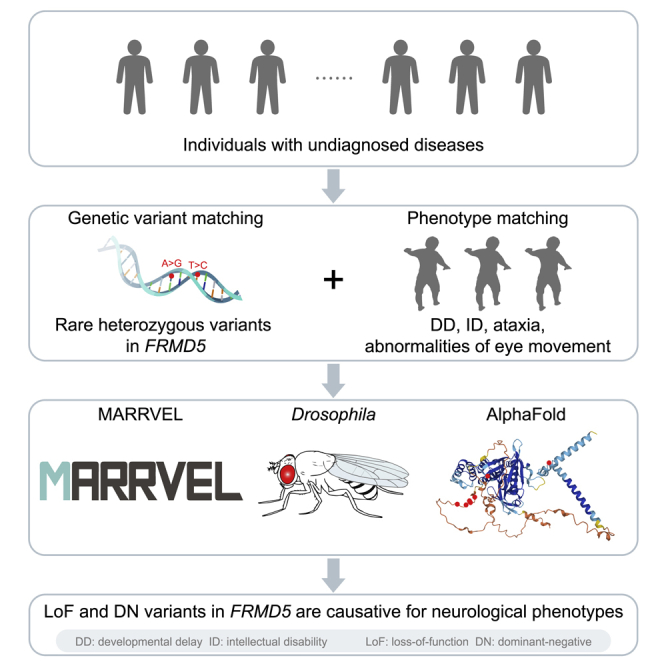
Proteins containing the FERM (four-point-one, ezrin, radixin, and moesin) domain link the plasma membrane with cytoskeletal structures at specific cellular locations and have been implicated in the localization of cell-membrane-associated proteins and/or phosphoinositides. FERM domain-containing protein 5 (FRMD5) localizes at cell adherens junctions and stabilizes cell-cell contacts. To date, variants in FRMD5 have not been associated with a Mendelian disease in OMIM. Here, we describe eight probands with rare heterozygous missense variants in FRMD5 who present with developmental delay, intellectual disability, ataxia, seizures, and abnormalities of eye movement. The variants are de novo in all for whom parental testing was available (six out of eight probands), and human genetic datasets suggest that FRMD5 is intolerant to loss of function (LoF). We found that the fly ortholog of FRMD5, CG5022 (dFrmd), is expressed in the larval and adult central nervous systems where it is present in neurons but not in glia. dFrmd LoF mutant flies are viable but are extremely sensitive to heat shock, which induces severe seizures. The mutants also exhibit defective responses to light. The human FRMD5 reference (Ref) cDNA rescues the fly dFrmd LoF phenotypes. In contrast, all the FRMD5 variants tested in this study (c.340T>C, c.1051A>G, c.1053C>G, c.1054T>C, c.1045A>C, and c.1637A>G) behave as partial LoF variants. In addition, our results indicate that two variants that were tested have dominant-negative effects. In summary, the evidence supports that the observed variants in FRMD5 cause neurological symptoms in humans.
含 FERM(four-point-one,ezrin,radixin,and moesin)结构域的蛋白质将质膜与细胞骨架结构连接到特定的细胞位置,并与细胞膜相关蛋白和/或磷酸肌醇的定位有关。FERM 结构域蛋白 5(FRMD5)位于细胞黏附连接点,稳定细胞间接触。迄今为止,在 OMIM 中,FRMD5 的变体与孟德尔疾病无关。在这里,我们描述了 8 名先证者,他们携带 FRMD5 中罕见的杂合错义变异,表现为发育迟缓、智力障碍、共济失调、癫痫发作和眼球运动异常。这些变异在所有可进行父母检测的个体中均为新生(8 名先证者中的 6 名),人类遗传数据集表明 FRMD5 不能耐受功能丧失(LoF)。我们发现 FRMD5 的果蝇同源物 CG5022(dFrmd)在幼虫和成年中枢神经系统中表达,在神经元中存在,但在神经胶质细胞中不存在。dFrmd LoF 突变果蝇是有活力的,但对热休克极其敏感,这会引起严重的癫痫发作。突变体对光的反应也有缺陷。人类 FRMD5 参考(Ref)cDNA 可挽救果蝇 dFrmd LoF 表型。相比之下,本研究中测试的所有 FRMD5 变体(c.340T>C、c.1051A>G、c.1053C>G、c.1054T>C、c.1045A>C 和 c.1637A>G)均表现为部分 LoF 变体。此外,我们的结果表明,两种经过测试的变体具有显性负效应。总之,这些证据表明 FRMD5 中的观察到的变异会导致人类出现神经症状。