Movement Analysis Laboratory, IRCCS Istituto Ortopedico Rizzoli, Via di Barbiano 1/10, Bologna, Italy.
Bentivoglio Orthopaedic Ward, IRCCS Istituto Ortopedico Rizzoli, Bologna, Italy.
Sci Rep. 2022 Oct 7;12(1):16900. doi: 10.1038/s41598-022-21440-9.
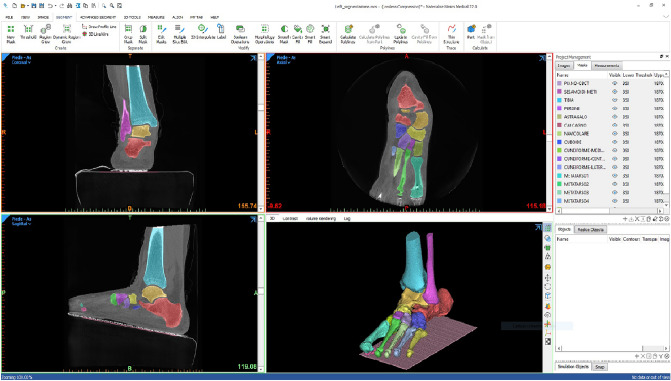
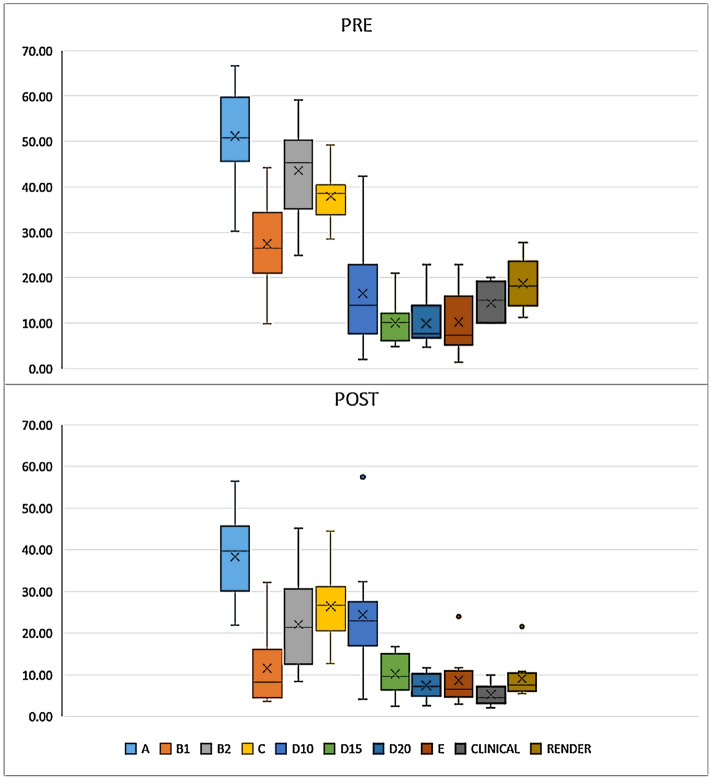
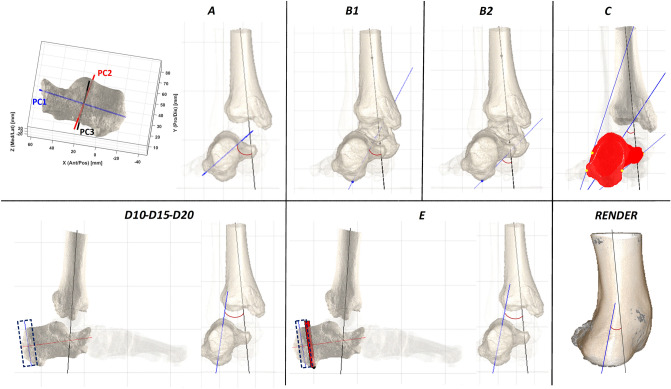
Cone-beam CT (CBCT) scans now enable accurate measurements on foot skeletal structures with the advantage of observing these in 3D and in weight-bearing. Among the most common skeletal deformities, the varus/valgus of the hindfoot is the most complex to be represented, and a number of measure proposals have been published. This study aims to analyze and to compare these measurements from CBCT scans in a real clinical population with large such deformity. Ten patients with severe acquired adult flatfoot and indication for surgery underwent CBCT scans (Carestream, USA) while standing on that leg, before and after surgical correction. Corresponding 3D shape of each bone of the distal shank and hindfoot were defined (Materialise, Belgium). Six different techniques from the literature were used to calculate the varus/valgus deformity, i.e. the inclination of the hindfoot in the frontal plane of the shank. Standard clinical measurements by goniometers were taken for comparison. According to these techniques, and starting from a careful 3D reconstruction of the relevant foot skeletal structures, a large spectrum of measurements was found to represent the same hindfoot alignment angle. Most of them were very different from the traditional clinical measures. The assessment of the pre-operative valgus deformity and of the corresponding post-operative correction varied considerably. CBCT finally allows 3D assessment of foot deformities in weight-bearing. Measurements from the different available techniques do not compare well, as they are based on very different approaches. It is recommended to be aware of the anatomical and functional concepts behind these techniques before clinical and surgical conclusions.
锥形束 CT(CBCT)扫描现在可以通过观察三维和负重状态下的足部骨骼结构,实现对足部骨骼结构的精确测量。在最常见的骨骼畸形中,后足的内翻/外翻畸形最为复杂,已有多种测量方法被提出。本研究旨在分析和比较这些在存在严重获得性成人扁平足并需要手术的临床实际患者的 CBCT 扫描中的测量值,并对存在此类严重畸形的患者进行研究。10 例患有严重获得性成人扁平足且需要手术的患者在手术矫正前后,单腿站立时接受了 CBCT 扫描(美国 Carestream)。对每个跟骨和后足的远端骨骼的相应 3D 形状进行了定义(比利时 Materialise)。使用文献中的 6 种不同技术来计算内翻/外翻畸形,即跟骨在小腿的额状面的倾斜度。同时还进行了传统的测角计临床测量作为比较。根据这些技术,并且从对相关足部骨骼结构的仔细 3D 重建开始,发现了大量的测量值来代表相同的后足对线角度。其中大多数与传统的临床测量值都有很大的不同。术前外翻畸形的评估和相应的术后矫正效果存在较大差异。CBCT 最终允许在负重状态下对足部畸形进行 3D 评估。来自不同可用技术的测量值之间的比较效果并不理想,因为它们基于非常不同的方法。建议在进行临床和手术结论之前,了解这些技术背后的解剖学和功能概念。