Department of Pediatric Oncology, Princess Máxima Center for Pediatric Oncology, Utrecht, The Netherlands.
Department of Pediatric Surgery, Princess Maxima Center Princess Máxima Center for Pediatric Oncology, Utrecht, The Netherlands.
Cancer Med. 2023 Feb;12(4):4739-4750. doi: 10.1002/cam4.5252. Epub 2022 Oct 7.
Adverse events (AE) of treatment are prevalent and diverse in head and neck rhabdomyosarcoma (HNRMS) survivors. These AEs are often reported by physicians; however, patients' perceptions of specific AE are not well known. In this study, we explored patient-reported outcomes measuring appearance, health-related quality of life (HRQOL), and facial function in HNRMS survivors. Second, we assess the relationship between physician grading of AE and patient reporting.
Survivors of pediatric HNRMS, diagnosed between 1993 and 2017, who were at least 2 years after completing treatment were invited to an outpatient clinic as part of a multicenter cross-sectional cohort study. At the outpatient clinics, survivors aged ≥8 years filled out the FACE-Q Craniofacial module; a patient-reported outcome instrument measuring issues specific to patients with facial differences. AE were systematically assessed by a multidisciplinary team based on the Common Terminology Criteria of Adverse Events system.
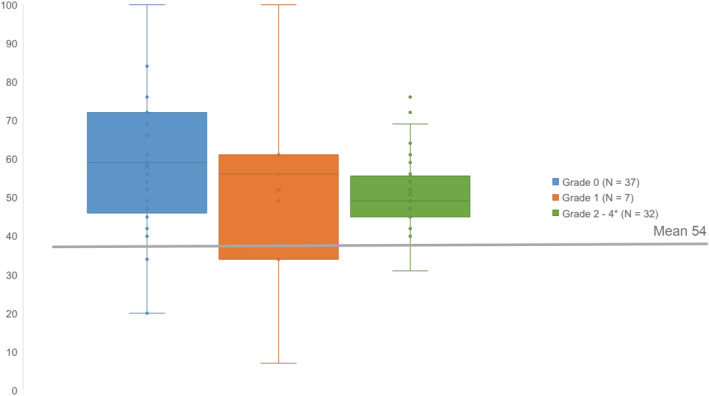
Seventy-seven survivors with a median age of 16 years (range 8-43) and median follow-up of 10 years (range 2-42) completed the questionnaire and were screened for AEs. Patient-reported outcomes varied widely between survivors. Many survivors reported negative consequences: 82% on appearance items, 81% on HRQOL items, and 38% on facial function items. There was a weak correlation between physician-scored AEs and the majority of patient-reported outcomes specific for those AEs.
Physician-graded AEs are not sufficient to provide tailored care for HNMRS survivors. Findings from this study highlight the importance of incorporating patient-reported outcome measures in survivorship follow-up.
头颈部横纹肌肉瘤(HNRMS)幸存者的治疗相关不良事件(AE)普遍存在且种类繁多。这些 AE 通常由医生报告;然而,患者对特定 AE 的看法并不为人所知。在这项研究中,我们探讨了测量 HNRMS 幸存者外貌、健康相关生活质量(HRQOL)和面部功能的患者报告结局。其次,我们评估了医生对 AE 的分级与患者报告之间的关系。
邀请了 1993 年至 2017 年期间诊断为小儿 HNRMS 的幸存者,且至少在完成治疗后 2 年以上,作为多中心横断面队列研究的一部分到门诊就诊。在门诊,年龄≥8 岁的幸存者填写了 FACE-Q 颅面模块;这是一种患者报告结局工具,用于测量面部差异患者的具体问题。AE 根据不良事件通用术语标准系统由多学科团队进行系统评估。
77 名幸存者完成了问卷调查,中位年龄为 16 岁(范围 8-43),中位随访时间为 10 年(范围 2-42),并筛查了 AE。幸存者的患者报告结局差异很大。许多幸存者报告了负面后果:82%的人在外观项目上,81%的人在 HRQOL 项目上,38%的人在面部功能项目上。医生评分的 AE 与大多数特定于这些 AE 的患者报告结局之间相关性较弱。
医生分级的 AE 不足以提供针对 HNMRS 幸存者的个体化护理。本研究的结果强调了在生存随访中纳入患者报告结局测量的重要性。