Department of Human Movement Sciences, Vrije Universiteit Amsterdam, Van der Boechorststraat 9, 1081 BT, Amsterdam, The Netherlands.
Department of Neurology, Amsterdam University Medical Centers, Amsterdam Neuroscience, University of Amsterdam, Amsterdam, The Netherlands.
J Neurol. 2023 Feb;270(2):1162-1177. doi: 10.1007/s00415-022-11388-1. Epub 2022 Oct 8.
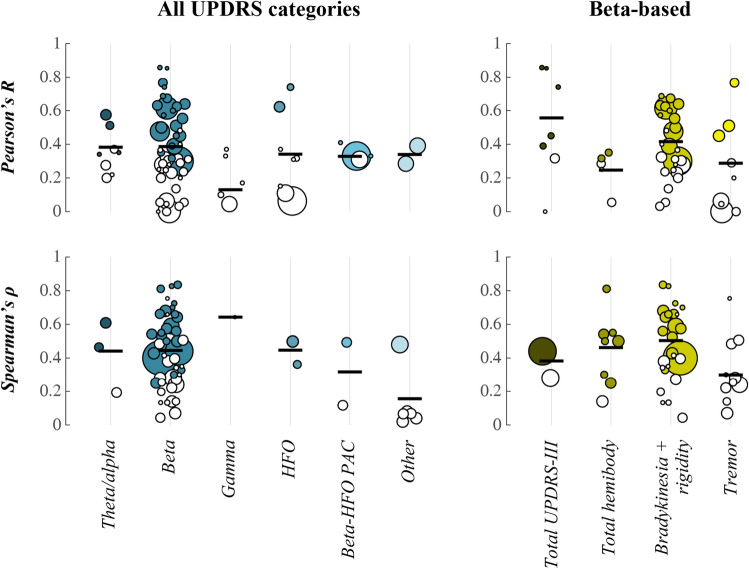
Deep brain stimulation (DBS) treatment has proven effective in suppressing symptoms of rigidity, bradykinesia, and tremor in Parkinson's disease. Still, patients may suffer from disabling fluctuations in motor and non-motor symptom severity during the day. Conventional DBS treatment consists of continuous stimulation but can potentially be further optimised by adapting stimulation settings to the presence or absence of symptoms through closed-loop control. This critically relies on the use of 'physiomarkers' extracted from (neuro)physiological signals. Ideal physiomarkers for adaptive DBS (aDBS) are indicative of symptom severity, detectable in every patient, and technically suitable for implementation. In the last decades, much effort has been put into the detection of local field potential (LFP) physiomarkers and in their use in clinical practice. We conducted a research synthesis of the correlations that have been reported between LFP signal features and one or more specific PD motor symptoms. Features based on the spectral beta band (~ 13 to 30 Hz) explained ~ 17% of individual variability in bradykinesia and rigidity symptom severity. Limitations of beta band oscillations as physiomarker are discussed, and strategies for further improvement of aDBS are explored.
深部脑刺激 (DBS) 治疗已被证明可有效抑制帕金森病患者的僵硬、运动迟缓及震颤等症状。然而,患者在白天仍可能会出现运动和非运动症状严重程度的致残性波动。传统的 DBS 治疗包括持续刺激,但通过闭环控制,根据症状的出现或消失来调整刺激设置,这种治疗方法可能会进一步得到优化。这严重依赖于从(神经)生理信号中提取“生理标记物”的使用。用于适应性 DBS(aDBS)的理想生理标记物应能指示症状的严重程度,可在每位患者中检测到,且在技术上适合实施。在过去的几十年中,人们在局部场电位 (LFP) 生理标记物的检测及其在临床实践中的应用方面付出了巨大努力。我们对报告的 LFP 信号特征与一种或多种特定帕金森病运动症状之间的相关性进行了研究综合。基于频谱β频带(~13 至 30 Hz)的特征解释了运动迟缓及僵硬症状严重程度的个体差异的约 17%。讨论了β频带振荡作为生理标记物的局限性,并探讨了进一步改善 aDBS 的策略。