Center for Bioinformatics and Functional Genomics, Department of Biomedical Sciences, Cedars-Sinai Medical Center, Los Angeles, CA, USA.
Centre for Cancer Genetic Epidemiology, Department of Public Health and Primary Care, University of Cambridge, Cambridge, UK.
J Natl Cancer Inst. 2022 Nov 14;114(11):1533-1544. doi: 10.1093/jnci/djac160.
Known risk alleles for epithelial ovarian cancer (EOC) account for approximately 40% of the heritability for EOC. Copy number variants (CNVs) have not been investigated as EOC risk alleles in a large population cohort.
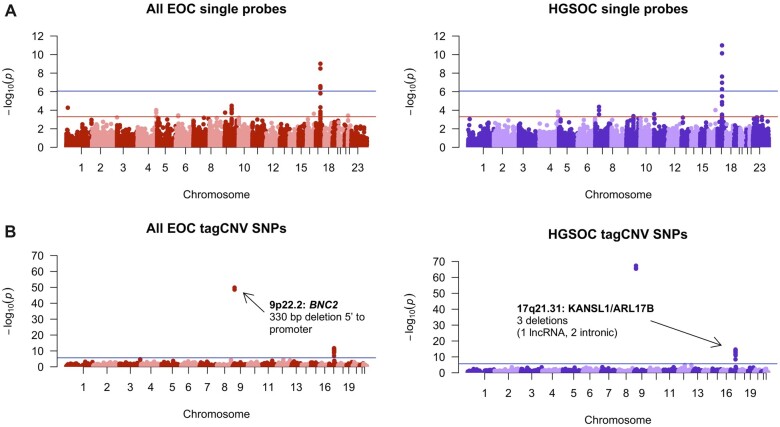
Single nucleotide polymorphism array data from 13 071 EOC cases and 17 306 controls of White European ancestry were used to identify CNVs associated with EOC risk using a rare admixture maximum likelihood test for gene burden and a by-probe ratio test. We performed enrichment analysis of CNVs at known EOC risk loci and functional biofeatures in ovarian cancer-related cell types.
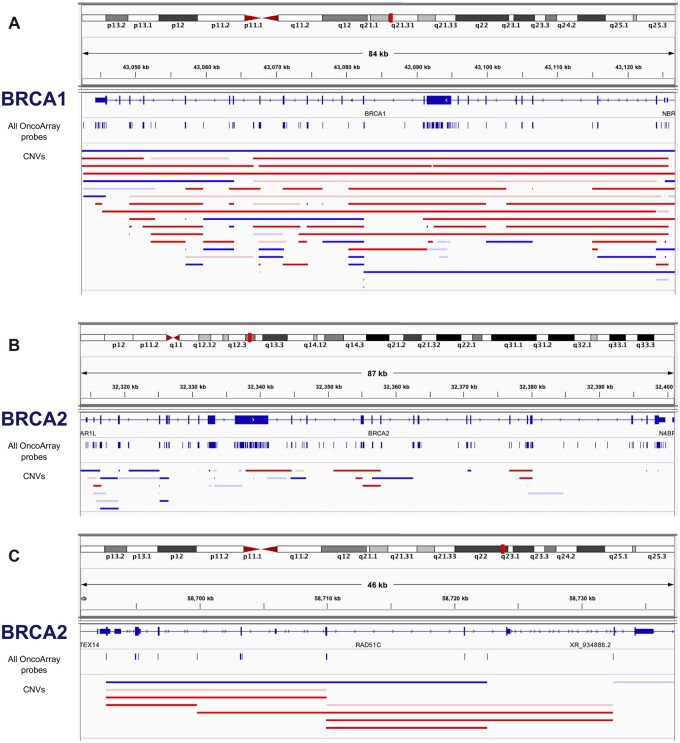
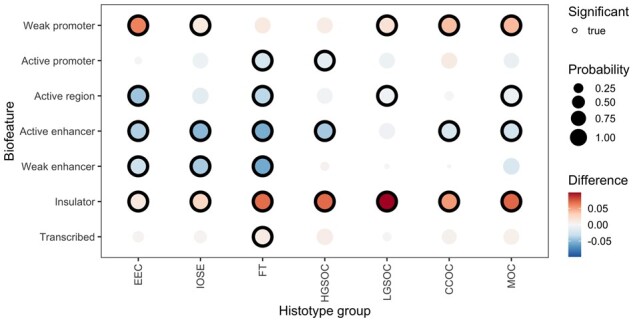
We identified statistically significant risk associations with CNVs at known EOC risk genes; BRCA1 (PEOC = 1.60E-21; OREOC = 8.24), RAD51C (Phigh-grade serous ovarian cancer [HGSOC] = 5.5E-4; odds ratio [OR]HGSOC = 5.74 del), and BRCA2 (PHGSOC = 7.0E-4; ORHGSOC = 3.31 deletion). Four suggestive associations (P < .001) were identified for rare CNVs. Risk-associated CNVs were enriched (P < .05) at known EOC risk loci identified by genome-wide association study. Noncoding CNVs were enriched in active promoters and insulators in EOC-related cell types.
CNVs in BRCA1 have been previously reported in smaller studies, but their observed frequency in this large population-based cohort, along with the CNVs observed at BRCA2 and RAD51C gene loci in EOC cases, suggests that these CNVs are potentially pathogenic and may contribute to the spectrum of disease-causing mutations in these genes. CNVs are likely to occur in a wider set of susceptibility regions, with potential implications for clinical genetic testing and disease prevention.
已知的上皮性卵巢癌(EOC)风险等位基因约占 EOC 遗传率的 40%。在大型人群队列中,尚未研究拷贝数变异(CNVs)作为 EOC 风险等位基因。
使用来自 13071 例 EOC 病例和 17306 例白种欧洲血统对照的单核苷酸多态性阵列数据,使用罕见混合最大似然检验基因负担和探针比检验来识别与 EOC 风险相关的 CNVs。我们在已知的 EOC 风险基因和卵巢癌相关细胞类型中的功能生物特征中对 CNVs 进行了富集分析。
我们确定了与已知的 EOC 风险基因中的 CNVs 具有统计学意义的风险关联;BRCA1(PEOC=1.60E-21;OREOC=8.24),RAD51C(高等级浆液性卵巢癌[HGSOC] Phigh-grade serous ovarian cancer=5.5E-4;ORHGSOC=5.74del)和 BRCA2(PHGSOC=7.0E-4;ORHGSOC=3.31 缺失)。对于罕见的 CNVs,确定了四个提示性关联(P<0.001)。风险相关的 CNVs 在全基因组关联研究中确定的已知 EOC 风险基因座上富集(P<0.05)。在卵巢癌相关细胞类型中,非编码 CNVs 富含活跃的启动子和绝缘子。
BRCA1 中的 CNVs 先前在较小的研究中已有报道,但在本大型基于人群的队列中观察到的其观察频率,以及在 EOC 病例中观察到的 BRCA2 和 RAD51C 基因座中的 CNVs,表明这些 CNVs 可能具有致病性,并且可能导致这些基因中致病突变的谱。CNVs 可能发生在更广泛的易感区域,这可能对临床遗传检测和疾病预防具有重要意义。