Department of Radiation Oncology, Peking University Third Hospital, Beijing, China.
Front Immunol. 2022 Sep 23;13:1025872. doi: 10.3389/fimmu.2022.1025872. eCollection 2022.
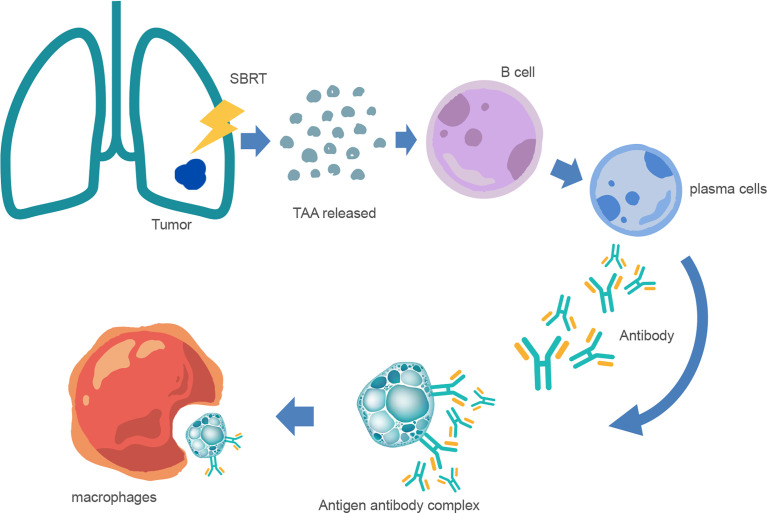
Stereotactic radiotherapy (SRT) is one of the main treatment modalities for lung cancer, and the current SRT approach combined with immunotherapy has initially presented good clinical efficacy in lung cancer. SRT activates the immune system through immunization, releasing antigens into the blood, which promotes the antigen-antibody response and then induces tumor cell apoptosis. Dose fractionation has different effects on the immune microenvironment, and the tumor microenvironment after SRT also changes over time, all of which have an impact on SRT combined immunotherapy. Although much research on the immune microenvironment of SRT has been conducted, many problems still require further exploration.
立体定向放疗(SRT)是肺癌的主要治疗方式之一,目前 SRT 联合免疫治疗在肺癌中初步表现出较好的临床疗效。SRT 通过免疫作用激活免疫系统,将抗原释放到血液中,促进抗原抗体反应,进而诱导肿瘤细胞凋亡。剂量分割对免疫微环境有不同的影响,SRT 后的肿瘤微环境也随时间而变化,这些都对 SRT 联合免疫治疗有影响。虽然对 SRT 的免疫微环境进行了大量研究,但仍有许多问题需要进一步探索。