Department of Urology, Beijing Chao-yang Hospital, Capital Medical University, Beijing, China.
Institute of Urology, Capital Medical University, Beijing, China.
Front Immunol. 2022 Sep 20;13:1022380. doi: 10.3389/fimmu.2022.1022380. eCollection 2022.
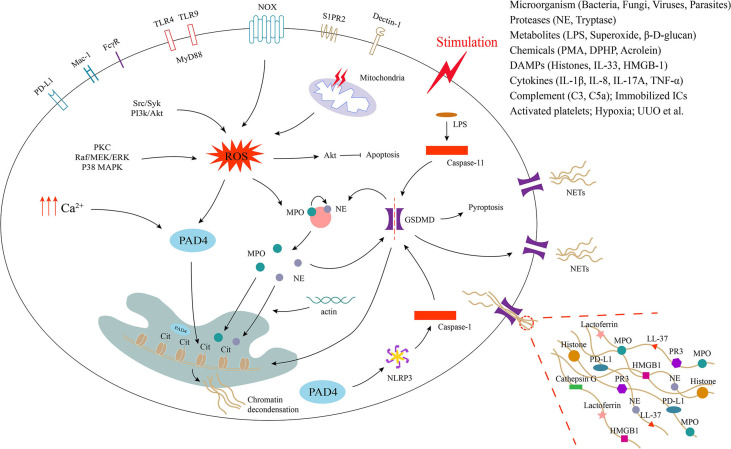
In response to strong signals, several types of immune cells release extracellular traps (ETs), which are web-like structures consisting of DNA decorated with various protein substances. This process is most commonly observed in neutrophils. Over the past two decades, ET formation has been recognized as a unique mechanism of host defense and pathogen destruction. However, the role of ETs in sterile inflammation has only been studied extensively in recent years. Ischemia reperfusion injury (IRI) is a type of sterile inflammatory injury. Several studies have reported that ETs have an important role in IRI in various organs. In this review, we describe the release of ETs by various types of immune cells and focus on the mechanism underlying the formation of neutrophil ETs (NETs). In addition, we summarize the role of ETs in IRI in different organs and their effects on tumors. Finally, we discuss the value of ETs as a potential therapeutic target for organ IRI and present possible challenges in conducting studies on IRI-related ETs as well as future research directions and prospects.
针对强烈的信号,几种类型的免疫细胞会释放细胞外陷阱(ETs),这是一种由 DNA 与各种蛋白质物质组成的网状结构。这个过程在中性粒细胞中最为常见。在过去的二十年中,ET 的形成已被认为是宿主防御和病原体破坏的一种独特机制。然而,近年来才广泛研究了 ET 在无菌性炎症中的作用。缺血再灌注损伤(IRI)是一种无菌性炎症损伤。有几项研究报告称,ET 在各种器官的 IRI 中具有重要作用。在这篇综述中,我们描述了各种类型的免疫细胞释放 ET,并重点介绍了中性粒细胞 ET(NETs)形成的机制。此外,我们总结了 ET 在不同器官的 IRI 中的作用及其对肿瘤的影响。最后,我们讨论了将 ET 作为器官 IRI 潜在治疗靶点的价值,并提出了与 IRI 相关的 ET 研究中可能存在的挑战,以及未来的研究方向和前景。