European Research Center on Economics and Sustainable Development, Economics and Business Department, University of Almería, Almería, Spain.
Department of Political Economy and Public Finance, Economic and Business Statistics, and Economic Policy, University of Castilla-La Mancha, Toledo, Spain.
Front Public Health. 2022 Sep 21;10:953827. doi: 10.3389/fpubh.2022.953827. eCollection 2022.
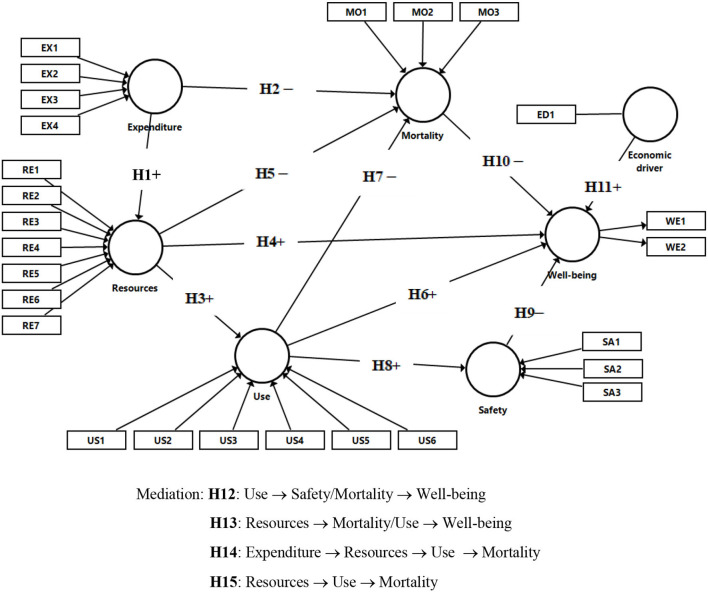
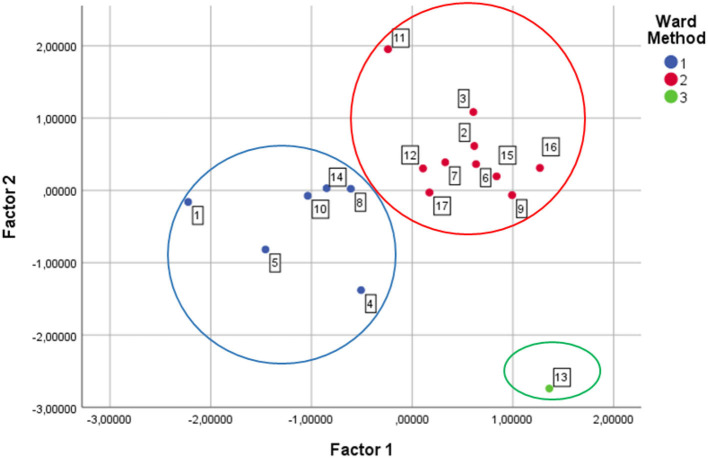
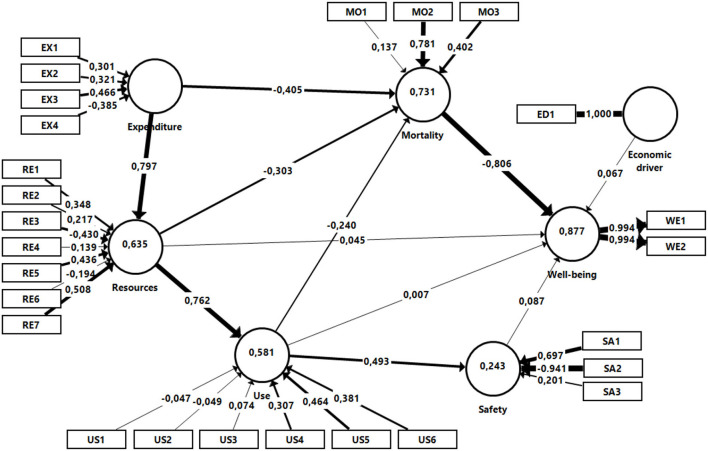
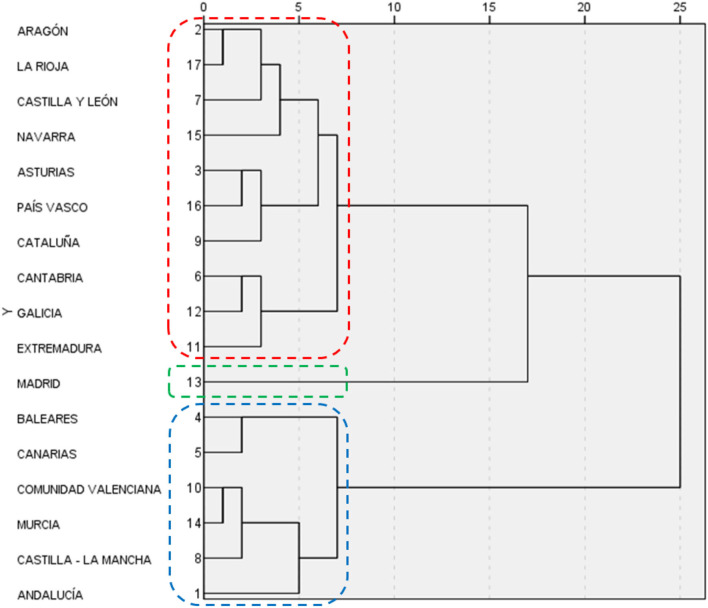
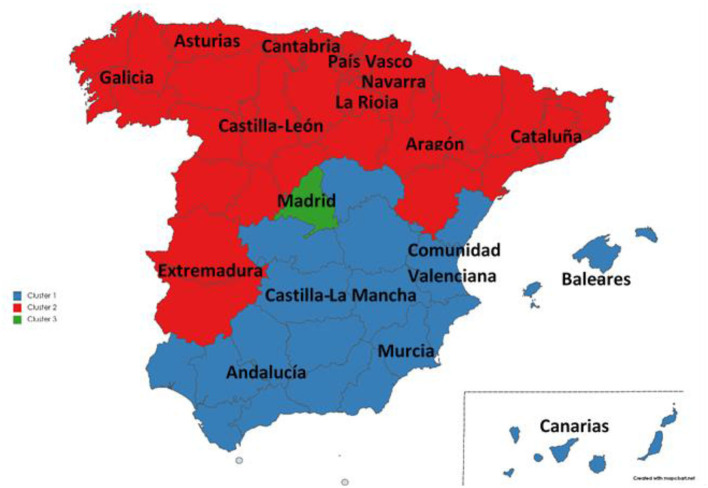
Well-being inequalities arising from different healthcare expenditure public policies is currently a hot topic at a national scale, but especially so at a sub-national level because the inequalities in question are among citizens of the same country. Spain is an optimal study area to carry out research on this topic because it is considered to have one of the best health systems in the world, it is one of the top-ranking countries in terms of life expectancy rates (the indicators we use for well-being), and it has a decentralized public health system with significantly different regional healthcare expenditure public policies. Given that the factors involved in the complex direct, indirect, and second-order relationships between well-being and health spending are latent in nature, and that there are more hypotheses than certainties regarding these relationships, we propose a partial least squares structural equation modeling specification to test the research hypotheses and to estimate the corresponding impacts. These constructs are proxied by a set of 26 indicators, for which annual values at a regional scale were used for the period 2005-2018. From the estimation of this model, it can be concluded that mortality, expenditure and resources are the factors that have the greatest impact on well-being. In addition, a cluster analysis of the indicators for the constructs included in this research reveals the existence of three clearly differentiated groups of autonomous communities: the northern part of the country plus Extremadura (characterized by the lowest well-being and the highest mortality rates), Madrid (with the best results in well-being and mortality, the lowest public health expenditure per inhabitant and percentage of pharmaceutical spending, and the highest percentage in specialty care services and medical staff spending), and the rest of the country (south-eastern regions, with similar well-being values to those of the first group but with less health expenditure). Finally, a principal component analysis reveals that "healthiness" and "basic spending" are the optimal factors for mapping well-being and health spending in Spain.
不同医疗支出公共政策导致的福祉不平等现象目前是国家层面上的热门话题,但在次国家层面上更是如此,因为所涉及的不平等现象存在于同一国家的公民之间。西班牙是开展这一主题研究的理想地区,因为它被认为拥有世界上最好的医疗体系之一,在预期寿命率(我们用于衡量福祉的指标)方面排名很高,并且它拥有分散的公共卫生系统,区域医疗支出公共政策存在显著差异。鉴于福祉与健康支出之间复杂的直接、间接和二阶关系所涉及的因素本质上是潜在的,并且这些关系存在更多的假设而不是确定性,我们提出了偏最小二乘结构方程模型规范来检验研究假设并估计相应的影响。这些结构由一组 26 个指标来表示,这些指标在 2005-2018 年期间以区域规模的年度值表示。从对该模型的估计可以得出结论,死亡率、支出和资源是对福祉影响最大的因素。此外,对本研究中包含的结构指标的聚类分析表明,存在三个明显区分的自治区群体:该国北部加上埃斯特雷马杜拉(以最低的福祉和最高的死亡率为特征)、马德里(在福祉和死亡率方面取得最好的成绩,人均公共卫生支出和药品支出比例最低,专科护理服务和医务人员支出比例最高),以及该国其他地区(东南部地区,福祉水平与第一组相似,但医疗支出较少)。最后,主成分分析表明,“健康”和“基本支出”是在西班牙描绘福祉和健康支出的最佳因素。