Department of Pharmacy, the Second Xiangya Hospital of Central South University, Changsha, China.
Menzies Institute for Medical Research, University of Tasmania, Hobart, TAS, Australia.
Front Public Health. 2022 Sep 21;10:985834. doi: 10.3389/fpubh.2022.985834. eCollection 2022.
Six anaplastic lymphoma kinase-tyrosine kinase inhibitors (ALK-TKIs), including one domestic (ensartinib) and five imported ALK-TKIs (crizotinib, ceritinib, alectinib, brigatinib, and lorlatinib), have been recommended as first-line treatments for advanced ALK-positive NSCLC in China. This study sought to examine the cost-effectiveness of these six novel therapies in Chinese patients.
We constructed a Markov model to compare the cost-effectiveness of the six ALK-TKIs as a first-line treatment for patients with advanced ALK-positive NSCLC from the perspective of the Chinese healthcare system. Transition probabilities were estimated by synthesizing data from the PROFILE 1,029 trial and a network meta-analysis. Health state utilities and costs were sourced from published literature, publicly available national databases, and local general hospitals. The robustness of model was assessed deterministic sensitivity analyses and probabilistic sensitivity analyses.
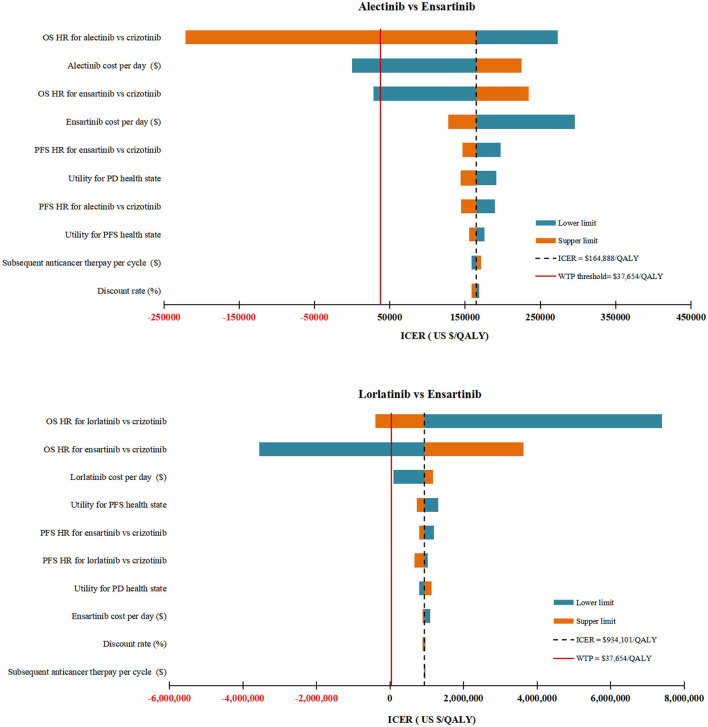
Compared with crizotinib, ensartinib achieved additional 0.12 quality-adjusted life-year (QALY) with marginal costs of $3,249, resulting in an incremental cost-effectiveness ratio (ICER) of $27,553/ QALY. When compared with ceritinib and brigatinib, ensartinib achieved additional 0.06 and 0.03 QALYs with substantially reduced costs. When compared with lorlatinib and alectinib, ensartinib was associated with a lower QALY and decreased total costs; the ICERs for lorlatinib and alectinib were $934,101/ QALY and $164,888/ QALY, respectively.
For Chinese patients with advanced ALK-positive NSCLC, ensartinib was a cost-effective option compared with crizotinib, and was a dominant alternative to ceritinib and brigatinib. Although lorlatinib and alectinib were associated with prolonged survival compared with ensartinib, they were less cost-effective than ensartinib due to the overwhelming total costs.
六种间变性淋巴瘤激酶酪氨酸激酶抑制剂(ALK-TKIs),包括一种国产(恩沙替尼)和五种进口 ALK-TKIs(克唑替尼、塞瑞替尼、阿来替尼、布加替尼和劳拉替尼),已被推荐为中国晚期ALK 阳性 NSCLC 的一线治疗药物。本研究旨在考察这六种新型治疗药物在中国患者中的成本效益。
我们构建了一个马尔可夫模型,从中国医疗保健系统的角度比较了六种 ALK-TKIs 作为晚期ALK 阳性 NSCLC 一线治疗药物的成本效益。通过综合 PROFILE 1029 试验和网络荟萃分析的数据来估计转移概率。健康状态效用和成本来自已发表的文献、公开的国家数据库和当地综合医院。通过确定性敏感性分析和概率敏感性分析来评估模型的稳健性。
与克唑替尼相比,恩沙替尼在边际成本为 3249 美元的情况下额外获得了 0.12 个质量调整生命年(QALY),增量成本效益比(ICER)为 27553 美元/QALY。与塞瑞替尼和布加替尼相比,恩沙替尼分别额外获得了 0.06 和 0.03 个 QALY,同时大幅降低了成本。与劳拉替尼和阿来替尼相比,恩沙替尼的 QALY 较低,总费用降低;劳拉替尼和阿来替尼的 ICER 分别为 934101 美元/QALY 和 164888 美元/QALY。
对于中国晚期ALK 阳性 NSCLC 患者,与克唑替尼相比,恩沙替尼是一种具有成本效益的选择,与塞瑞替尼和布加替尼相比,是一种更具优势的选择。尽管与恩沙替尼相比,劳拉替尼和阿来替尼的生存期更长,但由于总成本过高,它们的成本效益不如恩沙替尼。