Curtin School of Population Health, Curtin University, Perth, Australia.
School of Public Health, Debre Berhan University, Debre Berhan, Ethiopia.
Pan Afr Med J. 2022 Jul 13;42:199. doi: 10.11604/pamj.2022.42.199.35082. eCollection 2022.
interpregnancy interval (IPI) is the time elapsed between the birth of one live child and the conception of subsequent pregnancies. Several studies in Ethiopia indicated a high prevalence of a short interbirth interval - a proxy indicator of IPI. However, these studies were prone to selection bias as they did not include women who did not go on to have another pregnancy. Therefore, this study estimated the incidence of short IPI (< 24 months) and its risk factors among women who had at least one child in Ethiopia.
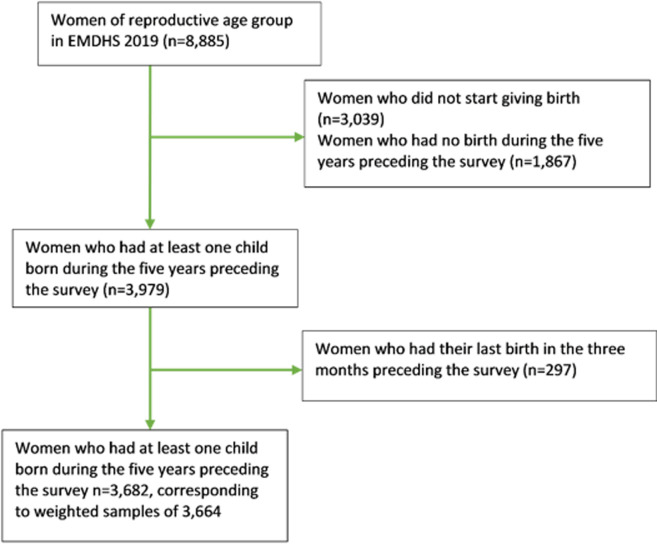
we used a retrospective analysis of a cross-sectional study from the nationally representative Ethiopian Mini Demographic and Health Survey (EMDHS) conducted in 2019. The event was defined as the conception of the subsequent pregnancy within 24 months following the last child. A weighted Cox Proportional Hazard model was used to estimate the adjusted hazard ratios (aHR) and 95% confidence intervals (CIs).
the incidence of short IPI was 6%. Rural residence, being young age, low educational attainment, having the last child died and having female last birth were the risk factors for short IPI. However, having higher parity, attending Antenatal Care (ANC) visits, being delivered at a health facility, and receiving Postnatal Care (PNC) visits were the protective factors for short IPI.
the incidence of short IPI in Ethiopia was considerable. Sociodemographic and health service-related factors determine the short IPI. Hence, considering the immediate and long-term health and socioeconomic consequences of short IPI, the Ethiopian government should implement holistic and multisectoral interventions.
孕期间隔(interpregnancy interval,IPI)是指从一个活产婴儿的出生到随后妊娠的受孕时间。埃塞俄比亚的几项研究表明,短孕期间隔(即 IPI 的间接指标)的流行率较高。然而,这些研究容易受到选择偏差的影响,因为它们没有包括那些没有再次怀孕的妇女。因此,本研究旨在估计在埃塞俄比亚至少有一个孩子的妇女中,短 IPI(<24 个月)及其危险因素的发生率。
我们对 2019 年全国代表性的埃塞俄比亚微型人口与健康调查(Ethiopian Mini Demographic and Health Survey,EMDHS)进行了回顾性分析。事件定义为在最后一个孩子出生后 24 个月内受孕。采用加权 Cox 比例风险模型估计调整后的危险比(adjusted hazard ratios,aHR)和 95%置信区间(confidence intervals,CIs)。
短 IPI 的发生率为 6%。农村居住、年龄较小、教育程度较低、最后一个孩子死亡以及最后一次分娩为女孩是短 IPI 的危险因素。然而,较高的产次、接受产前保健(antenatal care,ANC)、在医疗机构分娩和接受产后保健(postnatal care,PNC)是短 IPI 的保护因素。
埃塞俄比亚的短 IPI 发生率相当可观。社会人口和卫生服务相关因素决定了短 IPI。因此,考虑到短 IPI 的即时和长期健康和社会经济后果,埃塞俄比亚政府应实施全面和多部门的干预措施。