Interuniversity Institute for Biostatistics and statistical Bioinformatics (I-BioStat), Data Science Institute, Hasselt University, Hasselt, Belgium.
Centre for Infectious Disease Control, National Institute for Public Health and the Environment, Bilthoven, The Netherlands.
PLoS Comput Biol. 2022 Oct 10;18(10):e1010618. doi: 10.1371/journal.pcbi.1010618. eCollection 2022 Oct.
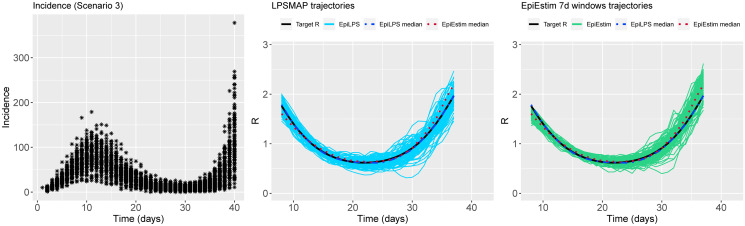
In infectious disease epidemiology, the instantaneous reproduction number [Formula: see text] is a time-varying parameter defined as the average number of secondary infections generated by an infected individual at time t. It is therefore a crucial epidemiological statistic that assists public health decision makers in the management of an epidemic. We present a new Bayesian tool (EpiLPS) for robust estimation of the time-varying reproduction number. The proposed methodology smooths the epidemic curve and allows to obtain (approximate) point estimates and credible intervals of [Formula: see text] by employing the renewal equation, using Bayesian P-splines coupled with Laplace approximations of the conditional posterior of the spline vector. Two alternative approaches for inference are presented: (1) an approach based on a maximum a posteriori argument for the model hyperparameters, delivering estimates of [Formula: see text] in only a few seconds; and (2) an approach based on a Markov chain Monte Carlo (MCMC) scheme with underlying Langevin dynamics for efficient sampling of the posterior target distribution. Case counts per unit of time are assumed to follow a negative binomial distribution to account for potential overdispersion in the data that would not be captured by a classic Poisson model. Furthermore, after smoothing the epidemic curve, a "plug-in'' estimate of the reproduction number can be obtained from the renewal equation yielding a closed form expression of [Formula: see text] as a function of the spline parameters. The approach is extremely fast and free of arbitrary smoothing assumptions. EpiLPS is applied on data of SARS-CoV-1 in Hong-Kong (2003), influenza A H1N1 (2009) in the USA and on the SARS-CoV-2 pandemic (2020-2021) for Belgium, Portugal, Denmark and France.
在传染病流行病学中,瞬时繁殖数[Formula: see text]是一个时变参数,定义为感染个体在 t 时刻产生的二次感染的平均数量。因此,它是一个至关重要的流行病学统计量,可以帮助公共卫生决策者管理疫情。我们提出了一种新的贝叶斯工具(EpiLPS),用于稳健估计时变繁殖数。该方法对流行曲线进行平滑处理,通过使用更新方程,结合贝叶斯 P-样条和样条向量的条件后验的拉普拉斯近似,获得[Formula: see text]的(近似)点估计和置信区间。我们提出了两种用于推断的替代方法:(1)基于模型超参数的最大后验估计的方法,仅用几秒钟即可提供[Formula: see text]的估计值;(2)基于具有潜在 Langevin动力学的马尔可夫链蒙特卡罗(MCMC)方案的方法,用于有效抽样后验目标分布。假设单位时间内的病例数遵循负二项分布,以考虑数据中可能存在的经典泊松模型无法捕捉到的过离散。此外,在对流行曲线进行平滑处理后,可以从更新方程中获得繁殖数的“插入”估计值,从而得到[Formula: see text]作为样条参数的函数的闭式表达式。该方法非常快速且没有任意的平滑假设。EpiLPS 应用于香港 2003 年 SARS-CoV-1、美国 2009 年甲型 H1N1 流感和 2020-2021 年比利时、葡萄牙、丹麦和法国的 SARS-CoV-2 大流行的数据。