Division of Gastroenterology and Hepatology, Key Laboratory of Gastroenterology and Hepatology, Ministry of Health, Shanghai Institute of Digestive Disease, Renji Hospital, School of Medicine, Shanghai Jiao Tong University, Shanghai, China.
State Key Laboratory of Natural Medicines, Research Center of Biostatistics and Computational Pharmacy, China Pharmaceutical University, Nanjing, China.
Cell Mol Gastroenterol Hepatol. 2023;15(2):393-424. doi: 10.1016/j.jcmgh.2022.10.001. Epub 2022 Oct 8.
BACKGROUND & AIMS: Approximately one-third of colorectal cancers develop from serrated lesions (SLs), including hyperplastic polyp (HP), sessile serrated lesion (SSL), traditional serrated adenoma (TSA), and SSL with dysplasia (SSLD) through the serrated neoplasia pathway, which progresses faster than the conventional adenoma-carcinoma pathway. We sought to depict the currently unclarified molecular and immune alterations by the single-cell landscape in SLs.
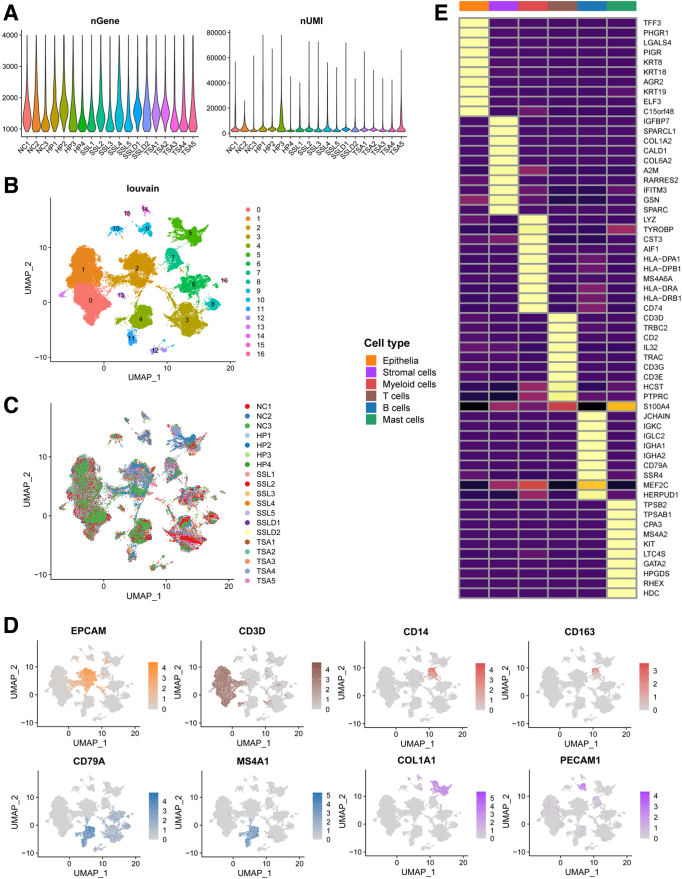
We performed single-cell RNA sequencing of 16 SLs (including 4 proximal HPs, 5 SSLs, 2 SSLDs, and 5 TSAs) vs 3 normal colonic tissues.
A total of 60,568 high-quality cells were obtained. Two distinct epithelial clusters with redox imbalance in SLs were observed, along with upregulation of tumor-promoting SerpinB6 that regulated ROS level. Epithelial clusters of SSL and TSA showed distinct molecular features: SSL-specific epithelium manifested overexpressed proliferative markers with Notch pathway activation, whereas TSA-specific epithelium showed Paneth cell metaplasia with aberrant lysozyme expression. As for immune contexture, enhanced cytotoxic activity of CD8 T cells was observed in SLs; it was mainly attributable to increased proportion of CD103CD8 tissue-resident memory T cells, which might be regulated by retinoic acid metabolism. Microenvironment of SLs was generally immune-activated, whereas some immunosuppressive cells (regulatory T cells, anti-inflammatory macrophages, MDKIgA plasma cells, MMP11-secreting PDGFRA fibroblasts) also emerged at early stage and further accumulated in SSLD.
Epithelial, immune, and stromal components in the serrated pathway undergo fundamental alterations. Future molecular subtypes of SLs and potential immune therapy might be developed.
大约三分之一的结直肠癌是由锯齿状病变(SL)发展而来,包括增生性息肉(HP)、无蒂锯齿状病变(SSL)、传统锯齿状腺瘤(TSA)和伴异型增生的无蒂锯齿状病变(SSLD),这些病变通过锯齿状肿瘤发生途径发展,其速度比传统腺瘤-癌途径快。我们试图通过 SL 的单细胞图谱描绘目前尚不清楚的分子和免疫改变。
我们对 16 个 SL(包括 4 个近端 HP、5 个 SSL、2 个 SSLD 和 5 个 TSA)和 3 个正常结肠组织进行了单细胞 RNA 测序。
共获得 60568 个高质量细胞。在 SL 中观察到两个具有氧化还原失衡的独特上皮簇,同时上调了促进肿瘤的 SerpinB6,它调节 ROS 水平。SSL 和 TSA 的上皮簇表现出不同的分子特征:SSL 特异性上皮表现出过度表达的增殖标记物和 Notch 途径激活,而 TSA 特异性上皮表现出潘氏细胞化生和异常溶菌酶表达。至于免疫环境,SL 中观察到 CD8 T 细胞的细胞毒性活性增强;这主要归因于 CD103CD8 组织驻留记忆 T 细胞比例增加,这可能受到视黄酸代谢的调节。SL 的微环境通常是免疫激活的,而一些免疫抑制细胞(调节性 T 细胞、抗炎巨噬细胞、MDKIgA 浆细胞、MMP11 分泌 PDGFRA 成纤维细胞)也在早期出现,并在 SSLD 中进一步积累。
锯齿状途径中的上皮、免疫和基质成分发生了根本性改变。未来可能会开发出 SL 的分子亚型和潜在的免疫治疗方法。