Department of Economics, FLAME University, Pune, India.
Department of Economics, Delhi School of Economics, University of Delhi, New Delhi, India.
Sci Rep. 2022 Oct 10;12(1):16978. doi: 10.1038/s41598-022-21334-w.
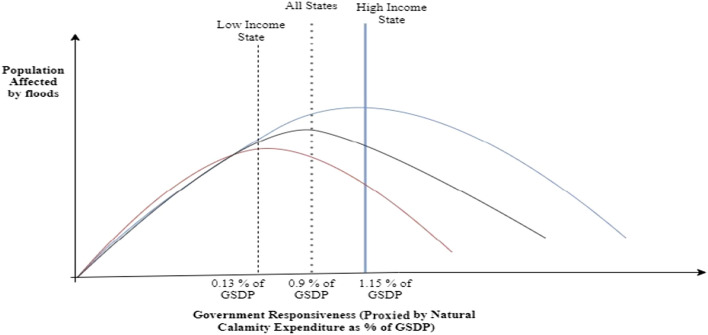
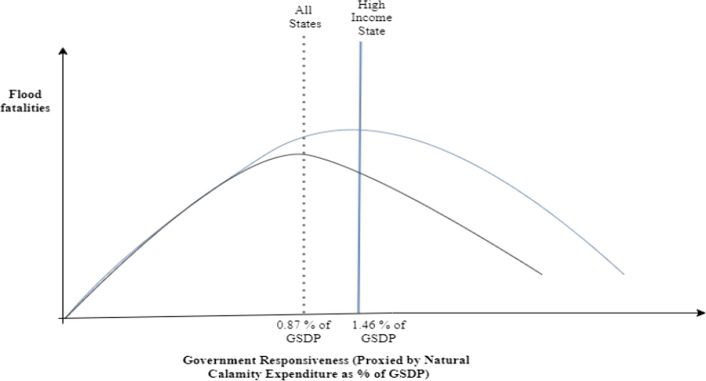
Floods are the most commonly occurring natural disasters in India due to India's unique geographical location and socioeconomic conditions. Frequent flooding causes enormous loss of human lives and damage crops and public utilities. Furthermore, floods adversely affect economic development and increase the government's financial burden by increasing spending on various disaster mitigation measures. Recent empirical literature based on cross-national comparisons shows that disaster fatalities and damages are monotonically decreasing in per capita income. We challenge this view on the monotonic negative relationship between income and flood damages. We examine the non-monotonic (inverted U-shaped) relationship between per capita income and flood impact in terms of deaths, people affected, and damages due to floods in 19 major Indian states from 1980 to 2011, using Poisson and Tobit estimation methods. In particular, deaths and the population affected by floods increase with a turning point of income up to 882 US$ and 578 US$, respectively, and diminishes thereafter. Our results confirm an inverted U-shaped relationship between income and fatalities and the population affected by floods. In addition to income, we argue that government responsiveness plays an essential role in mitigating the risk of floods. We employ the fixed-effect Poisson estimation method to examine the government's role in protecting people against disaster risk, focusing on regional differences in India. Deaths from floods remain non-linear and follow the inverted U-pattern with respect to government responsiveness. However, the effect of government responsiveness on flood fatalities and flood damages is statistically insignificant. Our results further suggest that high-income states experience a lower death toll from floods. The high-income (rich) states are capable of incurring a higher threshold level of income and higher natural calamity expenditure to reduce flood fatalities and protect the population affected by floods than the low-income (poor) states. The poor states have minimal resources and face severe financial constraints to reduce the death toll from floods. From the perspective of public policy, the poor states, in particular, require an increase in income, better governance, and effective disaster management policies to mitigate flood impact.
洪水是印度最常见的自然灾害,这是由于印度独特的地理位置和社会经济条件造成的。频繁的洪水导致巨大的人员伤亡和农作物及公共设施的破坏。此外,洪水还对经济发展产生不利影响,并通过增加各种灾害缓解措施的支出,增加了政府的财政负担。最近基于跨国比较的实证文献表明,灾难死亡率和损失随着人均收入的增加而单调减少。我们对收入与洪水损失之间的这种单调负相关关系提出了质疑。我们考察了 1980 年至 2011 年期间印度 19 个主要邦的人均收入与洪水影响之间的非单调(倒 U 型)关系,包括洪水造成的死亡人数、受灾人数和损失,使用泊松和托比特估计方法。特别是,洪水造成的死亡人数和受灾人口分别在收入达到 882 美元和 578 美元的转折点后增加,此后则减少。我们的结果证实了收入与洪水造成的死亡人数和受灾人口之间的倒 U 型关系。除了收入,我们还认为政府的响应能力在减轻洪水风险方面起着至关重要的作用。我们采用固定效应泊松估计方法来考察政府在保护人民免受灾害风险方面的作用,重点关注印度的地区差异。洪水造成的死亡人数仍然是非线性的,并且与政府响应能力呈倒 U 型模式。然而,政府响应能力对洪水死亡率和洪水损失的影响在统计学上并不显著。我们的结果进一步表明,高收入州的洪水死亡率较低。高收入(富裕)州能够承受更高的收入门槛水平和更高的自然灾害支出,以减少洪水死亡率和保护受灾人口,而低收入(贫穷)州则无法做到。贫穷州的资源有限,面临严重的财政限制,无法减少洪水造成的死亡人数。从公共政策的角度来看,特别是贫穷州需要增加收入、改善治理和实施有效的灾害管理政策,以减轻洪水的影响。