Palacios Miguel A, Verheijen Sonja, Schneiders Famke L, Bohoudi Omar, Slotman Berend J, Lagerwaard Frank J, Senan Suresh
Amsterdam UMC, Vrije Universiteit Medical Centre, Dept. of Radiation Oncology, de Boelelaan 1117, 1081 HV Amsterdam, the Netherlands.
Phys Imaging Radiat Oncol. 2022 Oct 3;24:76-81. doi: 10.1016/j.phro.2022.09.010. eCollection 2022 Oct.
Magnetic resonance-guided radiotherapy (MRgRT) with real-time intra-fraction tumor motion monitoring allows for high precision Stereotactic Ablative Radiotherapy (SABR). This study aimed to investigate the clinical feasibility, patient satisfaction and delivery accuracy of single-fraction MR-guided SABR in a single day (one-stop-shop, OSS).
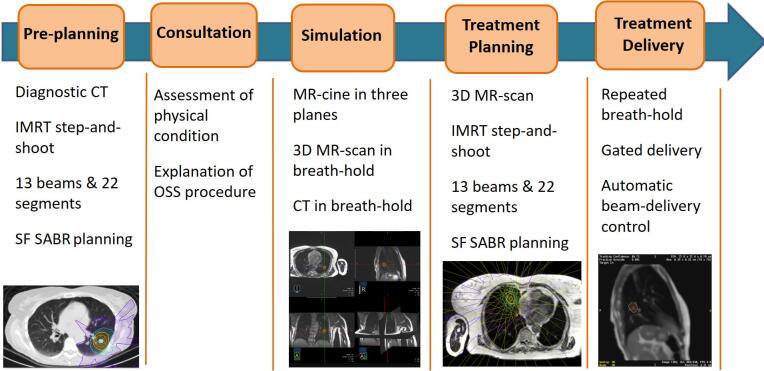
Ten patients with small lung tumors eligible for single fraction treatments were included. The OSS procedure consisted of consultation, treatment simulation, treatment planning and delivery. Following SABR delivery, patients completed a reported experience measure (PREM) questionnaire. Prescribed doses ranged 28-34 Gy. Median GTV was 2.2 cm (range 1.3-22.9 cm). A gating boundary of 3 mm, and PTV margin of 5 mm around the GTV, were used with auto-beam delivery control. Accuracy of SABR delivery was studied by analyzing delivered MR-cines reconstructed from machine log files.
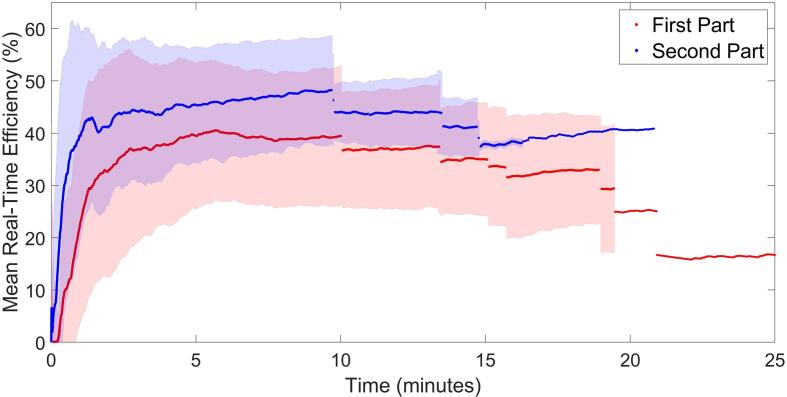
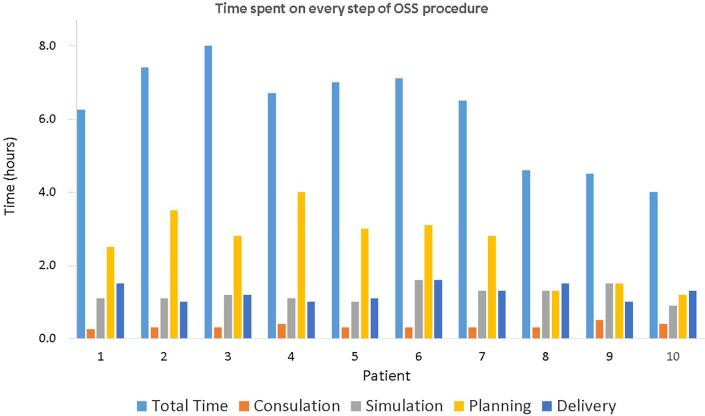
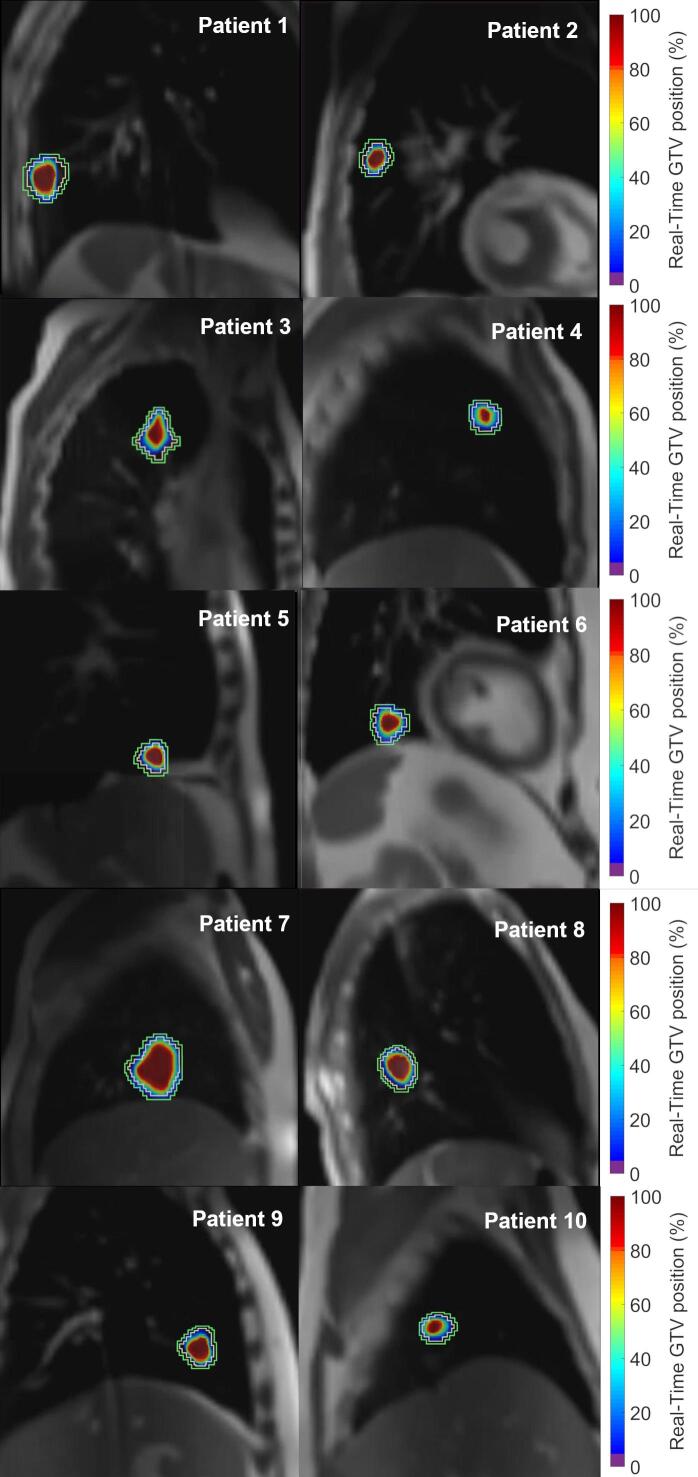
All 10 patients completed the OSS procedure in a single day, and all reported satisfaction with the process. Median time for the treatment planning step and the whole procedure were 2.8 h and 6.6 h, respectively. With optimization of the procedure, treatment could be completed in half a day. During beam-on, the 3 mm tracking boundary encompassed between 78.0 and 100 % of the GTV across all patients, with corresponding PTV values being 94.4-100 % (5th-95th percentiles). On average, system-latency for triggering a beam-off event comprised 5.3 % of the delivery time. Latency reduced GTV coverage by an average of -0.3 %. Duty-cycles during treatment delivery ranged from 26.1 to 64.7 %.
An OSS procedure with MR-guided SABR for lung cancer led to good patient satisfaction. Gated treatment delivery was highly accurate with little impact of system-latency.
磁共振引导放疗(MRgRT)结合实时分次内肿瘤运动监测可实现高精度立体定向消融放疗(SABR)。本研究旨在探讨单日单次磁共振引导SABR(一站式服务,OSS)的临床可行性、患者满意度及放疗准确性。
纳入10例适合单次治疗的小肺肿瘤患者。OSS流程包括会诊、治疗模拟、治疗计划制定及放疗实施。SABR放疗后,患者完成一份报告体验量表(PREM)问卷。处方剂量范围为28 - 34 Gy。GTV中位数为2.2 cm(范围1.3 - 22.9 cm)。采用3 mm的门控边界及GTV周围5 mm的PTV边界,并使用自动束流输送控制。通过分析从机器日志文件重建的已交付MR电影来研究SABR放疗的准确性。
所有10例患者均在单日完成OSS流程,且均对该过程表示满意。治疗计划制定步骤及整个流程的中位时间分别为2.8小时和6.6小时。通过优化流程,治疗可在半天内完成。在束流开启期间,3 mm的跟踪边界覆盖了所有患者GTV的78.0%至100%,相应的PTV值为94.4% - 100%(第5至95百分位数)。平均而言,触发束流关闭事件的系统延迟占输送时间的5.3%。延迟使GTV覆盖率平均降低了 - 0.3%。治疗输送期间的工作周期范围为26.1%至64.7%。
肺癌的磁共振引导SABR一站式服务流程使患者满意度良好。门控治疗输送高度准确,系统延迟影响较小。