Department of Psychiatry, Washington University School of Medicine in St. Louis, St. Louis, MO 63110.
Department of Pediatrics, Washington University School of Medicine in St. Louis, St. Louis, MO 63110.
Proc Natl Acad Sci U S A. 2022 Oct 18;119(42):e2204135119. doi: 10.1073/pnas.2204135119. Epub 2022 Oct 11.
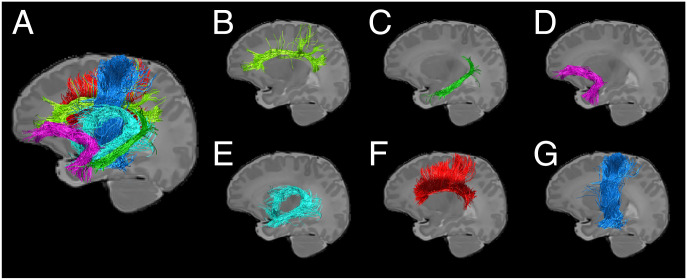
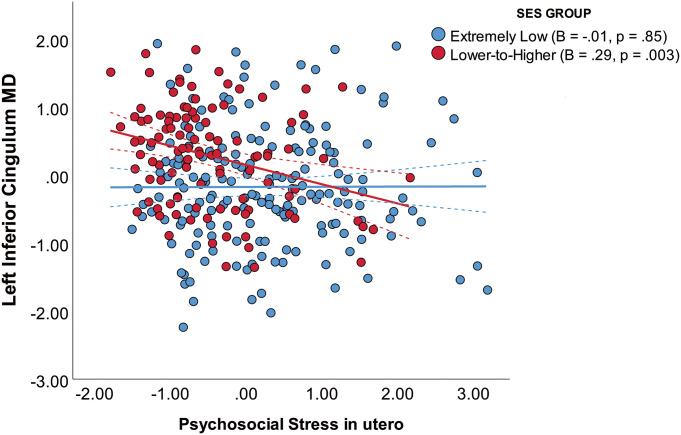
Early life adversity (social disadvantage and psychosocial stressors) is associated with altered microstructure in fronto-limbic pathways important for socioemotional development. Understanding when these associations begin to emerge may inform the timing and design of preventative interventions. In this longitudinal study, 399 mothers were oversampled for low income and completed social background measures during pregnancy. Measures were analyzed with structural equation analysis resulting in two latent factors: social disadvantage (education, insurance status, income-to-needs ratio [INR], neighborhood deprivation, and nutrition) and psychosocial stress (depression, stress, life events, and racial discrimination). At birth, 289 healthy term-born neonates underwent a diffusion MRI (dMRI) scan. Mean diffusivity (MD) and fractional anisotropy (FA) were measured for the dorsal and inferior cingulum bundle (CB), uncinate, and fornix using probabilistic tractography in FSL. Social disadvantage and psychosocial stress were fitted to dMRI parameters using regression models adjusted for infant postmenstrual age at scan and sex. Social disadvantage, but not psychosocial stress, was independently associated with lower MD in the bilateral inferior CB and left uncinate, right fornix, and lower MD and higher FA in the right dorsal CB. Results persisted after accounting for maternal medical morbidities and prenatal drug exposure. In moderation analysis, psychosocial stress was associated with lower MD in the left inferior CB among the lower-to-higher socioeconomic status (SES) (INR ≥ 200%) group, but not the extremely low SES (INR < 200%) group. Increasing access to social welfare programs that reduce the burden of social disadvantage and related psychosocial stressors may be an important target to protect fetal brain development in fronto-limbic pathways.
早期生活逆境(社会劣势和心理社会压力源)与额 - 边缘通路的微观结构改变有关,这些通路对社会情感发展很重要。了解这些关联何时开始出现,可以为预防性干预措施的时间和设计提供信息。在这项纵向研究中,399 名母亲因收入低而被过度抽样,并在怀孕期间完成了社会背景测量。使用结构方程分析对这些测量结果进行了分析,结果得出了两个潜在因素:社会劣势(教育、保险状况、收入需求比 [INR]、邻里贫困和营养)和心理社会压力源(抑郁、压力、生活事件和种族歧视)。在出生时,289 名健康的足月新生儿接受了弥散 MRI(dMRI)扫描。使用 FSL 中的概率追踪技术,测量了背侧和下扣带束(CB)、钩束和穹窿的平均扩散系数(MD)和分数各向异性(FA)。使用回归模型将社会劣势和心理社会压力源拟合到 dMRI 参数中,模型调整了扫描时婴儿的胎龄和性别。社会劣势,而不是心理社会压力源,与双侧下 CB 以及左钩束、右穹窿的 MD 降低和右 CB 的 MD 降低、FA 升高独立相关。在考虑到母亲的医疗合并症和产前药物暴露后,结果仍然存在。在适度分析中,心理社会压力与较低 SES(INR≥200%)组的左 CB 中 MD 降低相关,但与极低 SES(INR<200%)组无关。增加社会福利计划的获取途径,以减轻社会劣势和相关心理社会压力源的负担,可能是保护额 - 边缘通路中胎儿大脑发育的重要目标。