Children's Medical Center Research Institute, University of Texas Southwestern Medical Center, Dallas, Texas.
Department of Pediatrics, Harold C. Simmons Comprehensive Cancer Center, and Hamon Center for Regenerative Science and Medicine, University of Texas Southwestern Medical Center, Dallas, Texas.
Cancer Discov. 2023 Jan 9;13(1):170-193. doi: 10.1158/2159-8290.CD-21-1661.
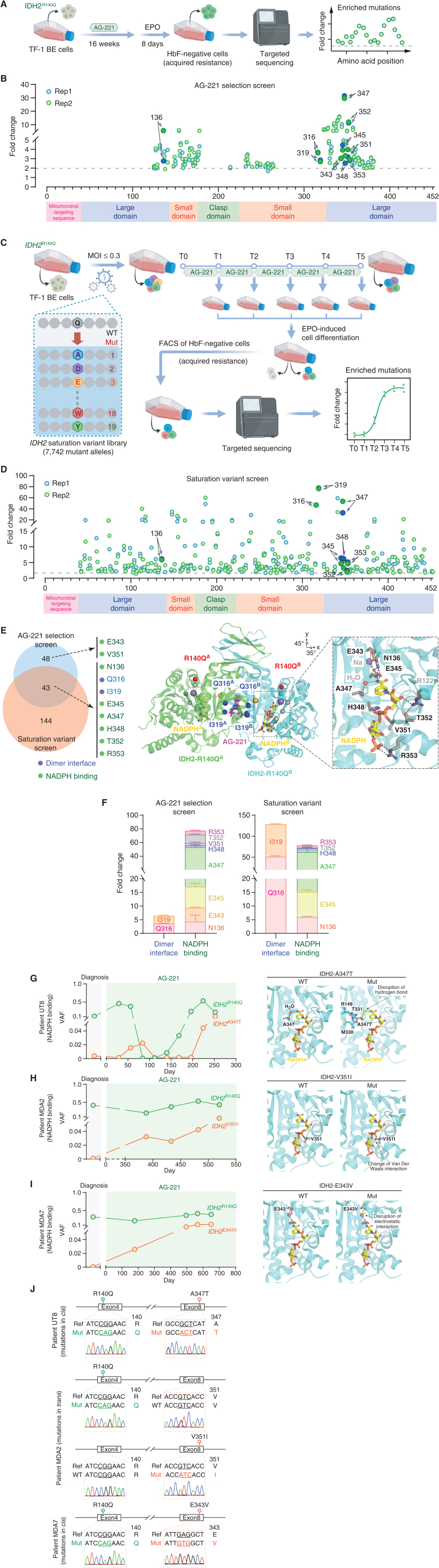
Mutations in IDH genes occur frequently in acute myeloid leukemia (AML) and other human cancers to generate the oncometabolite R-2HG. Allosteric inhibition of mutant IDH suppresses R-2HG production in a subset of patients with AML; however, acquired resistance emerges as a new challenge, and the underlying mechanisms remain incompletely understood. Here we establish isogenic leukemia cells containing common IDH oncogenic mutations by CRISPR base editing. By mutational scanning of IDH single amino acid variants in base-edited cells, we describe a repertoire of IDH second-site mutations responsible for therapy resistance through disabling uncompetitive enzyme inhibition. Recurrent mutations at NADPH binding sites within IDH heterodimers act in cis or trans to prevent the formation of stable enzyme-inhibitor complexes, restore R-2HG production in the presence of inhibitors, and drive therapy resistance in IDH-mutant AML cells and patients. We therefore uncover a new class of pathogenic mutations and mechanisms for acquired resistance to targeted cancer therapies.
Comprehensive scanning of IDH single amino acid variants in base-edited leukemia cells uncovers recurrent mutations conferring resistance to IDH inhibition through disabling NADPH-dependent uncompetitive inhibition. Together with targeted sequencing, structural, and functional studies, we identify a new class of pathogenic mutations and mechanisms for acquired resistance to IDH-targeting cancer therapies. This article is highlighted in the In This Issue feature, p. 1.
IDH 基因突变在急性髓细胞白血病(AML)和其他人类癌症中经常发生,以产生致癌代谢物 R-2HG。突变型 IDH 的变构抑制在 AML 患者亚群中抑制 R-2HG 的产生;然而,获得性耐药性是一个新的挑战,其潜在机制仍不完全清楚。在这里,我们通过 CRISPR 碱基编辑建立了含有常见 IDH 致癌突变的同基因白血病细胞。通过对碱基编辑细胞中 IDH 单一氨基酸变体的突变扫描,我们描述了一组 IDH 第二点突变,这些突变通过使非竞争性酶抑制失活而导致耐药性。IDH 异二聚体中 NADPH 结合位点的反复突变在顺式或反式作用下,阻止稳定的酶-抑制剂复合物的形成,在抑制剂存在的情况下恢复 R-2HG 的产生,并驱动 IDH 突变型 AML 细胞和患者的耐药性。因此,我们发现了一类新的致病突变和机制,用于获得性耐药性的靶向癌症治疗。
对碱基编辑白血病细胞中 IDH 单一氨基酸变体的全面扫描揭示了通过使 NADPH 依赖性非竞争性抑制失活而赋予耐药性的反复突变。结合靶向测序、结构和功能研究,我们确定了一类新的致病突变和机制,用于获得性耐药性的 IDH 靶向癌症治疗。本文在本期特色栏目中重点介绍,第 1 页。