Department of Oral and Maxillofacial Surgery, Public Dental Services, Folktandvården Stockholm, Eastmaninstitutet, Stockholm, Sweden.
Department of Dental Medicine, Division of Oral Diagnostics and Rehabilitation, Karolinska Institutet, Stockholm, Sweden.
PLoS One. 2022 Oct 12;17(10):e0275930. doi: 10.1371/journal.pone.0275930. eCollection 2022.
Temporomandibular disorders (TMD) are comprised by a heterogenous group of diagnoses with multifaceted and complex etiologies. Although diseases of the musculoskeletal system and connective tissue (MSD) have been reported as risk factors for developing TMD, no nationwide population-based registry studies have been conducted to investigate this possible link. The aim of this study was to investigate the association between MSD and TMD in a population-based sample using Swedish registry data, and to further investigate the difference in such association between patients diagnosed with TMD in a hospital setting and patients surgically treated for the condition.
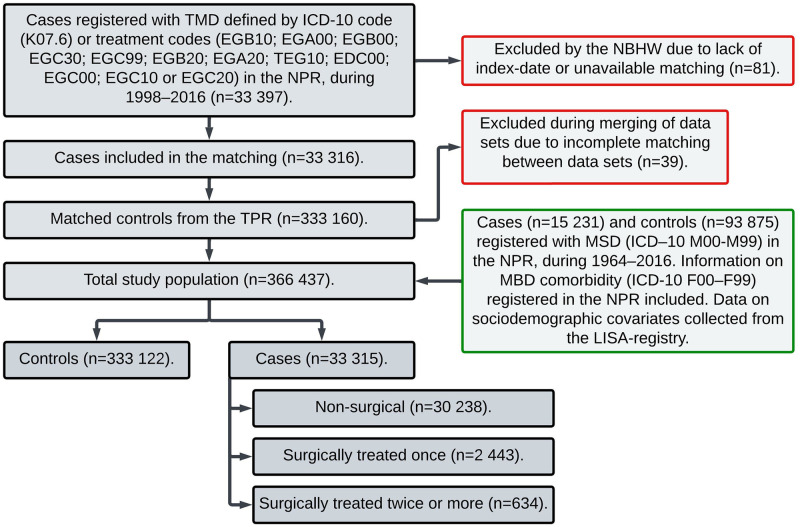
Population based case-control study using Swedish nationwide registry data. Data was collected between 1998 and 2016 from 33 315 incident cases and 333 122 controls aged ≥18, matched for sex, age, and living area. Cases were stratified into non-surgical (NS), surgically treated once (ST1) and surgically treated twice or more (ST2). Information on MSD exposure (ICD-10 M00-M99) was collected between 1964 and 2016. Odds ratios were calculated using conditional logistic regression, adjusted for country of birth, educational level, living area, and mental health comorbidity.
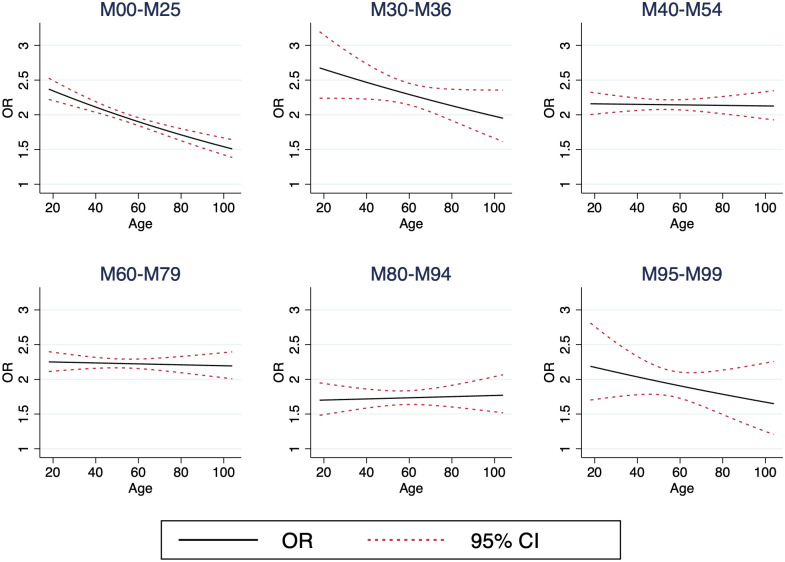
A significant association between MSD and the development of TMD was found for all diagnostic categories: arthropathies (OR 2.0, CI 1.9-2.0); systemic connective tissue disorders (OR 2.3, CI 2.1-2.4); dorsopathies (OR 2.2, CI 2.1-2.2); soft tissue disorders (OR 2.2, CI 2.2-2.3); osteopathies and chondropathies (OR 1.7, CI 1.6-1.8); and other disorders of the musculoskeletal system and connective tissue (OR 1.9, CI 1.8-2.1). The associations were generally much stronger for TMD requiring surgical treatment. The diagnostic group with the strongest association was inflammatory polyarthropathies, M05-M14 (OR 11.7, CI 8.6-15.9), which was seen in the ST2 group.
Patients with MSD diagnoses have a higher probability of being diagnosed with TMD, in comparison to individuals without MSD. This association is even stronger for TMD that requires surgery. The results are in line with earlier findings, but present new population-based evidence of a possible causal relationship between MSD and TMD, even after adjusting for known confounders. Both dentists and physicians should be aware of this association and be wary of early signs of painful TMD among patients with MSD, to make early referral and timely conservative treatment possible.
颞下颌关节紊乱(TMD)是一组异质性的诊断,具有多方面和复杂的病因。尽管肌肉骨骼系统和结缔组织(MSD)疾病已被报道为发生 TMD 的危险因素,但尚未有全国性的基于人群的登记研究来调查这种可能的联系。本研究旨在使用瑞典登记数据调查 MSD 与 TMD 之间的关联,并进一步研究在医院诊断为 TMD 的患者和接受手术治疗的患者之间,这种关联的差异。
使用瑞典全国登记数据进行基于人群的病例对照研究。数据收集于 1998 年至 2016 年期间,涉及 33315 例新发病例和 333122 例年龄≥18 岁的对照,按性别、年龄和居住地区匹配。病例分为非手术(NS)、手术治疗一次(ST1)和手术治疗两次或以上(ST2)。1964 年至 2016 年期间收集 MSD 暴露(ICD-10 M00-M99)信息。使用条件逻辑回归计算比值比,并调整了出生地、教育程度、居住地区和心理健康合并症。
发现 MSD 与 TMD 的发生存在显著关联,适用于所有诊断类别:关节病(OR 2.0,CI 1.9-2.0);系统性结缔组织疾病(OR 2.3,CI 2.1-2.4);背痛(OR 2.2,CI 2.1-2.2);软组织疾病(OR 2.2,CI 2.2-2.3);骨病和软骨病(OR 1.7,CI 1.6-1.8);以及其他肌肉骨骼系统和结缔组织疾病(OR 1.9,CI 1.8-2.1)。对于需要手术治疗的 TMD,关联通常更强。关联最强的诊断组是炎症性多关节炎,M05-M14(OR 11.7,CI 8.6-15.9),见于 ST2 组。
与没有 MSD 的个体相比,患有 MSD 诊断的患者更有可能被诊断为 TMD。对于需要手术的 TMD,这种关联甚至更强。这些结果与早期研究结果一致,但提供了新的基于人群的证据,表明 MSD 和 TMD 之间可能存在因果关系,即使在调整了已知混杂因素后也是如此。牙医和内科医生都应该意识到这种关联,并警惕 MSD 患者出现早期疼痛性 TMD 的迹象,以便进行早期转诊和及时的保守治疗。