Gobato Mariana L M, Segabinazzi Lorenzo G T M, Scheeren Verônica F C, Bandeira Rafael S, Freitas-Dell'Aqua Camila P, Dell'Aqua José A, Papa Frederico O
School of Veterinary Medicine and Animal Science, São Paulo State University (UNESP), Botucatu, São Paulo, Brazil.
Ross University School of Veterinary Medicine, Basseterre, Saint Kitts and Nevis.
Front Vet Sci. 2022 Sep 26;9:1011899. doi: 10.3389/fvets.2022.1011899. eCollection 2022.
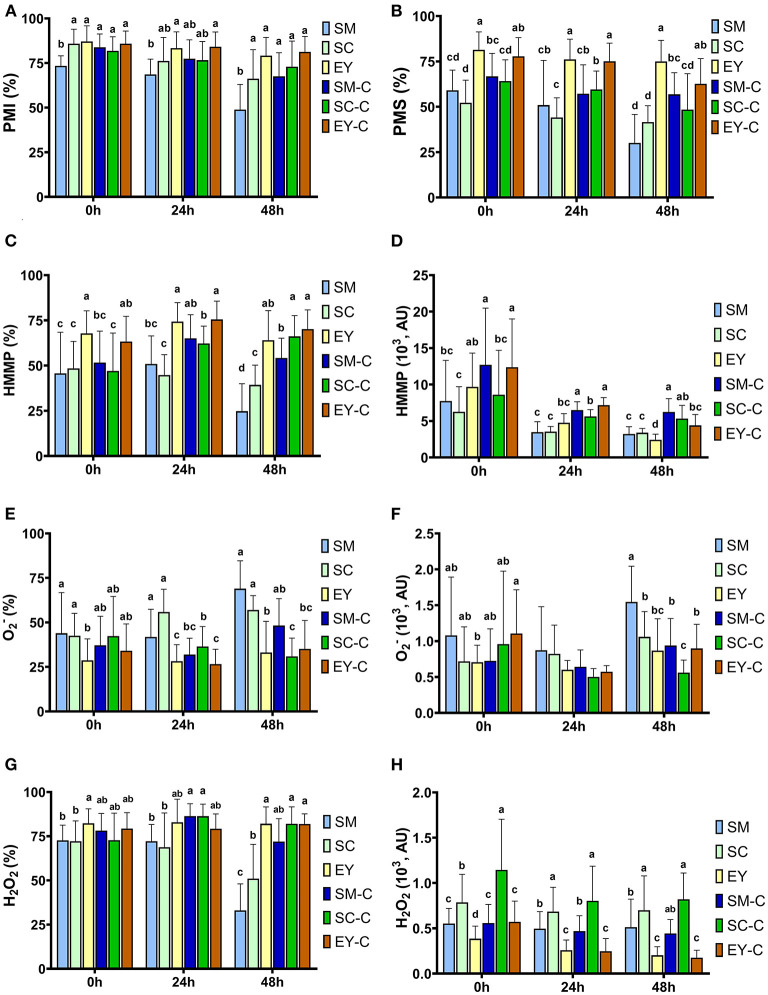
Artificial insemination using cooled-transported semen has marked importance in equine breeding programs around the world, and the high value of mules has generated avid interest in donkey semen biotechnology. However, donkey semen cools poorly in commercially available equine extenders. Therefore, this study aimed to develop approaches to improve the ability of donkey semen to tolerate cooling. Ejaculates of seven donkeys ( = 21) were cooled at 5°C for 48 h in three different extenders (milk-based, SM; sodium caseinate-based, SC; or egg yolk-based, EY) in the presence or absence of seminal plasma (centrifugation, C). Sperm motility, plasma membrane integrity (PMI), plasma membrane stability (PMS), mitochondrial membrane potential (HMMP), intracellular hydrogen peroxide (HO), and intracellular superoxide ( ) were assessed before, 24 h, and 48 h post-cooling. In addition, 15 mares (163 estrous cycles) were randomly inseminated with semen from two jacks (Jack 1, = 90; Jack 2, = 73) previously cooled for 24 h under one of the treatments (SM, SC, EY, SM-C, SC-C, or EY-C). Groups EY, SC-C, and EY-C ( < 0.05) demonstrated superior sperm analytical parameters to SM at 24 and 48 h. Centrifugation positively affected sperm analytical parameters in cooled donkey semen extended in SM and SC ( < 0.05). Mares bred with semen extended in SC (67%, 18/27), SC-C (89%, 24/27), EY (89%, 25/28), or EY-C (74%, 20/27) had significantly greater conception rates than mares bred with SM (33%, 9/27; < 0.05). Mares bred with SM-C had intermediate conception rates (59%, 16/27). In conclusion, SC and EY improved the cooling ability and fertility of donkey semen in horse mares, and centrifugation positively affected donkey semen extended in SM.
在世界各地的马繁育计划中,使用经冷却运输的精液进行人工授精具有显著重要性,而骡子的高价值引发了人们对驴精液生物技术的浓厚兴趣。然而,驴精液在市售的马用稀释液中冷却效果不佳。因此,本研究旨在开发提高驴精液耐冷却能力的方法。将7头驴( = 21)的射精精液在三种不同的稀释液(基于牛奶的,SM;基于酪蛋白酸钠的,SC;或基于蛋黄的,EY)中于5°C下冷却48小时,有无精浆(离心,C)。在冷却前、冷却后24小时和48小时评估精子活力、质膜完整性(PMI)、质膜稳定性(PMS)、线粒体膜电位(HMMP)、细胞内过氧化氢(HO)和细胞内超氧化物( )。此外,将15匹母马(163个发情周期)随机用来自两头公驴(公驴1, = 90;公驴2, = 73)的精液进行授精,这些精液先前在其中一种处理(SM、SC、EY、SM-C、SC-C或EY-C)下冷却24小时。在24小时和48小时时,EY组、SC-C组和EY-C组( < 0.05)的精子分析参数优于SM组。离心对在SM和SC中稀释的冷却驴精液的精子分析参数有积极影响( < 0.05)。用在SC(67%,18/27)、SC-C(89%,24/27)、EY(89%,25/28)或EY-C(74%,20/27)中稀释的精液进行配种的母马的受孕率显著高于用SM(33%,9/27)进行配种的母马( < 0.05)。用SM-C进行配种的母马受孕率处于中等水平(59%,16/27)。总之,SC和EY提高了驴精液在母马中的冷却能力和生育力,离心对在SM中稀释的驴精液有积极影响。