Department of Neuropsychology & Psychopharmacology, Faculty of Psychology & Neuroscience, Maastricht University, Maastricht, Netherlands.
Centre for Human Psychopharmacology, Swinburne University of Technology, Melbourne, VIC, Australia.
Psychopharmacology (Berl). 2022 Nov;239(11):3731-3741. doi: 10.1007/s00213-022-06248-9. Epub 2022 Oct 13.
Delta-9-tetrahydrocannabinol (THC), an active component of cannabis, can cause anxiety in some users during intoxication. Cannabidiol (CBD), another constituent of cannabis, has anxiolytic properties suggesting that cannabis products containing CBD in addition to THC may produce less anxiety than THC-only products. Findings to date around this issue have been inconclusive and could conceivably depend on moderating factors such as baseline anxiety levels in users.
The present study examined whether anxiety following single doses of vaporised THC, CBD and THC/CBD might be explained by state and trait anxiety levels at baseline.
A placebo-controlled, randomised, within-subjects study including 26 healthy recreational cannabis users tested the effects of vaporised THC-dominant cannabis (13.75 mg THC), CBD-dominant cannabis (13.75 mg CBD), THC/CBD-equivalent cannabis (13.75 mg THC/13.75 mg CBD) and placebo cannabis on anxiety. Self-rated trait anxiety was assessed with the State-Trait Anxiety Inventory (STAI). State levels of anxiety were objectively assessed with a computer-based emotional Stroop task (EST) and subjectively rated with the STAI-state questionnaire and a visual analogue scale.
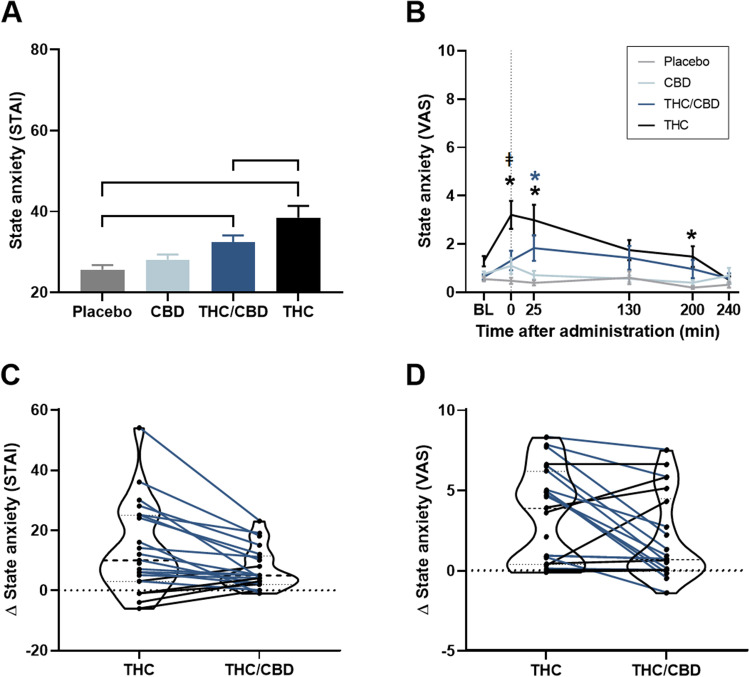
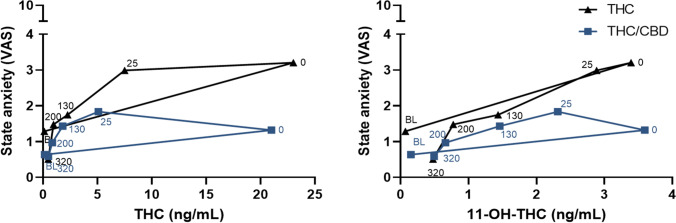
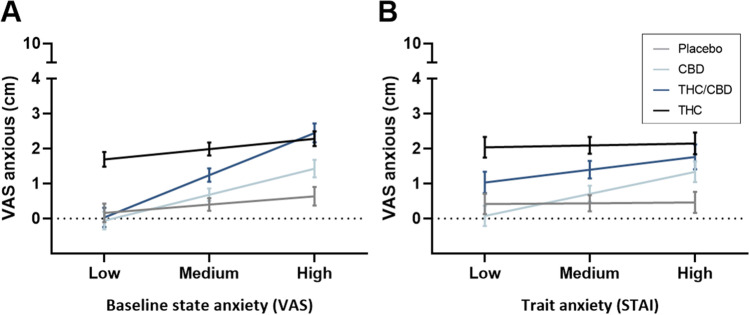
Both THC and THC/CBD significantly increased self-rated state anxiety compared to placebo. State anxiety after THC/CBD was significantly lower than after THC alone. THC-induced anxiety was independent of anxiety at baseline. When baseline anxiety was low, CBD completely counteracted THC-induced anxiety; however, when baseline anxiety was high, CBD did not counteract THC-induced anxiety. There were no effects of any treatment condition on the EST.
Overall, the study demonstrated that the THC/CBD-equivalent cannabis induces less state anxiety than THC-dominant cannabis.
大麻的有效成分之一四氢大麻酚(THC)会使部分使用者在吸食大麻后产生焦虑。另一种大麻成分大麻二酚(CBD)具有抗焦虑作用,这表明除了 THC 以外还含有 CBD 的大麻制品可能比只含有 THC 的产品产生的焦虑少。目前围绕这一问题的研究结果尚无定论,而且可能取决于调节因素,如使用者的基线焦虑水平。
本研究旨在探讨单次吸入 THC、CBD 和 THC/CBD 后出现的焦虑是否可以用基线时的状态和特质焦虑水平来解释。
一项纳入 26 名健康的娱乐性大麻使用者的安慰剂对照、随机、自身对照研究,测试了蒸气化 THC 优势大麻(13.75mg THC)、CBD 优势大麻(13.75mg CBD)、THC/CBD 等效大麻(13.75mg THC/13.75mg CBD)和安慰剂大麻对焦虑的影响。特质焦虑采用状态-特质焦虑量表(STAI)进行自我评估。焦虑的状态水平通过基于计算机的情绪 Stroop 任务(EST)进行客观评估,以及通过 STAI 状态问卷和视觉模拟量表进行主观评估。
与安慰剂相比,THC 和 THC/CBD 均显著增加了自我评估的状态焦虑。与单独使用 THC 相比,THC/CBD 后状态焦虑明显降低。THC 引起的焦虑与基线时的焦虑无关。当基线焦虑较低时,CBD 完全抵消了 THC 引起的焦虑;然而,当基线焦虑较高时,CBD 并不能抵消 THC 引起的焦虑。任何治疗条件对 EST 均无影响。
总体而言,该研究表明,THC/CBD 等效大麻引起的状态焦虑比 THC 优势大麻少。