Department of Family Medicine, Ditmanson Medical Foundation Chiayi Christian Hospital, Chiayi City, Taiwan.
Department of Nursing, Min-Hwei Junior College of Health Care Management, Tainan, Taiwan.
Sci Rep. 2022 Oct 13;12(1):17151. doi: 10.1038/s41598-022-22090-7.
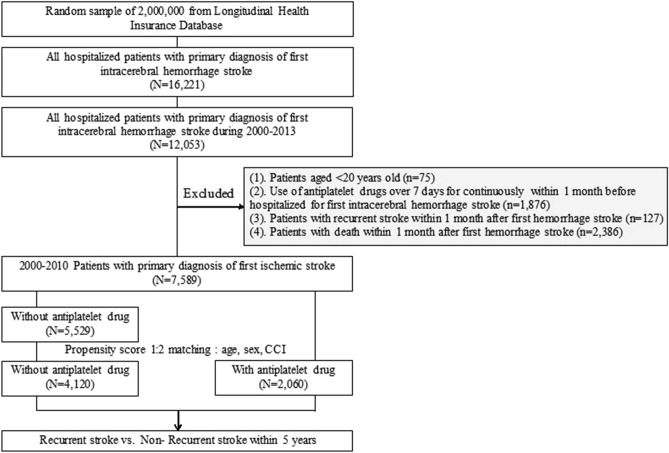
The risk factors for recurrence of hemorrhagic or ischemic stroke in patients with intracranial hemorrhage (ICH) are inconclusive. This study was designed to investigate the risk factors for stroke recurrence and the impact of antiplatelet on stroke recurrence in patients with ICH. This population-based case-cohort study analyzed the data obtained from a randomized sample of 2 million subjects in the Taiwan National Health Insurance Research Database. The survival of patients with hemorrhagic stroke from January 1, 2000, to December 31, 2013, was included in the study. During the 5-year follow-up period, the recurrence rate of stroke was 13.1% (7.01% hemorrhagic stroke, and 6.12% ischemic stroke). The recurrence rate of stroke was 13.3% in the without antiplatelet group and 12.6% in the antiplatelet group. The risk factor for hemorrhagic stroke was hypertension (OR 1.87). The risk factors for ischemic stroke were age (OR 2.99), diabetes mellitus (OR 1.28), hypertension (OR 2.68), atrial fibrillation (OR 1.97), cardiovascular disease (OR 1.42), and ischemic stroke history (OR 1.68). Antiplatelet may decrease risk of hemorrhagic stroke (OR 0.53). The risk of stroke recurrence is high in patients with ICH. Hypertension is a risk factor for ischemic and hemorrhagic stroke recurrence. Antiplatelet therapy does not decrease risk of ischemic stroke recurrence but may reduce recurrence of hemorrhagic stroke.
颅内出血 (ICH) 患者再发出血性或缺血性卒中的危险因素尚无定论。本研究旨在探讨 ICH 患者卒中再发的危险因素及抗血小板治疗对卒中再发的影响。这项基于人群的病例-队列研究分析了来自台湾全民健康保险研究数据库中 200 万随机抽样对象的数据。研究纳入了 2000 年 1 月 1 日至 2013 年 12 月 31 日期间发生出血性卒中患者的生存情况。在 5 年的随访期间,卒中再发率为 13.1%(7.01%为出血性卒中,6.12%为缺血性卒中)。无抗血小板组的卒中再发率为 13.3%,抗血小板组为 12.6%。出血性卒中的危险因素为高血压(OR 1.87)。缺血性卒中的危险因素为年龄(OR 2.99)、糖尿病(OR 1.28)、高血压(OR 2.68)、心房颤动(OR 1.97)、心血管疾病(OR 1.42)和缺血性卒中史(OR 1.68)。抗血小板治疗可能降低出血性卒中的风险(OR 0.53)。ICH 患者卒中再发风险较高。高血压是缺血性和出血性卒中再发的危险因素。抗血小板治疗不能降低缺血性卒中再发风险,但可能降低出血性卒中再发风险。