Program in Molecular Medicine, College of Life Sciences, National Yang Ming Chiao Tung University, Taipei 11221, Taiwan.
Department of Ophthalmology, Taipei Veterans General Hospital, 201 Sec. 2, Shih-Pai Rd., Taipei 11217, Taiwan.
Int J Mol Sci. 2022 Oct 6;23(19):11891. doi: 10.3390/ijms231911891.
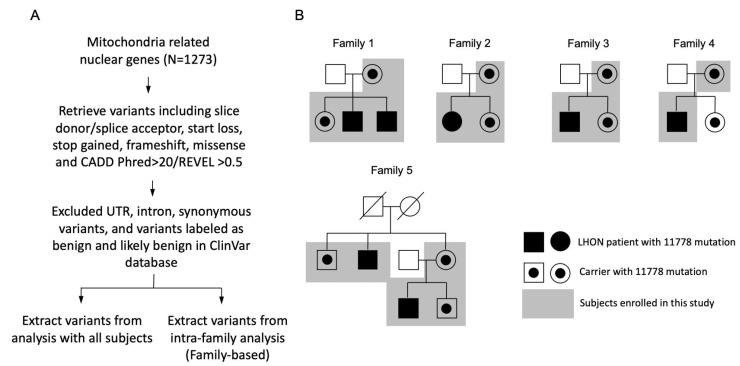
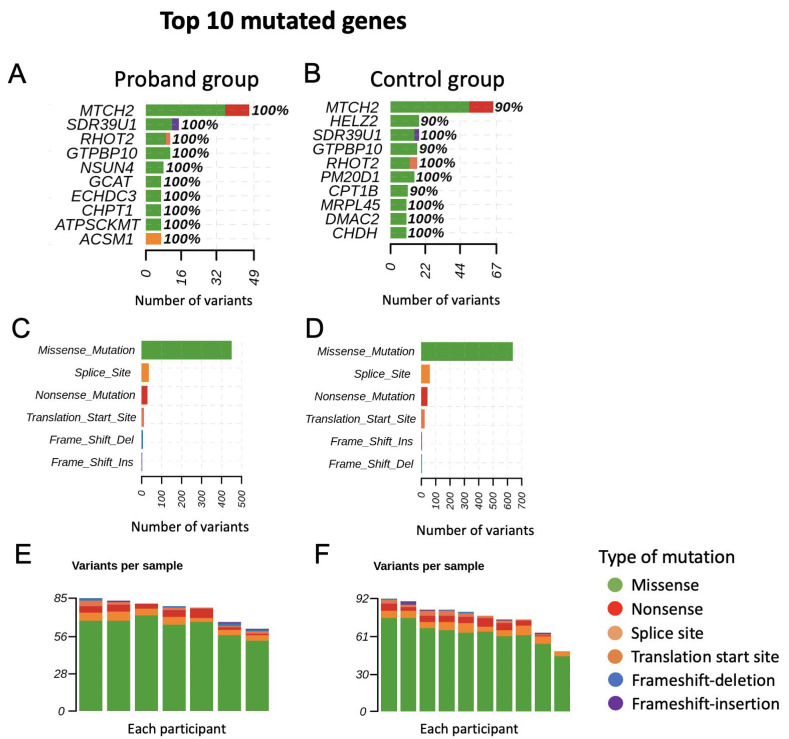
Leber’s hereditary optic neuropathy (LHON) is a maternally transmitted disease caused by mitochondria DNA (mtDNA) mutation. It is characterized by acute and subacute visual loss predominantly affecting young men. The mtDNA mutation is transmitted to all maternal lineages. However, only approximately 50% of men and 10% of women harboring a pathogenic mtDNA mutation develop optic neuropathy, reflecting both the incomplete penetrance and its unexplained male prevalence, where over 80% of patients are male. Nuclear modifier genes have been presumed to affect the penetrance of LHON. With conventional genetic methods, prior studies have failed to solve the underlying pathogenesis. Whole exome sequencing (WES) is a new molecular technique for sequencing the protein-coding region of all genes in a whole genome. We performed WES from five families with 17 members. These samples were divided into the proband group (probands with acute onset of LHON, n = 7) and control group (carriers including mother and relative carriers with mtDNSA 11778 mutation, without clinical manifestation of LHON, n = 10). Through whole exome analysis, we found that many mitochondria related (MT-related) nuclear genes have high percentage of variants in either the proband group or control group. The MT genes with a difference over 0.3 of mutation percentage between the proband and control groups include AK4, NSUN4, RDH13, COQ3, and FAHD1. In addition, the pathway analysis revealed that these genes were associated with cofactor metabolism pathways. Family-based analysis showed that several candidate MT genes including METAP1D (c.41G > T), ACACB (c.1029del), ME3 (c.972G > C), NIPSNAP3B (c.280G > C, c.476C > G), and NSUN4 (c.4A > G) were involved in the penetrance of LHON. A GWAS (genome wide association study) was performed, which found that ADGRG5 (Chr16:575620A:G), POLE4 (Chr2:7495872T:G), ERMAP (Chr1:4283044A:G), PIGR (Chr1:2069357C:T;2069358G:A), CDC42BPB (Chr14:102949A:G), PROK1 (Chr1:1104562A:G), BCAN (Chr 1:1566582C:T), and NES (Chr1:1566698A:G,1566705T:C, 1566707T:C) may be involved. The incomplete penetrance and male prevalence are still the major unexplained issues in LHON. Through whole exome analysis, we found several MT genes with a high percentage of variants were involved in a family-based analysis. Pathway analysis suggested a difference in the mutation burden of MT genes underlining the biosynthesis and metabolism pathways. In addition, the GWAS analysis also revealed several candidate nuclear modifier genes. The new technology of WES contributes to provide a highly efficient candidate gene screening function in molecular genetics.
Leber 遗传性视神经病变(LHON)是一种由线粒体 DNA(mtDNA)突变引起的母系遗传性疾病。它的特征是急性和亚急性视力丧失,主要影响年轻男性。mtDNA 突变会传递给所有母系血统。然而,只有大约 50%的携带致病性 mtDNA 突变的男性和 10%的女性会发展为视神经病变,这反映了不完全外显率和其无法解释的男性高发率,超过 80%的患者为男性。核修饰基因被认为会影响 LHON 的外显率。使用传统的遗传方法,先前的研究未能解决潜在的发病机制。全外显子组测序(WES)是一种新的分子技术,可对整个基因组中的所有基因的编码区进行测序。我们对五个有 17 名成员的家庭进行了 WES。这些样本分为先证者组(急性 LHON 发病的先证者,n=7)和对照组(包括母亲和携带 mtDNA11778 突变的相关携带者,无 LHON 临床表现,n=10)。通过全外显子分析,我们发现无论是先证者组还是对照组,许多与线粒体相关(MT 相关)的核基因的变异百分比都很高。先证者组和对照组之间突变百分比差异超过 0.3 的 MT 基因包括 AK4、NSUN4、RDH13、COQ3 和 FAHD1。此外,通路分析表明这些基因与辅助因子代谢途径有关。基于家系的分析表明,几个候选 MT 基因,包括 METAP1D(c.41G>T)、ACACB(c.1029del)、ME3(c.972G>C)、NIPSNAP3B(c.280G>C,c.476C>G)和 NSUN4(c.4A>G),参与了 LHON 的外显率。进行了全基因组关联研究(GWAS),发现 ADGRG5(Chr16:575620A:G)、POLE4(Chr2:7495872T:G)、ERMAP(Chr1:4283044A:G)、PIGR(Chr1:2069357C:T;2069358G:A)、CDC42BPB(Chr14:102949A:G)、PROK1(Chr1:1104562A:G)、BCAN(Chr 1:1566582C:T)和 NES(Chr1:1566698A:G、1566705T:C、1566707T:C)可能参与其中。LHON 的不完全外显率和男性高发率仍然是主要的未解之谜。通过全外显子组分析,我们发现了一些 MT 基因,其变异百分比很高,参与了基于家系的分析。通路分析表明 MT 基因的突变负担存在差异,这突显了生物合成和代谢途径。此外,GWAS 分析还揭示了一些候选核修饰基因。WES 等新技术有助于在分子遗传学中提供高效的候选基因筛选功能。