Department of Physiology and Institute of Neurosciences "Federico Olóriz", Centre of Biomedical Research, University of Granada, 18016 Granada, Spain.
Instituto de Investigación Biosanitaria ibs.GRANADA, 18012 Granada, Spain.
Int J Mol Sci. 2022 Oct 9;23(19):12004. doi: 10.3390/ijms231912004.
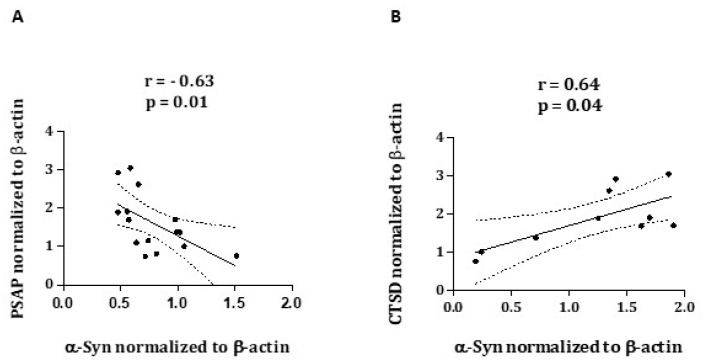
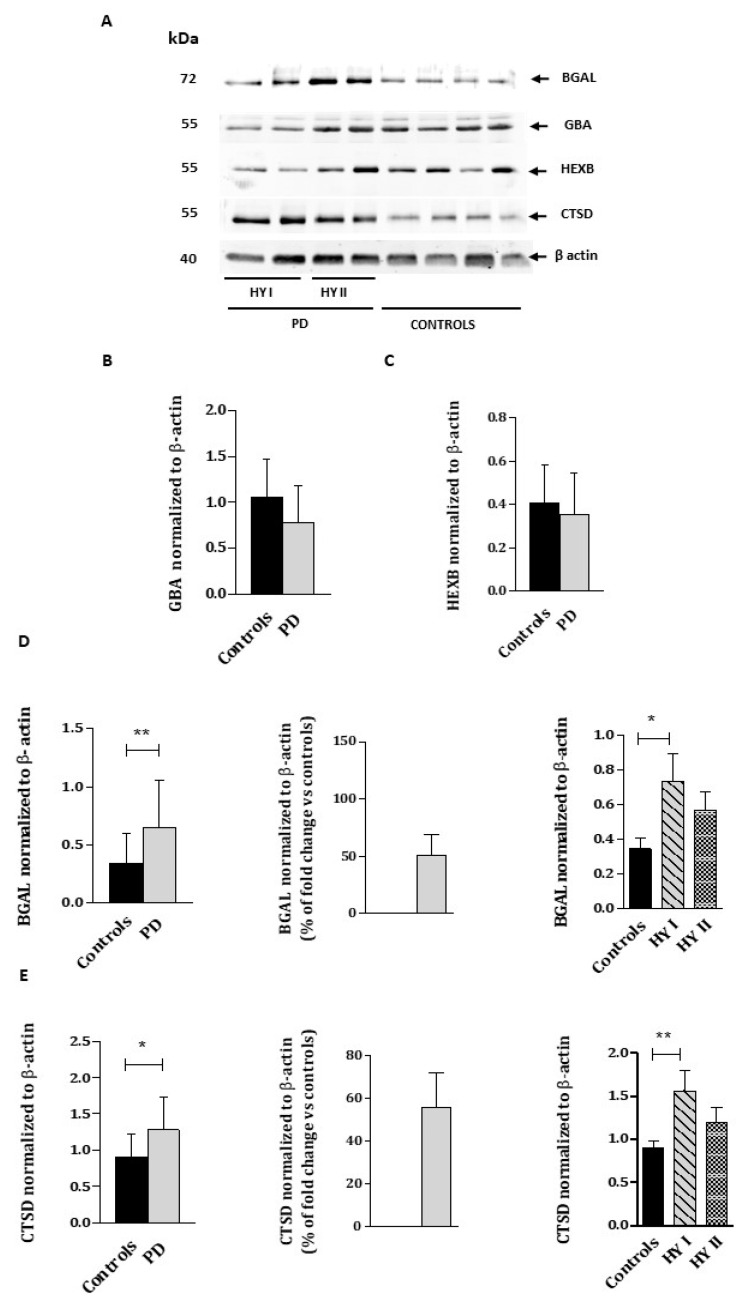
Lysosomal dysfunction has been proposed as one of the most important pathogenic molecular mechanisms in Parkinson disease (PD). The most significant evidence lies in the gene, which encodes for the lysosomal enzyme β-glucocerebrosidase (β-GCase), considered the main genetic risk factor for sporadic PD. The loss of β-GCase activity results in the formation of α-synuclein deposits. The present study was aimed to determine the activity of the main lysosomal enzymes and the cofactors Prosaposin (PSAP) and Saposin C in PD and healthy controls, and their contribution to α-synuclein (α-Syn) aggregation. 42 PD patients and 37 age-matched healthy controls were included in the study. We first analyzed the β-GCase, β-galactosidase (β-gal), β-hexosaminidase (Hex B) and Cathepsin D (CatD) activities in white blood cells. We also measured the GBA, β-GAL, β-HEX, CTSD, PSAP, Saposin C and α-Syn protein levels by Western-blot. We found a 20% reduced β-GCase and β-gal activities in PD patients compared to controls. PSAP and Saposin C protein levels were significantly lower in PD patients and correlated with increased levels of α-synuclein. CatD, in contrast, showed significantly increased activity and protein levels in PD patients compared to controls. Increased CTSD protein levels in PD patients correlated, intriguingly, with a higher concentration of α-Syn. Our findings suggest that lysosomal dysfunction in sporadic PD is due, at least in part, to an alteration in Saposin C derived from reduced PSAP levels. That would lead to a significant decrease in the β-GCase activity, resulting in the accumulation of α-syn. The accumulation of monohexosylceramides might act in favor of CTSD activation and, therefore, increase its enzymatic activity. The evaluation of lysosomal activity in the peripheral blood of patients is expected to be a promising approach to investigate pathological mechanisms and novel therapies aimed to restore the lysosomal function in sporadic PD.
溶酶体功能障碍被认为是帕金森病(PD)最重要的发病机制之一。最有力的证据在于 基因,该基因编码溶酶体酶β-葡糖苷脑苷脂酶(β-GCase),被认为是散发性 PD 的主要遗传风险因素。β-GCase 活性的丧失导致α-突触核蛋白的沉积。本研究旨在确定 PD 患者和健康对照者主要溶酶体酶及其辅因子 Prosaposin(PSAP)和 Saposin C 的活性,并探讨其对α-突触核蛋白(α-Syn)聚集的影响。本研究纳入了 42 名 PD 患者和 37 名年龄匹配的健康对照者。我们首先分析了白细胞中的β-GCase、β-半乳糖苷酶(β-gal)、β-己糖胺酶(Hex B)和组织蛋白酶 D(CatD)的活性。我们还通过 Western blot 测量了 GBA、β-GAL、β-HEX、CTSD、PSAP、Saposin C 和 α-Syn 蛋白水平。与对照组相比,PD 患者的β-GCase 和β-gal 活性降低了 20%。PD 患者的 PSAP 和 Saposin C 蛋白水平显著降低,且与 α-synuclein 水平升高相关。与对照组相比,PD 患者的 CatD 活性和蛋白水平显著升高。有趣的是,PD 患者的 CTSD 蛋白水平升高与 α-Syn 浓度升高相关。我们的研究结果表明,散发性 PD 中的溶酶体功能障碍至少部分是由于 PSAP 水平降低导致 Saposin C 来源的改变所致。这将导致β-GCase 活性显著降低,导致α-syn 的积累。单己糖神经酰胺的积累可能有利于 CTSD 的激活,从而增加其酶活性。外周血中溶酶体活性的评估有望成为一种有前途的方法,用于研究病理性机制和旨在恢复散发性 PD 中溶酶体功能的新型治疗方法。