Laboratory of Food Chemistry, Department of Chemistry, University of Ioannina, 45110 Ioannina, Greece.
Department of Food Science and Technology, School of Agricultural Sciences, University of Patras, 30100 Agrinio, Greece.
Molecules. 2022 Sep 20;27(19):6166. doi: 10.3390/molecules27196166.
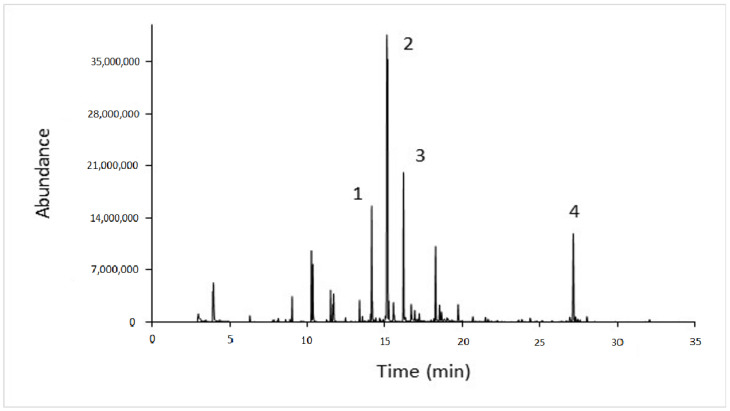
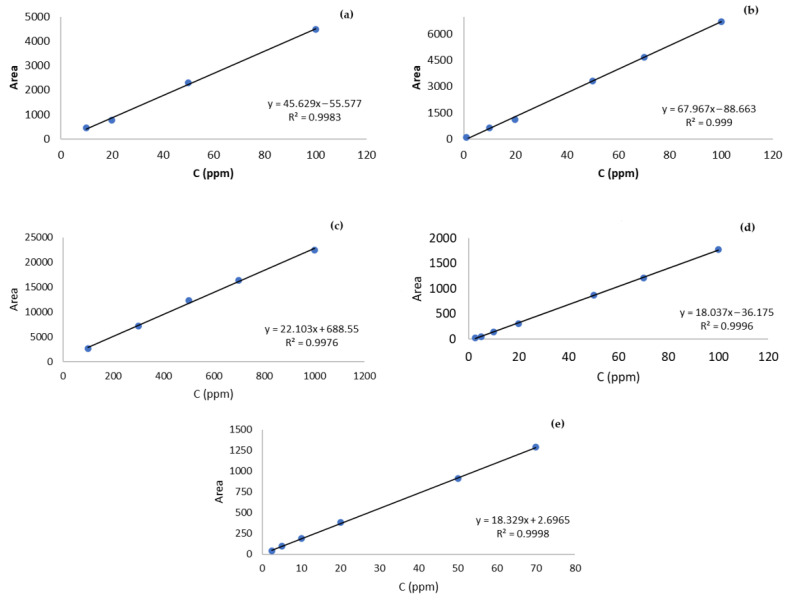
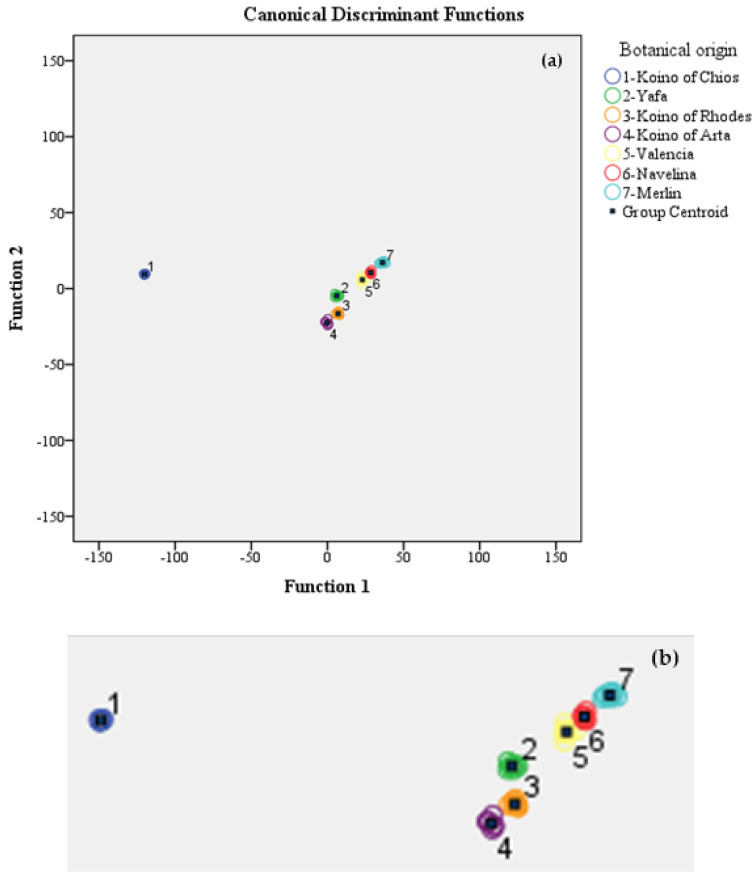
The present study focused on the possibility of differentiating fresh-unprocessed orange juice according to botanical origin (variety), based on the use of conventional physico-chemical parameters, flavonoids, and volatile compounds, in combination with chemometrics. For this purpose, oranges from seven different varieties were collected during the harvest years of 2013−2014 and 2014−2015 from central and southern Greece. The physico-chemical parameters that were determined included: electrical conductivity, acidity, pH, and total soluble solids. The flavonoids: hesperidin, neohespseridin, quercetin, naringin, and naringenin were determined using high-performance liquid chromatography (HPLC-DAD). Finally, volatile compounds were determined using headspace solid-phase micro-extraction in combination with gas chromatography-mass spectrometry (HS-SPME/GC-MS). Statistical treatment of data by multivariate techniques showed that orange juice variety had a significant (p < 0.05) impact on the above analytical parameters. The classification rate for the differentiation of orange juice according to orange variety using multivariate analysis of variance (MANOVA) and linear discriminant analysis (LDA) was 89.3%, based on the cross-validation method.
本研究旨在探讨根据植物学来源(品种)区分新鲜未加工橙汁的可能性,方法是结合使用常规理化参数、类黄酮和挥发性化合物,并结合化学计量学。为此,在 2013-2014 年和 2014-2015 年的收获季节,从希腊中部和南部收集了来自七个不同品种的橙子。测定的理化参数包括:电导率、酸度、pH 值和总可溶性固体。使用高效液相色谱法(HPLC-DAD)测定类黄酮:橙皮苷、新橙皮苷、槲皮素、柚皮苷和柚皮苷。最后,使用顶空固相微萃取结合气相色谱-质谱联用(HS-SPME/GC-MS)测定挥发性化合物。多元技术对数据的统计处理表明,橙汁品种对上述分析参数有显著影响(p < 0.05)。使用方差分析(MANOVA)和线性判别分析(LDA)的多元分析对橙汁根据橙子品种进行分类的分类率为 89.3%,基于交叉验证方法。