College of Electronic Engineering, Naval University of Engineering, Wuhan 430033, China.
Sensors (Basel). 2022 Sep 26;22(19):7280. doi: 10.3390/s22197280.
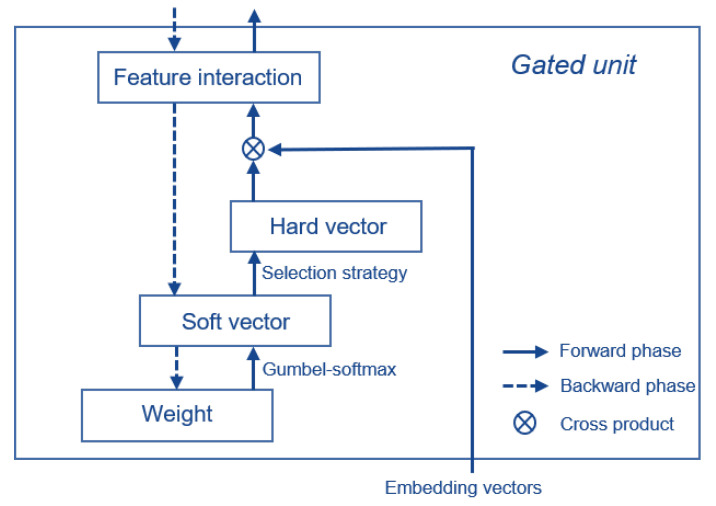
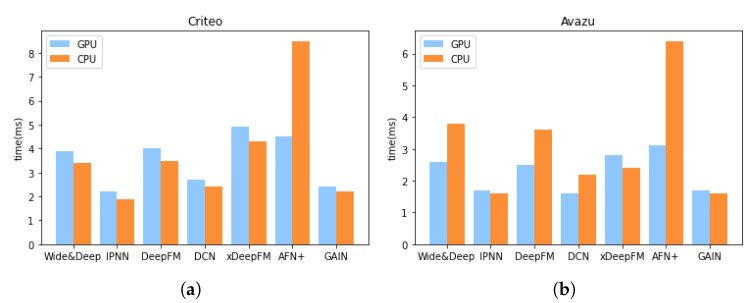
CTR (Click-Through Rate) prediction has attracted more and more attention from academia and industry for its significant contribution to revenue. In the last decade, learning feature interactions have become a mainstream research direction, and dozens of feature interaction-based models have been proposed for the CTR prediction task. The most common approach for existing models is to enumerate all possible feature interactions or to learn higher-order feature interactions by designing complex models. However, a simple enumeration will introduce meaningless and harmful interactions, and a complex model structure will bring a higher complexity. In this work, we propose a lightweight, yet effective model called the Gated Adaptive feature Interaction Network (GAIN). We devise a novel cross module to drop meaningless feature interactions and preserve informative ones. Our cross module consists of multiple gated units, each of which can independently learn an arbitrary-order feature interaction. We combine the cross module with a deep module into GAIN and conduct comparative experiments with state-of-the-art models on two public datasets to verify its validity. Our experimental results show that GAIN can achieve a comparable or even better performance compared to its competitors. Furthermore, in order to verify the effectiveness of the feature interactions learned by GAIN, we transfer learned interactions to other models, such as Logistic Regression (LR) and Factorization Machines (FM), and find out that their performance can be significantly improved.
点击率 (Click-Through Rate, CTR) 预测因其对收入的显著贡献而引起了学术界和工业界的越来越多的关注。在过去的十年中,学习特征交互已经成为主流研究方向,已经提出了数十种基于特征交互的模型来进行 CTR 预测任务。现有模型最常用的方法是枚举所有可能的特征交互,或者通过设计复杂的模型来学习更高阶的特征交互。然而,简单的枚举会引入无意义和有害的交互,而复杂的模型结构会带来更高的复杂性。在这项工作中,我们提出了一个轻量级但有效的模型,称为门控自适应特征交互网络 (Gated Adaptive feature Interaction Network, GAIN)。我们设计了一个新颖的交叉模块,用于去除无意义的特征交互并保留有意义的特征交互。我们的交叉模块由多个门控单元组成,每个门控单元都可以独立学习任意阶的特征交互。我们将交叉模块与深度模块结合起来形成 GAIN,并在两个公共数据集上与最先进的模型进行了对比实验,以验证其有效性。我们的实验结果表明,GAIN 可以实现与竞争对手相当甚至更好的性能。此外,为了验证 GAIN 学习到的特征交互的有效性,我们将学到的交互转移到其他模型,如逻辑回归 (Logistic Regression, LR) 和因子分解机 (Factorization Machines, FM),并发现它们的性能可以显著提高。