Ahn Do Yeon, Park Hee Jin, Yi Jung Woo, Kim Ji Na
Taehan Yongsang Uihakhoe Chi. 2022 Jan;83(1):102-111. doi: 10.3348/jksr.2021.0017. Epub 2021 Nov 4.
To evaluate the correlation between Lee's grades and surgical intervention for central lumbar spinal stenosis (CLSS) and to assess whether this grading system can be used as a decision-making tool for the surgical treatment of this condition.
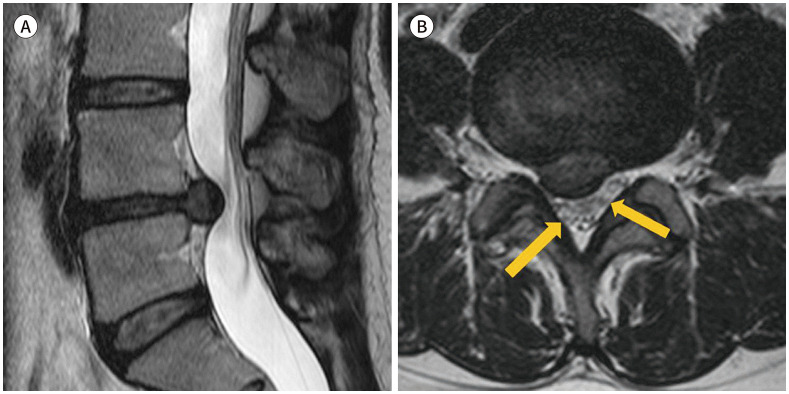
This retrospective study included 290 patients (M:F = 156:134; mean age, 46 ± 16 years). Radiologists assessed the presence and grade of CLSS at the stenosis point according to Lee's grading system, in which CLSS is classified into four grades according to the shape of the cauda equina. Correlation coefficients ( ) between Lee's grades and the operation were calculated with Spearman rank correlation.
Among the operated patients, grade 2 was the most commonly assigned grade (50%-58%), grade 3 was less common (35%), and grade 0 was the least common (2%-3%). Among the non-operated patients, grade 1 was the most common (63%-65%), grade 0 was less common (15%-16%), and grade 3 was the least common (8%). The distribution of grades differed between the operated and non-operated groups ( < 0.001). Less than 25% of patients who underwent surgery were assigned grades 0 and 1, and more than 88% were assigned grades 2 and 3. A moderate correlation was found between the grade and surgical intervention ( = 0.632 and = 0.583).
Lee's grade was moderately correlated with surgical intervention. Lee's grading system can be a decision-making tool for the surgical treatment of CLSS.
评估李氏分级与中央型腰椎管狭窄症(CLSS)手术干预之间的相关性,并评估该分级系统是否可作为这种疾病手术治疗的决策工具。
这项回顾性研究纳入了290例患者(男∶女 = 156∶134;平均年龄,46±16岁)。放射科医生根据李氏分级系统评估狭窄部位CLSS的存在情况及分级,在该分级系统中,CLSS根据马尾神经的形态分为四个等级。采用Spearman秩相关计算李氏分级与手术之间的相关系数( )。
在接受手术的患者中,2级是最常分配的等级(50%-58%),3级较不常见(35%),0级最不常见(2%-3%)。在未接受手术的患者中,1级最常见(63%-65%),0级较不常见(15%-16%),3级最不常见(8%)。手术组和非手术组的分级分布不同(<0.001)。接受手术的患者中,不到25%被分配为0级和1级,超过88%被分配为2级和3级。分级与手术干预之间存在中度相关性( = 0.632和 = 0.583)。
李氏分级与手术干预中度相关。李氏分级系统可作为CLSS手术治疗的决策工具。