Smith Kayla, Miller Nicole, Laslovich Steve
Physical Therapy, University of St. Augustine for Health Sciences.
Physical Therapy, Hawaii Pacific University.
Int J Sports Phys Ther. 2022 Oct 2;17(6):1016-1025. doi: 10.26603/001c.38252. eCollection 2022.
Stability of the knee is dependent on multiple factors including integrity of the anterior cruciate ligament (ACL). Greater knee joint laxity appears to negatively affect dynamic joint function and therefore reliable and valid measures of ACL stiffness and laxity are clinically valuable.
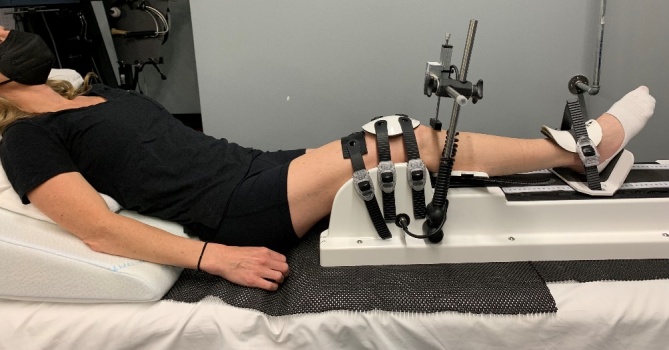
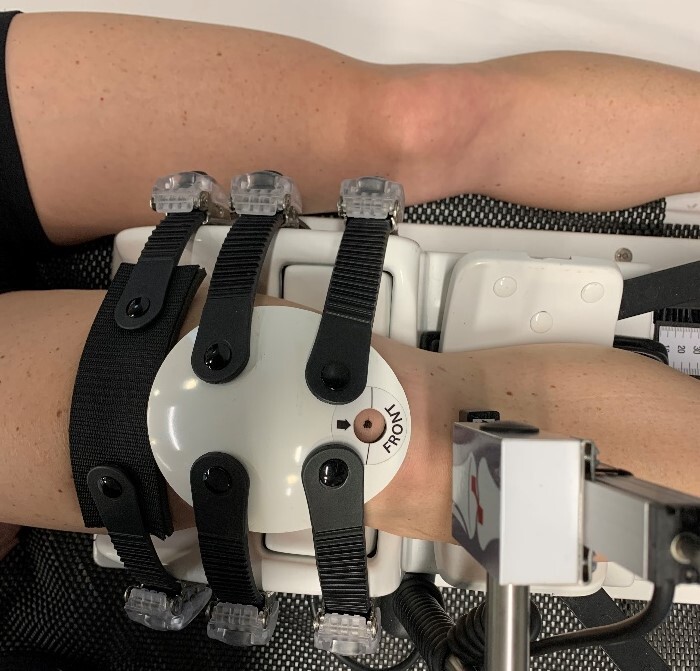
The aim of this study was to investigate the reliability of the GENOUROB, (GNRB®) knee arthrometer device in measuring both stiffness and laxity of the ACL, and to provide information on sample size calculation for future clinical trials.
Cross-sectional test-retest study.
Twelve healthy student participants (age 24-30 years; 6 females and 6 males) completed testing on two different testing dates. Anterior tibial translation and stiffness were measured using the GNRB® device at forces of 134N and 200N. Reliability analyses were performed using intraclass correlation coefficients (ICC). SEM, MDC, and sample size calculations were also determined.
Average anterior tibial displacements of 3.63mm and 5.32mm were found for 134N and 200N of force respectively. ICC values for intra-rater, inter-rater, and test-retest reliability were similar across measures of anterior tibial translation and stiffness, ranging from .72 to .83 (95% CI: .54 to .90). The standard error of measurement (SEM) for anterior tibial stiffness ranged from 3.47 mm/N to 3.76 mm/N. Minimal detectable change (MDC) for test-retest anterior tibial stiffness was 9.6 mm/N. Sample sizes for crossover and parallel design studies were determined.
ACL laxity and stiffness measures were found to be reliably obtainable using the GNRB® knee arthrometer under the strict control of the individual's alignment to the device and patellar pad forces. Reliable laxity and stiffness values may assist practitioners in clinical reasoning and the development of individualized ACL rehabilitation programs. Additionally, the sample size calculations presented may aid in future research design.
膝关节的稳定性取决于多种因素,包括前交叉韧带(ACL)的完整性。膝关节更大的松弛度似乎会对动态关节功能产生负面影响,因此,可靠且有效的ACL刚度和松弛度测量方法具有临床价值。
本研究旨在调查GENOUROB(GNRB®)膝关节测角仪在测量ACL刚度和松弛度方面的可靠性,并为未来的临床试验提供样本量计算信息。
横断面重测研究。
12名健康学生参与者(年龄24 - 30岁;6名女性和6名男性)在两个不同的测试日期完成测试。使用GNRB®设备在134N和200N的力下测量胫骨前移和刚度。使用组内相关系数(ICC)进行可靠性分析。还确定了标准误(SEM)、最小可检测变化(MDC)和样本量计算。
在134N和200N的力下,胫骨平均前移分别为3.63mm和5.32mm。在胫骨前移和刚度测量中,评分者内、评分者间和重测可靠性的ICC值相似,范围为0.72至0.83(95%CI:0.54至0.90)。胫骨前刚度的测量标准误(SEM)范围为3.47mm/N至3.76mm/N。重测胫骨前刚度的最小可检测变化(MDC)为9.6mm/N。确定了交叉设计和平行设计研究的样本量。
发现在严格控制个体与设备的对齐和髌垫力的情况下,使用GNRB®膝关节测角仪可可靠地获得ACL松弛度和刚度测量值。可靠的松弛度和刚度值可能有助于从业者进行临床推理和制定个性化的ACL康复计划。此外,给出的样本量计算可能有助于未来的研究设计。
3级。