Stehlin Florian, Mahdi-Aljedani Rima, Canton Loris, Monzambani-Banderet Véronique, Miauton Alix, Girard Cedric, Kammermann Kevin, Meylan Sylvain, Ribi Camillo, Harr Thomas, Yerly Daniel, Muller Yannick D
Division of Immunology and Allergy, University Hospital of Lausanne, Lausanne, Switzerland.
Tropical, Travel and Vaccination Clinic, Center for Primary Care and Public Health (Unisanté), Lausanne, Switzerland.
Front Allergy. 2022 May 31;3:818049. doi: 10.3389/falgy.2022.818049. eCollection 2022.
The newly developed mRNA-based COVID-19 vaccines can provoke anaphylaxis, possibly induced by polyethylene glycol (PEG) contained in the vaccine. The management of persons with a history of PEG allergy or with a suspected allergic reaction after the first dose remains to be defined.
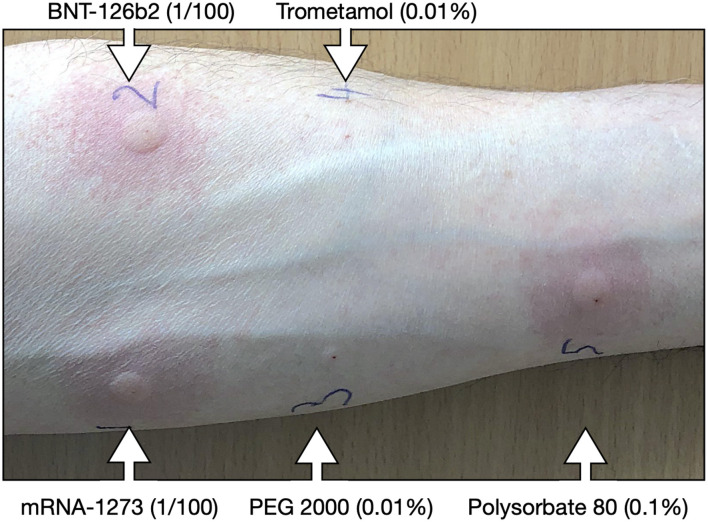
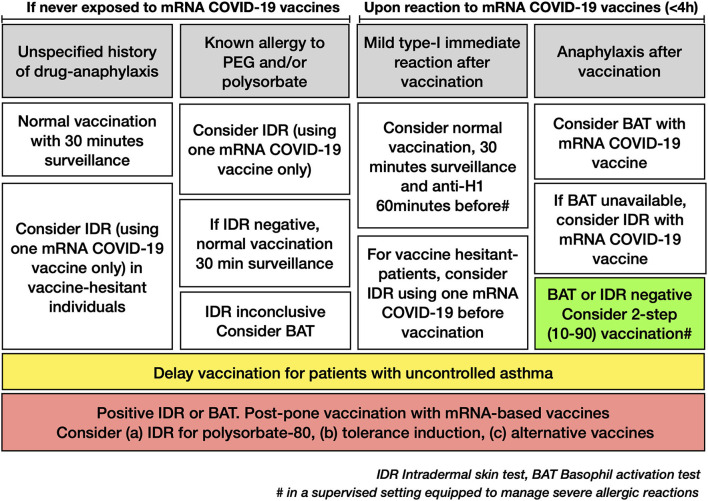
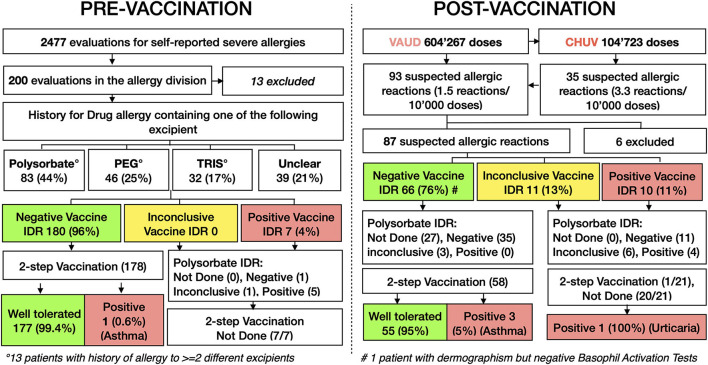
In this real-life study, we defined two cohorts of individuals: one pre-vaccination including 187 individuals with high-risk profiles for developing anaphylaxis and a second post-vaccination including 87 individuals with suspected allergic reactions after the COVID-19 mRNA vaccine. Upon negative skin test with an mRNA vaccine, a two-step (10-90%) vaccination protocol was performed. Positive skin tests were confirmed with the basophil activation test (BAT).
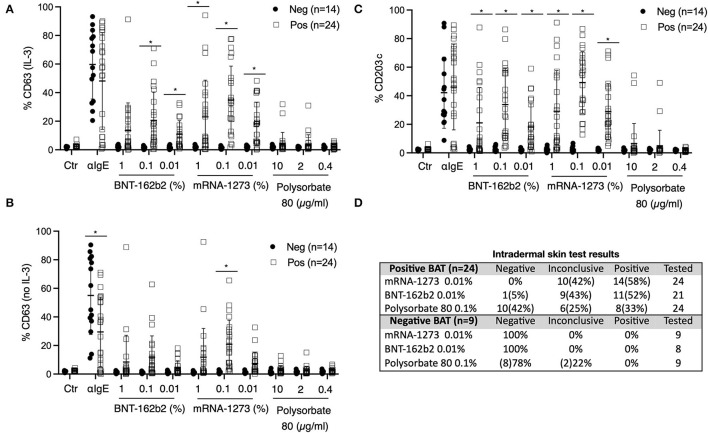
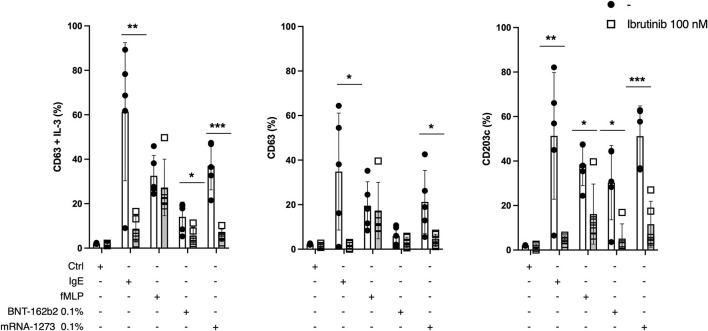
Among 604,267 doses of vaccine, 87 suspected allergic reactions (5 after the booster) were reported to our division for further investigations: 18/87 (21%) were consistent with anaphylaxis, 78/87 (90%) were female, and 47/87 (54%) received the BNT162b2 mRNA vaccine. Vaccine skin tests were negative in 96% and 76% of the pre- and post-vaccination cohorts, respectively. A two-step vaccination was tolerated in 232/236 (98%) of individuals with negative tests. Four individuals experienced isolated asthmatic reactions during the two-step challenge. Vaccine-positive skin tests were consistently confirmed by BAT; CD63 and CD203c expression was selectively inhibited with ibrutinib, suggesting an IgE-dependent mechanism.
Sensitization to SARS-CoV-2 mRNA vaccines can be detected with intradermal testing. Significantly more individuals were sensitized to mRNA vaccines in the post-vaccination cohort. A two-step 10-90%-vaccination protocol can be safely administered upon negative skin testing.
新研发的基于信使核糖核酸(mRNA)的新冠疫苗可能引发过敏反应,可能由疫苗中含有的聚乙二醇(PEG)诱发。既往有PEG过敏史或接种首剂疫苗后疑似发生过敏反应者的管理方法仍有待确定。
在这项真实世界研究中,我们定义了两组个体:一组为接种疫苗前,包括187名发生过敏反应风险较高的个体;另一组为接种疫苗后,包括87名接种新冠mRNA疫苗后疑似发生过敏反应的个体。在mRNA疫苗皮肤试验阴性后,实施两步法(10%-90%)接种方案。通过嗜碱性粒细胞活化试验(BAT)确认皮肤试验阳性。
在604267剂疫苗中,有87例疑似过敏反应(5例在加强免疫后)上报至我们科室进行进一步调查:18/87(21%)符合过敏反应,78/87(90%)为女性,47/87(54%)接种的是BNT162b2 mRNA疫苗。接种疫苗前和接种疫苗后的队列中,分别有96%和76%的个体疫苗皮肤试验为阴性。236名试验阴性的个体中有232/236(98%)耐受两步法接种。4名个体在两步法激发试验期间出现孤立性哮喘反应。疫苗皮肤试验阳性经BAT一致确认;伊布替尼可选择性抑制CD63和CD203c表达,提示存在IgE依赖机制。
通过皮内试验可检测出对严重急性呼吸综合征冠状病毒2(SARS-CoV-2)mRNA疫苗的致敏情况。接种疫苗后的队列中对mRNA疫苗致敏的个体明显更多。皮肤试验阴性时可安全实施两步法10%-90%接种方案。