Badawy Sherif M, DiMartino Lisa, Brambilla Donald, Klesges Lisa, Baumann Ana, Burns Ebony, DeMartino Terri, Jacobs Sara, Khan Hamda, Nwosu Chinonyelum, Shah Nirmish, Hankins Jane S
Division of Hematology, Oncology and Stem Cell Transplant, Ann & Robert H. Lurie Children's Hospital of Chicago, Chicago, IL, United States.
Department of Pediatrics, Northwestern University Feinberg School Medicine, Chicago, IL, United States.
JMIR Form Res. 2022 Oct 14;6(10):e41415. doi: 10.2196/41415.
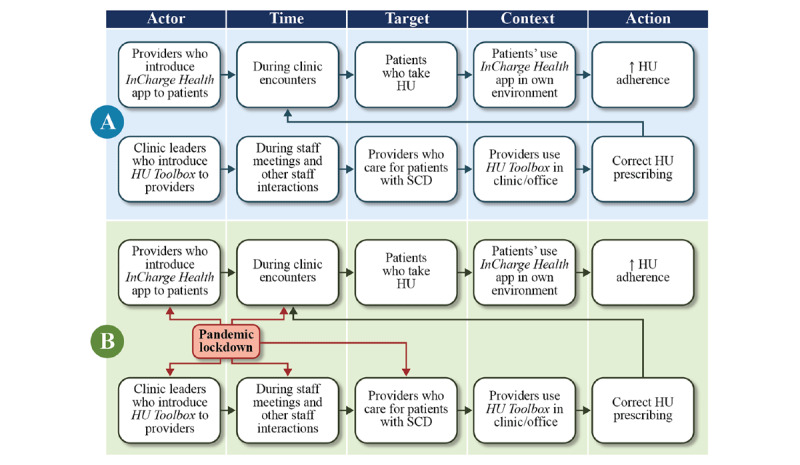
Hydroxyurea therapy is effective for reducing complications related to sickle cell disease (SCD) and is recommended by National Health Lung and Blood Institute care guidelines. However, hydroxyurea is underutilized, and adherence is suboptimal. We wanted to test a multilevel mobile health (mHealth) intervention to increase hydroxyurea adherence among patients and improve prescribing among providers in a multicenter clinical trial. In the first 2 study sites, participants were exposed to the early phases of the COVID-19 pandemic, which included disruption to their regular SCD care.
We aimed to describe the impact of the COVID-19 pandemic on the implementation of an mHealth behavioral intervention for improving hydroxyurea adherence among patients with SCD.
The first 2 sites initiated enrollment 3 months prior to the start of the pandemic (November 2019 to March 2020). During implementation, site A clinics shut down for 2 months and site B clinics shut down for 9 months. We used the reach, effectiveness, adoption, implementation, and maintenance (RE-AIM) framework to evaluate the implementation and effectiveness of the intervention. mHealth implementation was assessed based on patients' daily app use. Adherence to hydroxyurea was calculated as the proportion of days covered (PDC) from prescription records over the first 12 and 24 weeks after implementation. A linear model examined the relationship between app usage and PDC change, adjusting for baseline PDC, lockdown duration, and site. We conducted semistructured interviews with patients, health care providers, administrators, and research staff to identify factors associated with mHealth implementation and effectiveness. We used a mixed methods approach to investigate the convergence of qualitative and quantitative findings.
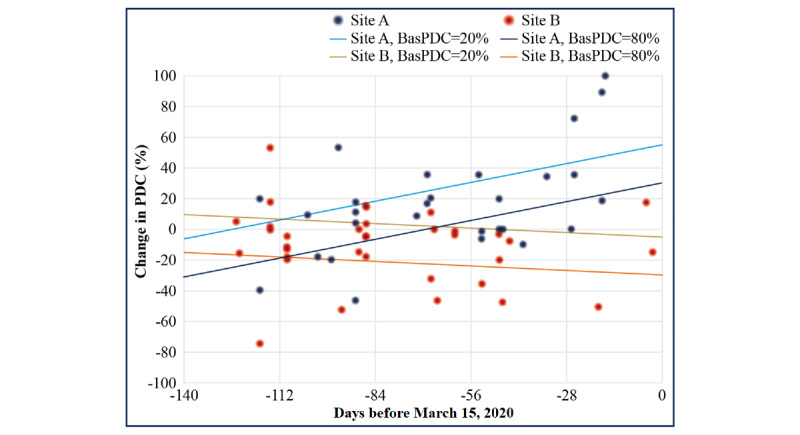
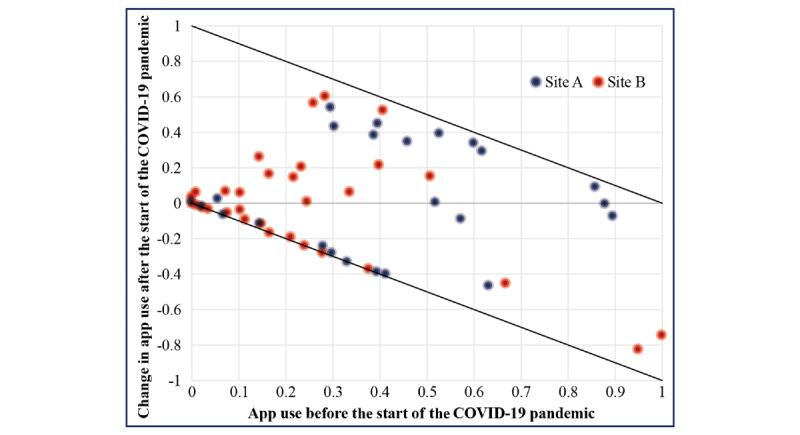
The percentage of patients accessing the app decreased after March 15, 2020 from 86% (n=55) to 70% (n=45). The overall mean PDC increase from baseline to week 12 was 4.5% (P=.32) and to week 24 was 1.5% (P=.70). The mean PDC change was greater at site A (12 weeks: 20.9%; P=.003; 24 weeks: 16.7%; P=.01) than site B (12 weeks: -8.2%; P=.14; 24 weeks: -10.3%; P=.02). After adjustment, PDC change was 13.8% greater in those with increased app use after March 15, 2020. Interview findings indicated that site B's closure during COVID-19 had a greater impact, but almost all patients reported that the InCharge Health app helped support more consistent medication use.
We found significant impacts of the early clinic lockdowns, which reduced implementation of the mHealth intervention and led to reduced patient adherence to hydroxyurea. However, disruptions were lower among participants who experienced shorter clinic lockdowns and were associated with higher hydroxyurea adherence. Investigation of added strategies to mitigate the effects of care interruptions during major emergencies (eg, patient coaching and health navigation) may "insulate" the implementation of interventions to increase medication adherence.
ClinicalTrials.gov NCT04080167; https://clinicaltrials.gov/ct2/show/NCT04080167.
INTERNATIONAL REGISTERED REPORT IDENTIFIER (IRRID): RR2-10.2196/16319.
羟基脲疗法对降低镰状细胞病(SCD)相关并发症有效,且被美国国立卫生研究院心肺血液研究所的护理指南所推荐。然而,羟基脲的使用未得到充分利用,且依从性欠佳。我们希望在一项多中心临床试验中测试一种多层次移动健康(mHealth)干预措施,以提高患者对羟基脲的依从性,并改善医护人员的处方开具情况。在前两个研究地点,参与者经历了2019冠状病毒病大流行的早期阶段,这包括其常规SCD护理的中断。
我们旨在描述2019冠状病毒病大流行对一项旨在提高SCD患者羟基脲依从性的mHealth行为干预措施实施情况的影响。
前两个地点在大流行开始前3个月(2019年11月至2020年3月)开始招募。在实施过程中,A地点的诊所关闭了2个月,B地点的诊所关闭了9个月。我们使用覆盖范围、有效性、采用情况、实施情况和维持情况(RE-AIM)框架来评估干预措施的实施情况和有效性。mHealth的实施情况根据患者每日应用程序的使用情况进行评估。羟基脲的依从性通过实施后前12周和24周处方记录中的覆盖天数比例(PDC)来计算。一个线性模型检验了应用程序使用情况与PDC变化之间的关系,并对基线PDC、封锁持续时间和地点进行了调整。我们对患者、医护人员、管理人员和研究人员进行了半结构化访谈,以确定与mHealth实施情况和有效性相关的因素。我们采用混合方法来研究定性和定量研究结果的趋同性。
2020年3月15日后,使用该应用程序的患者百分比从86%(n = 55)降至70%(n = 45)。从基线到第12周,总体平均PDC增加了4.5%(P = 0.32),到第24周增加了1.5%(P = 0.70)。A地点的平均PDC变化大于B地点(第12周:20.9%;P = 0.003;第24周:16.7%;P = 0.01)(B地点第12周:-8.2%;P = 0.14;第24周:-10.3%;P = 0.02)。调整后,2020年3月15日后应用程序使用增加的患者的PDC变化要高13.8%。访谈结果表明,B地点在2019冠状病毒病期间的关闭影响更大,但几乎所有患者都报告称InCharge Health应用程序有助于支持更持续的药物使用。
我们发现早期诊所封锁产生了重大影响,这降低了mHealth干预措施的实施,并导致患者对羟基脲的依从性降低。然而,诊所封锁时间较短的参与者受到的干扰较小,且与较高的羟基脲依从性相关。对在重大紧急情况期间减轻护理中断影响的附加策略(如患者指导和健康导航)进行调查,可能会“隔离”旨在提高药物依从性的干预措施的实施。
ClinicalTrials.gov NCT04080167;https://clinicaltrials.gov/ct2/show/NCT04080167。
国际注册报告识别码(IRRID):RR2-10.2196/16319。