
使用RE-AIM模型对移动健康应用程序进行评估:系统评价与荟萃分析
Evaluation of mobile health applications using the RE-AIM model: systematic review and meta-analysis.
作者信息
Jorge Emanuele Louise Gomes de Magalhães, Ferreira Emily de Souza, Pereira Michele Duarte, Mingote Ana Luiza Paes, Silva João Henrique Corrêa, Moreira Tiago Ricardo, Cotta Rosângela Minardi Mitre
机构信息
Department of Nutrition and Health, Federal University of Viçosa, Viçosa, Brazil.
Department of Medicine and Nursing, Federal University of Viçosa, Viçosa, Brazil.
出版信息
Front Public Health. 2025 Aug 4;13:1611789. doi: 10.3389/fpubh.2025.1611789. eCollection 2025.
BACKGROUND
The Reach, Effectiveness, Adoption, Implementation, and Maintenance (RE-AIM) model has been used as an instrument to determine the impact of the intervention on health in digital format. This study aims to evaluate, through a systematic review and meta-analysis, the dimensions of RE-AIM in interventions carried out by mobile health apps.
METHODS
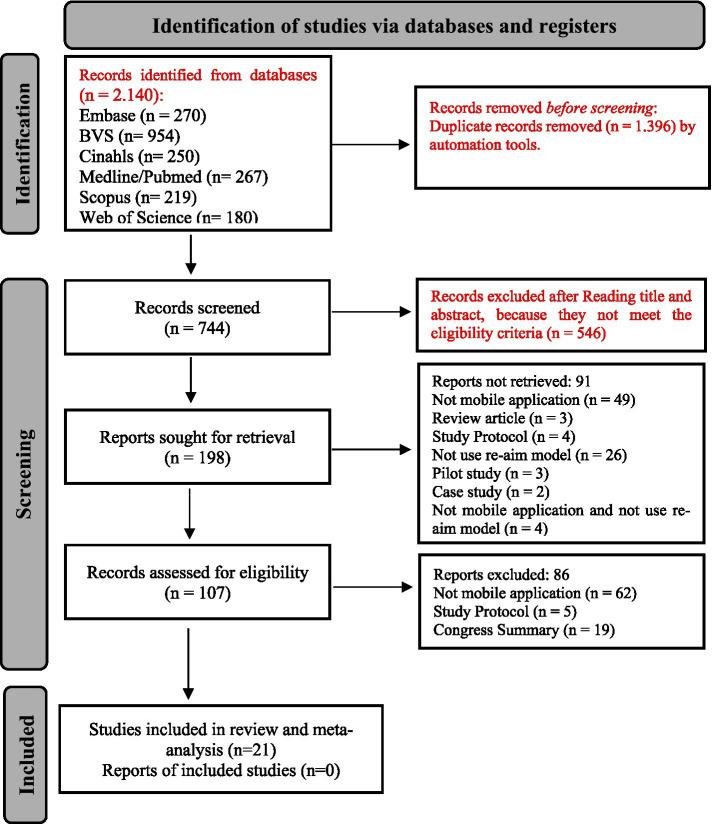
The systematic review and meta-analysis were conducted following the Preferred Reporting Items for Systematic Reviews and Meta-Analyses (PRISMA) guidelines and involved searching six databases - Medline/PubMed, Embase, CINAHL, Virtual Library in Health, and Cochrane Library. The review included randomized, cross-sectional, and cohort clinical trials assessing the prevalence of each RE-AIM dimension according to the duration of the intervention in days. The quality of the selected studies was evaluated using the Joanna Briggs Institute tool. The random effects meta-analysis method was used to explain the distribution of effects between the studies, by Stata® software (version 11.0) and publication bias was examined by visual inspection of graphs and Egger's test.
RESULTS
After analyzing the articles found in the databases, and respecting the PRISMA criteria, 21 studies were included, published between 2011 and 2023 in 11 countries. Improvements in health care and self-management were reported for various conditions. The result of the meta-analysis showed a prevalence of 67% (CI: 53-80) for the reach dimension, of 52% (CI: 32-72) for effectiveness, 70% (CI: 58-82) for adoption, 68% (CI: 57-79) for implementation and 64% (CI: 48-80) for maintenance.
CONCLUSION
The RE-AIM dimensions are useful for assessing how digital health interventions have been implemented and reported in the literature. By highlighting the strengths and areas requiring improvement, the study provides important input for the future development of mobile health applications capable of achieving better clinical and health promotion outcomes.
SYSTEMATIC REVIEW REGISTRATION
PROSPERO. International Prospective Registry of Systematic Reviews. CRD42024556886.
背景
“覆盖、效果、采用、实施和维持”(RE-AIM)模型已被用作一种工具,以确定数字形式干预措施对健康的影响。本研究旨在通过系统评价和荟萃分析,评估移动健康应用程序实施的干预措施中RE-AIM的各个维度。
方法
按照系统评价和荟萃分析的首选报告项目(PRISMA)指南进行系统评价和荟萃分析,涉及检索六个数据库——Medline/PubMed、Embase、CINAHL、健康虚拟图书馆和Cochrane图书馆。该评价纳入了根据干预天数评估每个RE-AIM维度患病率的随机、横断面和队列临床试验。使用乔安娜·布里格斯研究所工具评估所选研究的质量。采用随机效应荟萃分析方法,通过Stata®软件(版本11.0)解释各研究间效应的分布情况,并通过图形直观检查和埃格检验来检验发表偏倚。
结果
在分析数据库中找到的文章并遵循PRISMA标准后,纳入了21项研究,这些研究于2011年至2023年期间在11个国家发表。报告了各种情况下医疗保健和自我管理方面的改善。荟萃分析结果显示,覆盖维度的患病率为67%(CI:53 - 80),效果维度为52%(CI:32 - 72),采用维度为70%(CI:58 - 82),实施维度为68%(CI:57 - 79),维持维度为64%(CI:48 - 80)。
结论
RE-AIM维度有助于评估数字健康干预措施在文献中的实施和报告情况。通过突出优势和需要改进的领域,本研究为未来能够实现更好临床和健康促进结果的移动健康应用程序的开发提供了重要参考。
系统评价注册
PROSPERO。国际系统评价前瞻性注册库。CRD42024556886。



 Zotero 插件