da Silva Daniela Bernardes Borges, de Oliveira Santos Katia Corrêa, Benega Margarete Aparecida, de Paiva Terezinha Maria
Respiratory Virus Laboratory/NDR/VC, Institute Adolfo Lutz, Brazil/Nacional Influenza Centre/World Health Organization.
Vaccine X. 2022 Sep 30;12:100220. doi: 10.1016/j.jvacx.2022.100220. eCollection 2022 Dec.
Two antigenically and genetically distinct lineages of influenza B viruses (B/Victoria and B/Yamagata) have been co-circulating worldwide since 2002. Virological surveillance is essential to differentiate between both lineages with a view to the annual updating of the B component for the trivalent or quadrivalent influenza vaccine composition.
The samples analyzed in the present study were collected by influenza sentinel units located in the Southeast, Midwest, North, and Northeast regions of Brazil, part of the National Influenza Virus Surveillance Network, coordinated by the Ministry of Health of Brazil. A total of 870 influenza B positive samples by reverse transcription real - time polymerase chain reaction (RT-qPCR), collected during 2014, 2015, and 2016 influenza seasons, were submitted to the influenza B lineage genotyping panel for characterization as B/Yamagata or Victoria lineages using RT-qPCR.
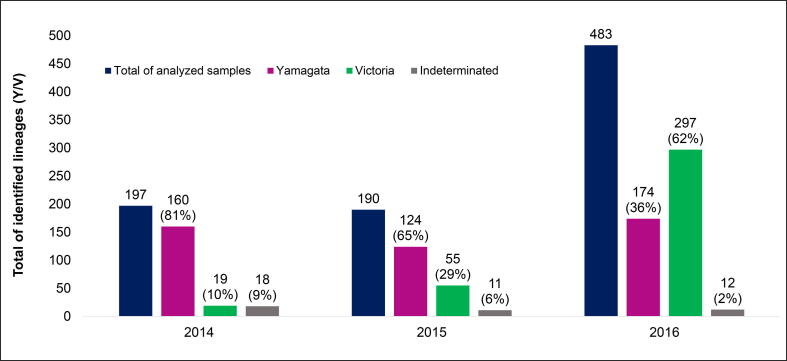
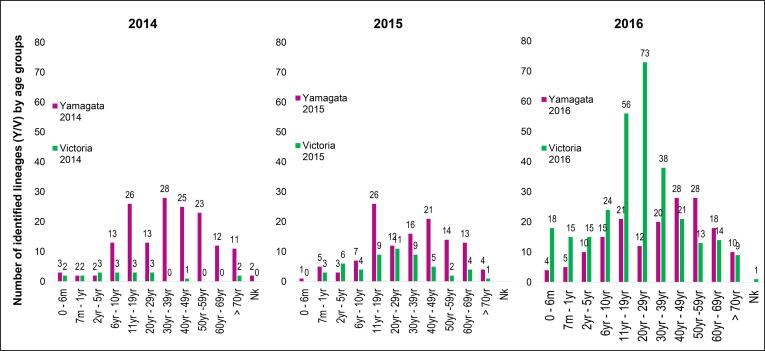
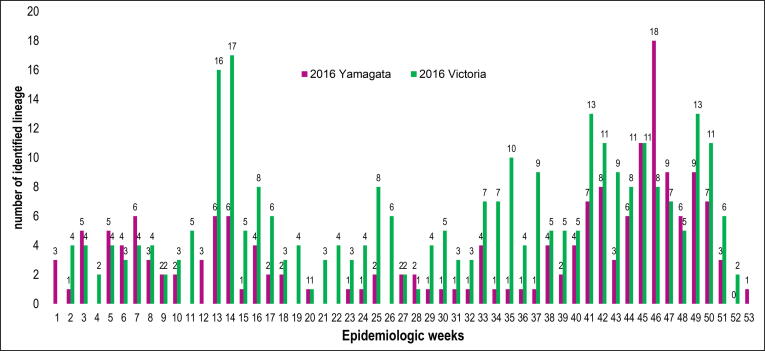
Of the 197 samples analyzed in 2014, a total of 160 (81 %) corresponded to the B/Yamagata lineage, 19 (10 %) to the B/Victoria lineage, and 18 (9 %) to indeterminate lineages. Of the 190 samples analyzed in 2015, a total of 124 (65 %) corresponded to the B/Yamagata lineage; 55 (29 %) to the B/Victoria lineage, whereas 11 (6 %) were of indeterminate lineages. Of the 483 samples analyzed in 2016, a total of 297 (62 %) corresponded to the B /Victoria lineage; 174 (36 %) to the B/Yamagata lineage and 12 (2 %) to indeterminate lineages. This cross-sectional study revealed influenza B virus (IBV) infection in all age groups, and among them, the highest prevalence was observed in individuals between 11 and 49 years of age Our findings demonstrate the match between influenza B virus lineages recommended by the World Health Organization (WHO) for the trivalent vaccine composition to be used in the Southern Hemisphere (SH) and the predominant circulating viruses during the 2014, 2015, and 2016 seasons.
自2002年以来,两种抗原性和基因性不同的乙型流感病毒谱系(B/维多利亚和B/山形)一直在全球共同流行。病毒学监测对于区分这两种谱系至关重要,以便每年更新三价或四价流感疫苗成分中的B组分。
本研究中分析的样本由位于巴西东南部、中西部、北部和东北部地区的流感哨点单位收集,这些单位是巴西国家流感病毒监测网络的一部分,由巴西卫生部协调。通过逆转录实时聚合酶链反应(RT-qPCR)检测出的870份2014年、2015年和2016年流感季节的乙型流感阳性样本,被提交至乙型流感谱系基因分型检测板,采用RT-qPCR鉴定为B/山形或维多利亚谱系。
在2014年分析的197份样本中,共有160份(81%)属于B/山形谱系,19份(10%)属于B/维多利亚谱系,18份(9%)属于不确定谱系。在2015年分析的190份样本中,共有124份(65%)属于B/山形谱系;55份(29%)属于B/维多利亚谱系,而11份(6%)为不确定谱系。在2016年分析的483份样本中,共有297份(62%)属于B/维多利亚谱系;174份(36%)属于B/山形谱系,12份(2%)属于不确定谱系。这项横断面研究揭示了所有年龄组均有乙型流感病毒(IBV)感染,其中11至49岁个体的感染率最高。我们的研究结果表明,世界卫生组织(WHO)推荐用于南半球(SH)三价疫苗成分的乙型流感病毒谱系与2014年、2015年和2016年季节主要流行的病毒相匹配。