Lotz-Havla Amelie S, Katzdobler Sabrina, Nuscher Brigitte, Weiß Katharina, Levin Johannes, Havla Joachim, Maier Esther M
Department of Pediatrics, Dr. von Hauner Children's Hospital, University Hospital, LMU Munich, Munich, Germany.
Department of Neurology, University Hospital, LMU Munich, Munich, Germany.
Front Neurol. 2022 Sep 29;13:1011470. doi: 10.3389/fneur.2022.1011470. eCollection 2022.
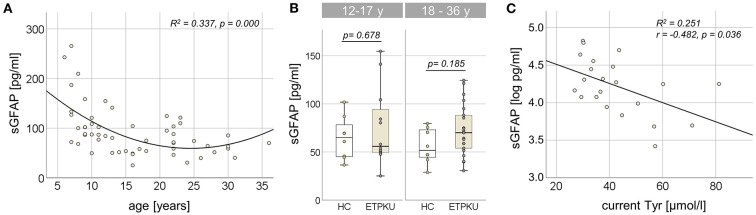
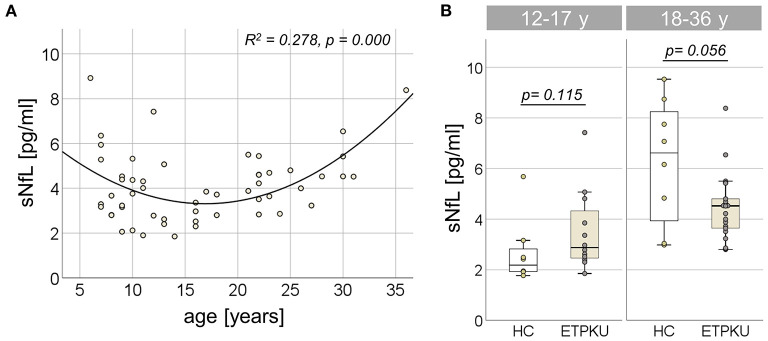
To pave the way for healthy aging in early treated phenylketonuria (ETPKU) patients, a better understanding of the neurological course in this population is needed, requiring easy accessible biomarkers to monitor neurological disease progression in large cohorts. The objective of this pilot study was to investigate the potential of glial fibrillary acidic protein (GFAP) and neurofilament light chain (NfL) as blood biomarkers to indicate changes of the central nervous system in ETPKU. In this single-center cross-sectional study, GFAP and NfL concentrations in serum were quantified using the Simoa multiplex technology in 56 ETPKU patients aged 6-36 years and 16 age matched healthy controls. Correlation analysis and hierarchical linear regression analysis were performed to investigate an association with disease-related biochemical parameters and retinal layers assessed by optical coherence tomography. ETPKU patients did not show significantly higher GFAP concentrations (mean 73 pg/ml) compared to healthy controls (mean 60 pg/ml = 0.140). However, individual pediatric and adult ETPKU patients had GFAP concentrations above the healthy control range. In addition, there was a significant association of GFAP concentrations with current plasma tyrosine concentrations (r = -0.482, = 0.036), a biochemical marker in phenylketonuria, and the retinal inner nuclear layer volume (r = 0.451, = 0.04). There was no evidence of NfL alterations in our ETPKU cohort. These pilot results encourage multicenter longitudinal studies to further investigate serum GFAP as a complementary tool to better understand and monitor neurological disease progression in ETPKU. Follow-up investigations on aging ETPKU patients are required to elucidate the potential of serum NfL as biomarker.
为了给早治疗苯丙酮尿症(ETPKU)患者的健康老龄化铺平道路,需要更好地了解这一人群的神经学病程,这就要求有易于获取的生物标志物来监测大样本人群中神经疾病的进展。这项初步研究的目的是调查胶质纤维酸性蛋白(GFAP)和神经丝轻链(NfL)作为血液生物标志物来指示ETPKU患者中枢神经系统变化的潜力。在这项单中心横断面研究中,使用Simoa多重技术对56名6至36岁的ETPKU患者和16名年龄匹配的健康对照者的血清中GFAP和NfL浓度进行了定量。进行了相关性分析和分层线性回归分析,以研究与通过光学相干断层扫描评估的疾病相关生化参数和视网膜层之间的关联。与健康对照者(平均60 pg/ml,P = 0.140)相比,ETPKU患者的GFAP浓度并未显著更高(平均73 pg/ml)。然而,个别儿科和成人ETPKU患者的GFAP浓度高于健康对照范围。此外,GFAP浓度与当前血浆酪氨酸浓度(r = -0.482,P = 0.036)显著相关,酪氨酸是苯丙酮尿症中的一种生化标志物,并且与视网膜内核层体积(r = 0.451,P = 0.04)也显著相关。在我们的ETPKU队列中没有NfL改变的证据。这些初步结果鼓励进行多中心纵向研究,以进一步研究血清GFAP作为一种补充工具,以便更好地理解和监测ETPKU患者的神经疾病进展。需要对老年ETPKU患者进行随访调查,以阐明血清NfL作为生物标志物的潜力。