
复发性腰椎间盘突出症手术是值得还是徒劳?一项基于患者报告结局的单中心观察性研究。
Is surgery for recurrent lumbar disc herniation worthwhile or futile? A single center observational study with patient reported outcomes.
作者信息
Lønne Vetle Vangen, Madsbu Mattis A, Salvesen Øyvind, Nygaard Øystein, Solberg Tore K, Gulati Sasha
机构信息
Department of Neurosurgery, St. Olavs University Hospital, Trondheim, Norway.
Department of Neuroscience, Norwegian University of Science and Technology (NTNU), Trondheim, Norway.
出版信息
Brain Spine. 2022 May 11;2:100894. doi: 10.1016/j.bas.2022.100894. eCollection 2022.
OBJECTIVE
To examine outcomes and complications following microdiscectomy for recurrent lumbar disc herniation.
METHODS
Prospectively collected data for patients operated at the Department of Neurosurgery, St. Olavs University Hospital, Norway, were obtained from the Norwegian Registry for Spine Surgery from May 2007 through July 2016. All patients underwent lumbar microdiscectomy. The primary outcome was change in the Oswestry Disability Index (ODI) at one year. Secondary endpoints were change in quality of life measured with EuroQol 5 Dimensions (EQ-5D), back and leg pain measured with numerical rating scales (NRS), complications, and duration of surgery and hospital stays.
RESULTS
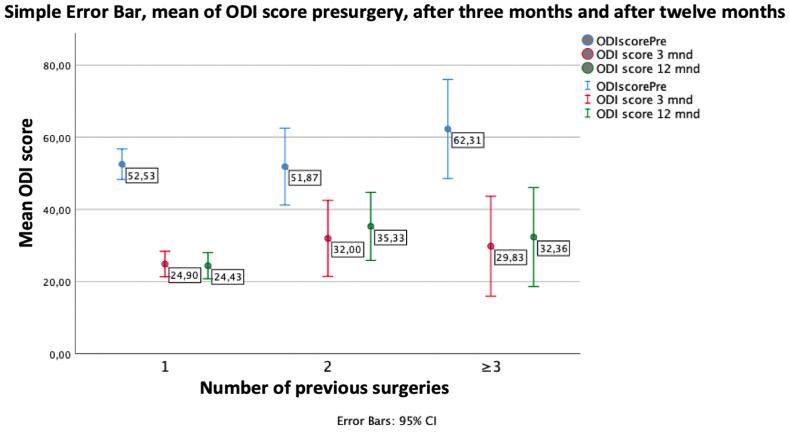
276 patients were enrolled in the study. A total of 161 patients (58.3%) completed one-year follow-up. The mean improvement in ODI at one year was 27.1 points (95% CI 23.1 to 31.0, P <0.001). The mean improvement in EQ-5D at one year of 0.47 points (95% CI 0.40-0.54, P <0.001), representing a large effect size (Cohens D = 1.3). The mean improvement in back pain and leg pain NRS were 4.3 points (95% CI 2.2-3.2, P <0.001) and 3.8 points (95% CI 2.8-3.9, P <0.001), respectively. Nine patients (3.3%) experienced intraoperative complications, and 15 (5.5%) out of 160 patients reported complications within three months following hospital discharge.
CONCLUSIONS
This study shows that patients operated for recurrent lumbar disc herniation in general report significant clinical improvement.
目的
探讨复发性腰椎间盘突出症行显微椎间盘切除术的疗效及并发症。
方法
前瞻性收集2007年5月至2016年7月在挪威圣奥拉夫大学医院神经外科接受手术的患者数据,这些数据来自挪威脊柱外科登记处。所有患者均接受了腰椎显微椎间盘切除术。主要结局指标为术后1年时Oswestry功能障碍指数(ODI)的变化。次要终点指标包括用欧洲五维健康量表(EQ-5D)测量的生活质量变化、用数字评分量表(NRS)测量的腰腿痛、并发症以及手术时间和住院时间。
结果
276例患者纳入本研究。共有161例患者(58.3%)完成了1年随访。术后1年ODI平均改善27.1分(95%可信区间23.1至31.0,P<0.001)。术后1年EQ-5D平均改善0.47分(95%可信区间0.40 - 0.54,P<0.001),代表着较大的效应量(科恩D值 = 1.3)。腰背痛和腿痛NRS平均改善分别为4.3分(95%可信区间2.2 - 3.2,P<0.001)和3.8分(95%可信区间2.8 - 3.9,P<0.001)。9例患者(3.3%)发生术中并发症,160例患者中有15例(5.5%)在出院后3个月内报告有并发症。
结论
本研究表明,接受复发性腰椎间盘突出症手术的患者总体上临床症状有显著改善。

 Zotero 插件