Baranowski Marek R, Wu Jiaqian, Han Ye Na, Lambert Lester J, Cosford Nicholas D P, Tautz Lutz
NCI-Designated Cancer Center, Sanford Burnham Prebys Medical Discovery Institute, 10901 N Torrey Pines Rd, La Jolla, CA 92037, USA.
Division of Biophysics, Institute of Experimental Physics, Faculty of Physics, University of Warsaw, Ludwika Pasteura 5, 02-093 Warsaw, Poland.
Bio Protoc. 2022 Sep 20;12(18). doi: 10.21769/BioProtoc.4510.
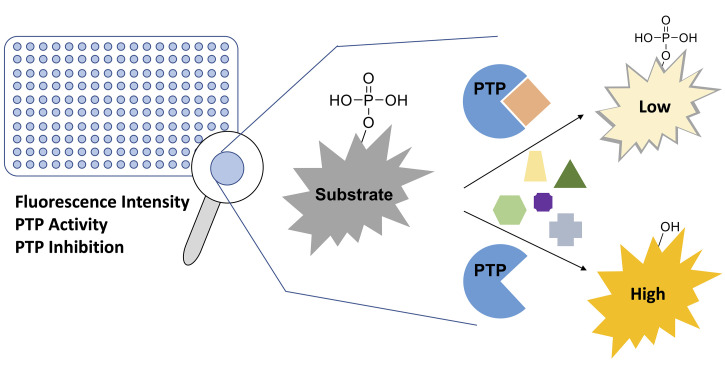
Disturbance of the dynamic balance between protein tyrosine phosphorylation and dephosphorylation, modulated by protein tyrosine kinases (PTKs) and protein tyrosine phosphatases (PTPs), is known to be crucial for the development of many human diseases. The discovery of agents that restore this balance has been the subject of many drug research efforts, most of which have focused on tyrosine kinase inhibitors (TKIs), resulting in the development of more than 50 FDA-approved TKIs during the past two decades. More recently, accumulating evidence has suggested that members of the PTP superfamily are also promising drug targets, and efforts to discover tyrosine phosphatase inhibitors (TPIs) have increased dramatically. Here, we provide protocols for determining the potency of TPIs in vitro. We focus on the use of fluorescence-based substrates, which exhibit a dramatic increase in fluorescence emission when dephosphorylated by the PTP, and thus allow setting up highly sensitive and miniaturized phosphatase activity assays using 384-well or 1536-well microplates and a continuous (kinetic) assay format. The protocols cover PTP specific activity assays, Michaelis-Menten kinetics, dose-response inhibition assays, and dose-response data analysis for determining IC values. Potential pitfalls are also discussed. While advanced instrumentation is utilized for compound spotting and liquid dispensing, all the assays can be adapted to existing equipment in most laboratories. Assays are described for selected PTP drug targets, including SHP2 ( ), PTP1B ( ), STEP ( ), and VHR ( ). However, all protocols are applicable to members of the PTP enzyme family in general. Graphical abstract.
蛋白质酪氨酸磷酸化和去磷酸化之间的动态平衡受蛋白质酪氨酸激酶(PTK)和蛋白质酪氨酸磷酸酶(PTP)调节,这种平衡的紊乱已知对许多人类疾病的发展至关重要。恢复这种平衡的药物的发现一直是许多药物研究工作的主题,其中大部分都集中在酪氨酸激酶抑制剂(TKI)上,在过去二十年中导致了50多种获得美国食品药品监督管理局(FDA)批准的TKI的研发。最近,越来越多的证据表明PTP超家族成员也是有前景的药物靶点,发现酪氨酸磷酸酶抑制剂(TPI)的努力急剧增加。在这里,我们提供了在体外测定TPI效力的方案。我们专注于使用基于荧光的底物,当被PTP去磷酸化时,其荧光发射会显著增加,因此可以使用384孔或1536孔微孔板和连续(动力学)测定形式建立高度灵敏且小型化的磷酸酶活性测定。这些方案涵盖PTP比活性测定、米氏动力学、剂量反应抑制测定以及用于确定IC值的剂量反应数据分析。还讨论了潜在的陷阱。虽然先进的仪器用于化合物点样和液体分配,但所有测定都可以适用于大多数实验室现有的设备。针对选定的PTP药物靶点描述了测定方法,包括SHP-2( )、PTP1B( )、STEP( )和VHR( )。然而,所有方案一般都适用于PTP酶家族成员。图形摘要。