
孟德尔随机化研究将腹部肥胖确定为肝脏脂肪堆积和心血管代谢疾病的一个独立因果因素。
Mendelian randomization prioritizes abdominal adiposity as an independent causal factor for liver fat accumulation and cardiometabolic diseases.
作者信息
Gagnon Eloi, Pelletier William, Gobeil Émilie, Bourgault Jérôme, Manikpurage Hasanga D, Maltais-Payette Ina, Abner Erik, Taba Nele, Esko Tõnu, Mitchell Patricia L, Ghodsian Nooshin, Després Jean-Pierre, Vohl Marie-Claude, Tchernof André, Thériault Sébastien, Arsenault Benoit J
机构信息
Centre de recherche de l'Institut universitaire de cardiologie et de pneumologie de Québec, Québec, QC Canada.
School of Nutrition, Université Laval, Québec, QC Canada.
出版信息
Commun Med (Lond). 2022 Oct 13;2:130. doi: 10.1038/s43856-022-00196-3. eCollection 2022.
BACKGROUND
Observational studies have linked adiposity and especially abdominal adiposity to liver fat accumulation and non-alcoholic fatty liver disease. These traits are also associated with type 2 diabetes and coronary artery disease but the causal factor(s) underlying these associations remain unexplored.
METHODS
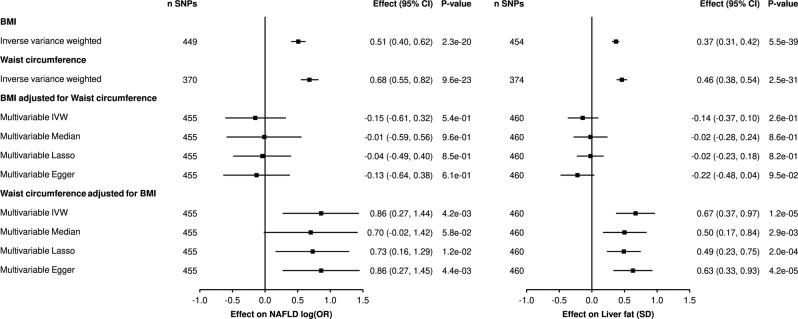
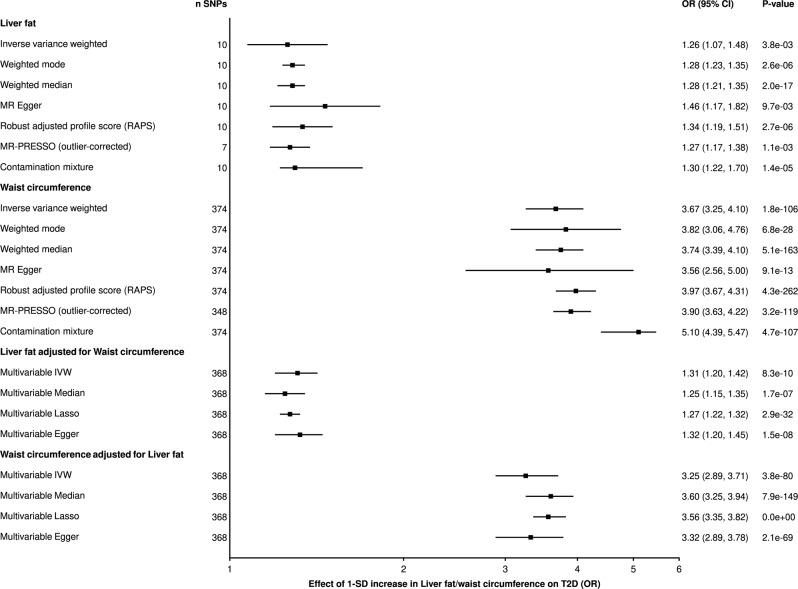
We used a multivariable Mendelian randomization study design to determine whether body mass index and waist circumference were causally associated with non-alcoholic fatty liver disease using publicly available genome-wide association study summary statistics of the UK Biobank ( = 461,460) and of non-alcoholic fatty liver disease (8434 cases and 770,180 control). A multivariable Mendelian randomization study design was also used to determine the respective causal contributions of waist circumference and liver fat ( = 32,858) to type 2 diabetes and coronary artery disease.
RESULTS
Using multivariable Mendelian randomization we show that waist circumference increase non-alcoholic fatty liver disease risk even when accounting for body mass index (odd ratio per 1-standard deviation increase = 2.35 95% CI = 1.31-4.22, = 4.2e-03), but body mass index does not increase non-alcoholic fatty liver disease risk when accounting for waist circumference (0.86 95% CI = 0.54-1.38, = 5.4e-01). In multivariable Mendelian randomization analyses accounting for liver fat, waist circumference remains strongly associated with both type 2 diabetes (3.27 95% CI = 2.89-3.69, = 3.8e-80) and coronary artery disease (1.66 95% CI = 1.54-1.8, = 3.4e-37).
CONCLUSIONS
These results identify waist circumference as a strong, independent, and causal contributor to non-alcoholic fatty liver disease, type 2 diabetes and coronary artery disease, thereby highlighting the importance of assessing body fat distribution for the prediction and prevention of cardiometabolic diseases.
背景
观察性研究已将肥胖尤其是腹部肥胖与肝脏脂肪堆积及非酒精性脂肪性肝病联系起来。这些特征也与2型糖尿病和冠状动脉疾病相关,但这些关联背后的因果因素仍未得到探索。
方法
我们采用多变量孟德尔随机化研究设计,利用英国生物银行公开的全基因组关联研究汇总统计数据(n = 461,460)以及非酒精性脂肪性肝病的数据(8434例病例和770,180例对照),来确定体重指数和腰围是否与非酒精性脂肪性肝病存在因果关联。还使用多变量孟德尔随机化研究设计来确定腰围和肝脏脂肪(n = 32,858)对2型糖尿病和冠状动脉疾病各自的因果贡献。
结果
使用多变量孟德尔随机化,我们发现即使考虑体重指数,腰围增加也会增加非酒精性脂肪性肝病风险(每增加1个标准差的优势比 = 2.35,95%置信区间 = 1.31 - 4.22,P = 4.2e - 03),但考虑腰围时体重指数不会增加非酒精性脂肪性肝病风险(0.86,95%置信区间 = 0.54 - 1.38,P = 5.4e - 01)。在考虑肝脏脂肪的多变量孟德尔随机化分析中,腰围仍与2型糖尿病(3.27,95%置信区间 = 2.89 - 3.69,P = 3.8e - 80)和冠状动脉疾病(1.66,95%置信区间 = 1.54 - 1.8,P = 3.4e - 37)密切相关。
结论
这些结果表明腰围是导致非酒精性脂肪性肝病、2型糖尿病和冠状动脉疾病的一个强大、独立的因果因素,从而凸显了评估身体脂肪分布对预测和预防心脏代谢疾病的重要性。



 Zotero 插件