Section of Hematology/Oncology, Department of Medicine, Baylor College of Medicine, Houston, TX 77030.
Cancer and Cell Biology Graduate Program, Baylor College of Medicine, Houston, TX 77030.
Proc Natl Acad Sci U S A. 2022 Oct 25;119(43):e2209211119. doi: 10.1073/pnas.2209211119. Epub 2022 Oct 17.
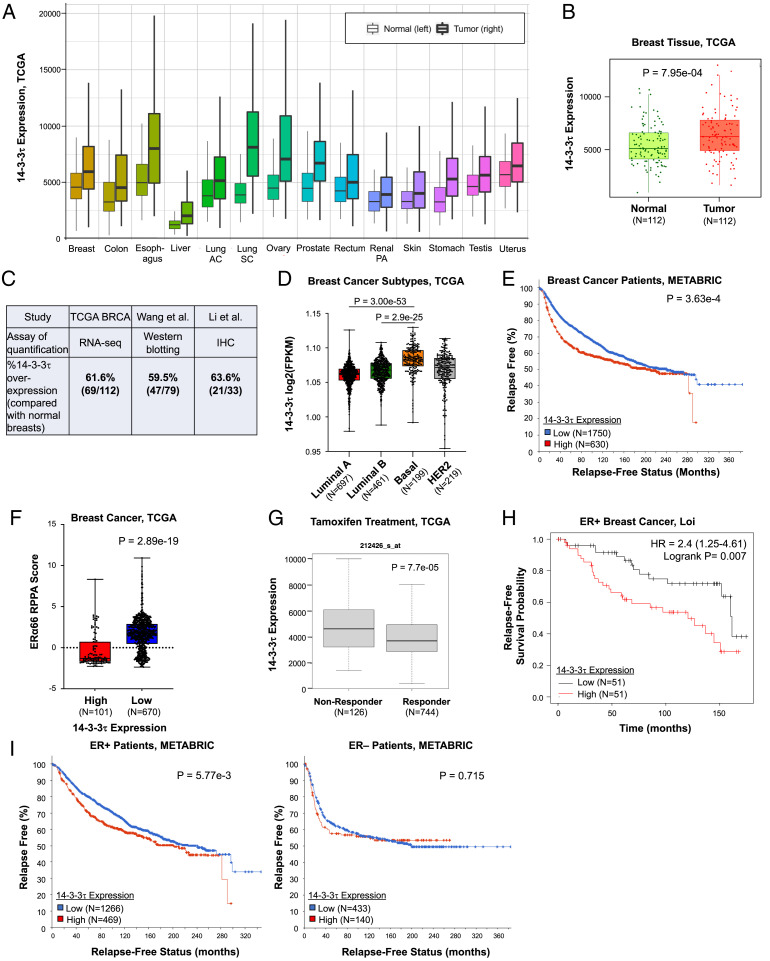
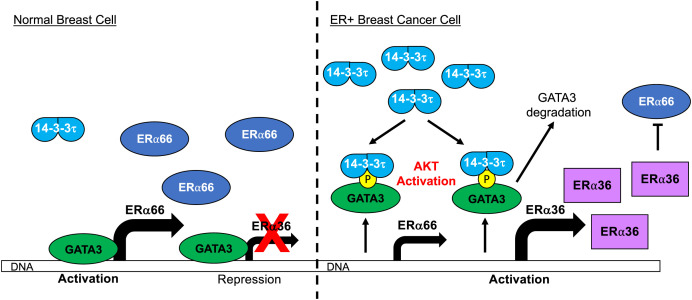
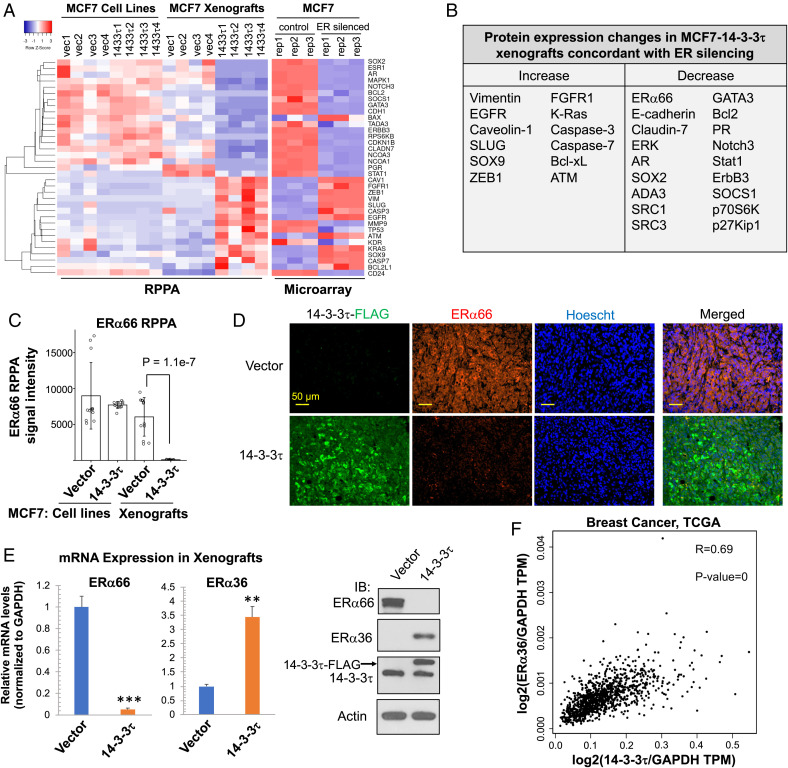
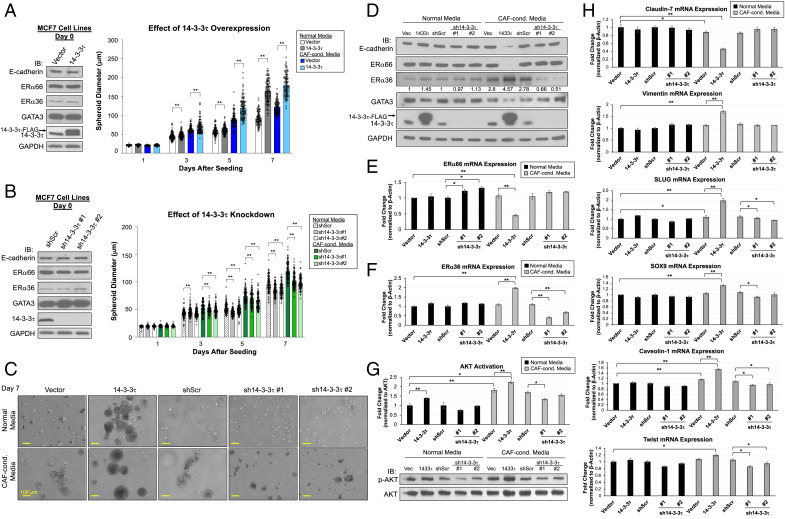
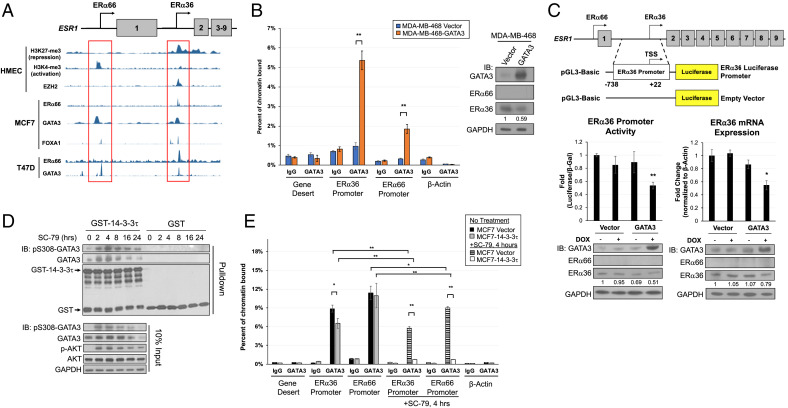
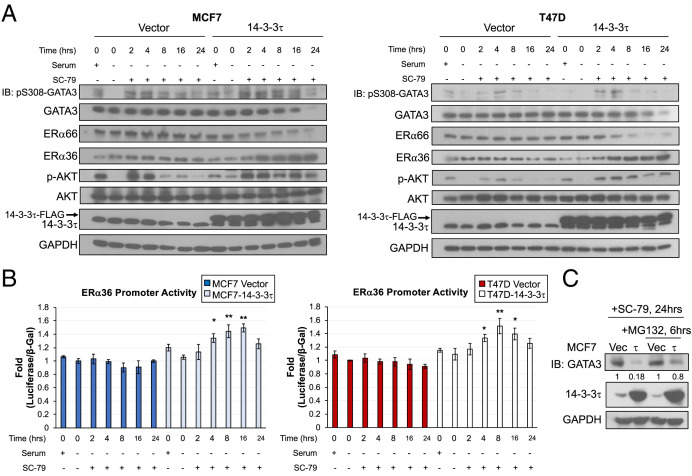
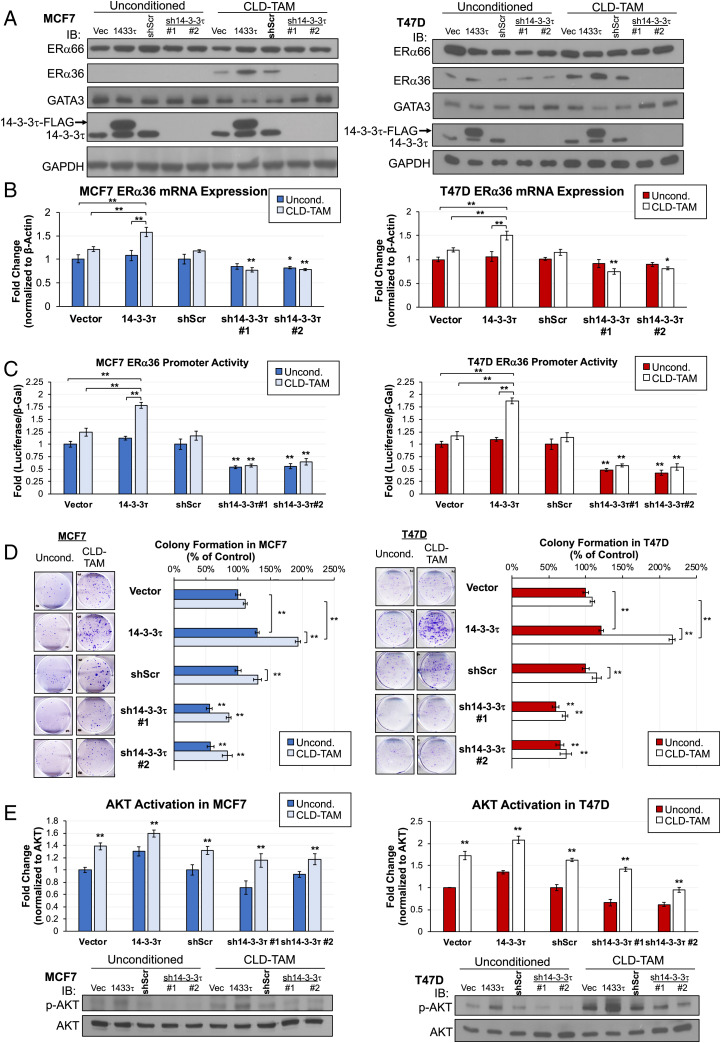
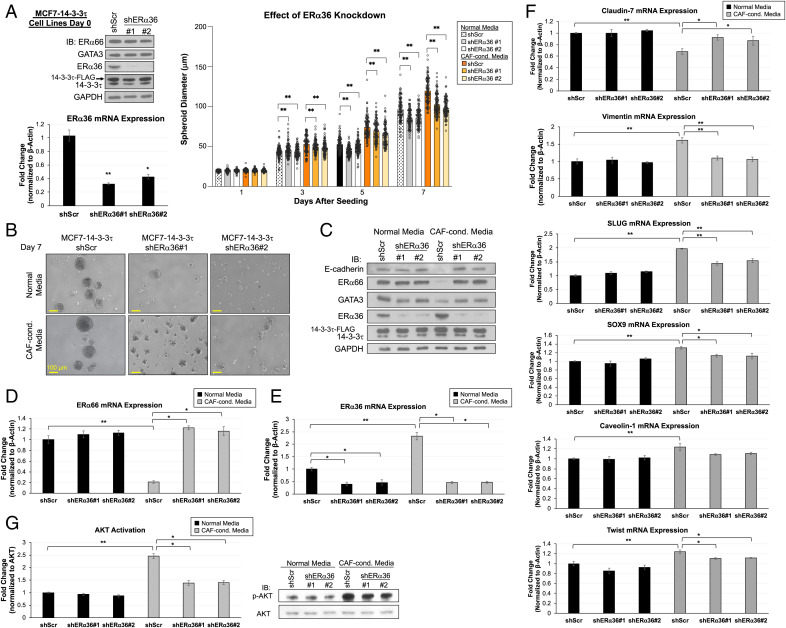
About one-fourth of recurrent estrogen receptor-positive (ER+) breast cancers lose ER expression, leading to endocrine therapy failure. However, the mechanisms underlying ER loss remain to be fully explored. We now show that 14-3-3τ, up-regulated in ∼60% of breast cancer, drives the conversion of ER+ to ER- and epithelial-to-mesenchymal transition (EMT). We identify ERα36, an isoform of ERα66, as a downstream effector of 14-3-3τ. Overexpression of 14-3-3τ induces ERα36 in xenografts and tumor spheroids. The regulation is further supported by a positive correlation between ERα36 and 14-3-3τ expression in human breast cancers. ERα36 can antagonize ERα66 and inhibit ERα66 expression. Isoform-specific depletion of ERα36 blocks the ER conversion and EMT induced by 14-3-3τ overexpression in tumor spheroids, thus establishing ERα36 as a key mediator in 14-3-3τ-driven ER loss and EMT. ERα36 promoter is repressed by GATA3, which can be phosphorylated by AKT at consensus binding sites for 14-3-3. Upon AKT activation, 14-3-3τ binds phosphorylated GATA3 and facilitates the degradation of GATA3 causing GATA3 to lose transcriptional control over its target genes ERα66 and ERα36. We also demonstrate a role for the collaboration between 14-3-3τ and AKT in ERα36 induction and endocrine therapy resistance by three-dimensional spheroid and tamoxifen treatment models in MCF7 and T47D ER+ breast cancer cells. Thus, the 14-3-3τ-ERα36 regulation provides a previously unrecognized mechanism for ER loss and endocrine therapy failure.
约四分之一的复发性雌激素受体阳性(ER+)乳腺癌失去 ER 表达,导致内分泌治疗失败。然而,ER 丢失的机制仍有待充分探索。我们现在表明,在大约 60%的乳腺癌中上调的 14-3-3τ 驱动 ER+向 ER-和上皮-间充质转化(EMT)的转化。我们确定 ERα36,一种 ERα66 的同工型,是 14-3-3τ 的下游效应物。14-3-3τ 的过表达在异种移植物和肿瘤球体中诱导 ERα36。这种调节进一步得到了人类乳腺癌中 ERα36 和 14-3-3τ 表达之间的正相关关系的支持。ERα36 可以拮抗 ERα66 并抑制 ERα66 的表达。在肿瘤球体中特异性耗尽 ERα36 可阻止 14-3-3τ 过表达诱导的 ER 转换和 EMT,从而确立 ERα36 是 14-3-3τ 驱动的 ER 丢失和 EMT 的关键介质。ERα36 启动子受 GATA3 抑制,AKT 可以在 14-3-3 的共识结合位点上磷酸化 GATA3。在 AKT 激活后,14-3-3τ 结合磷酸化的 GATA3 并促进 GATA3 的降解,导致 GATA3 失去对其靶基因 ERα66 和 ERα36 的转录控制。我们还通过 MCF7 和 T47D ER+乳腺癌细胞的三维球体和他莫昔芬治疗模型证明了 14-3-3τ 和 AKT 之间的协作在 ERα36 诱导和内分泌治疗耐药中的作用。因此,14-3-3τ-ERα36 调节提供了一种以前未被认识的 ER 丢失和内分泌治疗失败的机制。