Jolman Devani, Batalla Martín I, Hungerford Alexis, Norwood Pryce, Tait Noah, Wallace Lisa E
Department of Biological Sciences Old Dominion University Norfolk Virginia 23529 USA.
Appl Plant Sci. 2022 Oct 11;10(5):e11496. doi: 10.1002/aps3.11496. eCollection 2022 Sep-Oct.
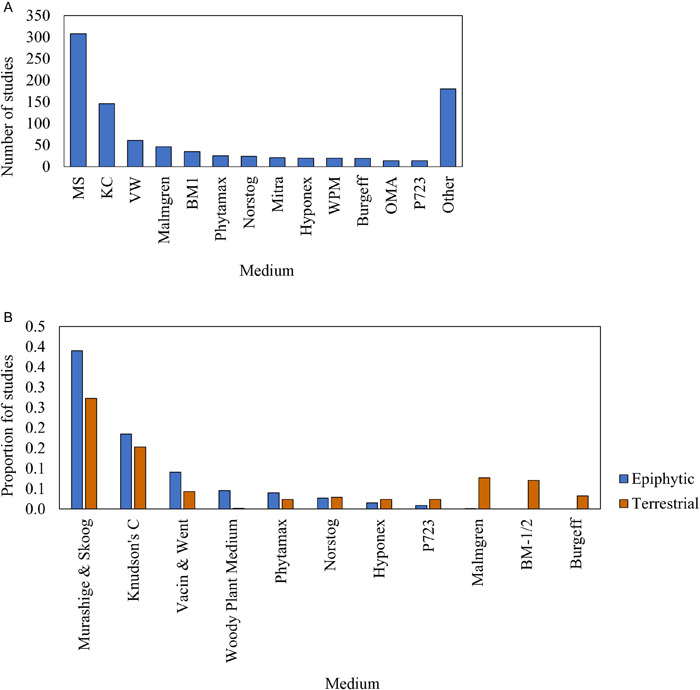
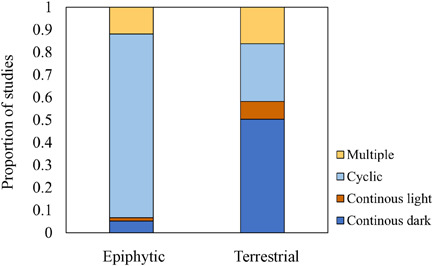
Lewis Knudson first successfully germinated orchid seeds asymbiotically on artificial medium in 1922. While many orchid species have since been grown asymbiotically, the tremendous variation in how species respond to artificial medium and growth conditions ex situ has also become apparent in the past century. In this study, we reviewed published journal articles on asymbiotic orchid seed germination to provide a summary of techniques used and to evaluate if these differ between terrestrial and epiphytic species, to identify areas where additional research is needed, and to evaluate whether asymbiotic germination could be used more often in ex situ conservation. We found articles reporting successful asymbiotic germination of 270 species and 20 cultivars across Orchidaceae. Researchers often used different techniques with epiphytic versus terrestrial species, but species-specific responses to growth media and conditions were common, indicating that individualized protocols will be necessary for most species. The widespread success in generating seedlings on artificial media suggests that asymbiotic techniques should be another tool for the conservation of rare orchid species. Further advances are needed in understanding how to introduce mycorrhizae to axenically grown orchids and to maximize the viability of seedlings reintroduced into natural habitats to fully utilize these methods for conservation.
1922年,刘易斯·克努森首次在人工培养基上成功地使兰花种子非共生萌发。自那时以来,虽然许多兰花物种已实现非共生培育,但在过去的一个世纪里,物种对人工培养基和异地生长条件的反应存在巨大差异这一点也变得很明显。在本研究中,我们查阅了已发表的关于兰花种子非共生萌发的期刊文章,以总结所使用的技术,并评估这些技术在陆生和附生物种之间是否存在差异,确定需要进一步研究的领域,并评估非共生萌发是否可以更频繁地用于异地保护。我们发现有文章报道了兰科270个物种和20个品种成功实现非共生萌发。研究人员对附生和陆生物种常常采用不同的技术,但物种对生长培养基和条件的特异性反应很常见,这表明大多数物种需要个性化的方案。在人工培养基上培育出幼苗的广泛成功表明,非共生技术应该成为保护珍稀兰花物种的另一种手段。在了解如何将菌根引入无菌培养的兰花以及如何最大限度地提高重新引入自然栖息地的幼苗的存活率方面,还需要进一步进展,以便充分利用这些方法进行保护。