Department of Molecular Neuropathology, Centro de Biología Molecular "Severo Ochoa" (CBMSO), Spanish Research Council (CSIC)-Universidad Autónoma de Madrid (UAM), Madrid, Spain.
Department of Molecular Biology, Faculty of Sciences, Universidad Autónoma de Madrid, Madrid, Spain.
Hippocampus. 2023 Apr;33(4):271-306. doi: 10.1002/hipo.23474. Epub 2022 Oct 18.
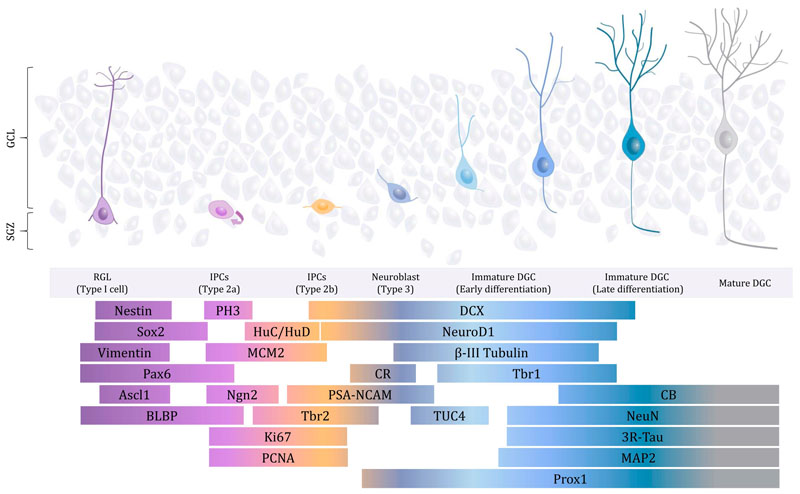
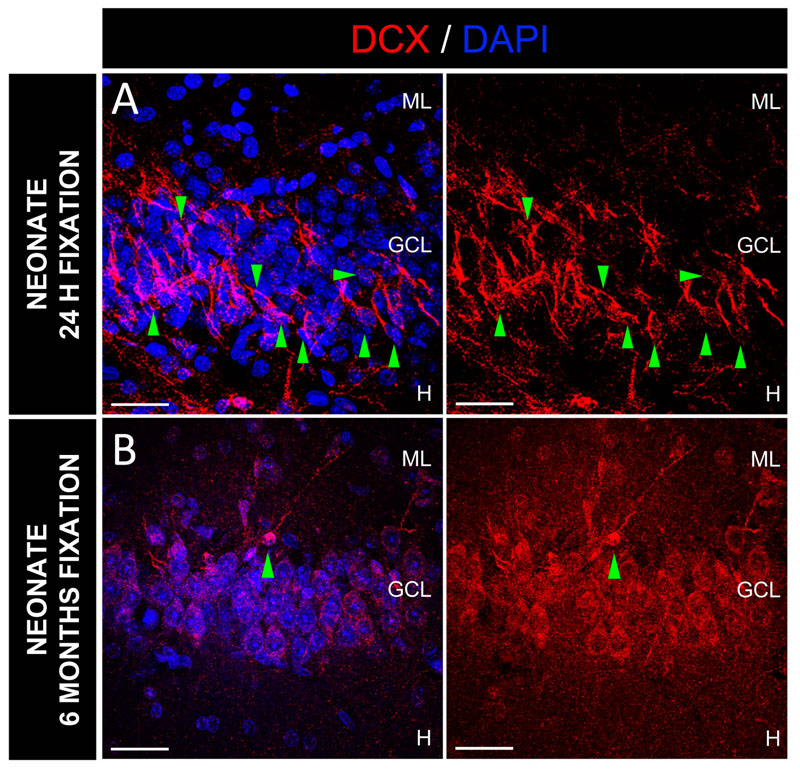
The hippocampus hosts the continuous addition of new neurons throughout life-a phenomenon named adult hippocampal neurogenesis (AHN). Here we revisit the occurrence of AHN in more than 110 mammalian species, including humans, and discuss the further validation of these data by single-cell RNAseq and other alternative techniques. In this regard, our recent studies have addressed the long-standing controversy in the field, namely whether cells positive for AHN markers are present in the adult human dentate gyrus (DG). Here we review how we developed a tightly controlled methodology, based on the use of high-quality brain samples (characterized by short postmortem delays and ≤24 h of fixation in freshly prepared 4% paraformaldehyde), to address human AHN. We review that the detection of AHN markers in samples fixed for 24 h required mild antigen retrieval and chemical elimination of autofluorescence. However, these steps were not necessary for samples subjected to shorter fixation periods. Moreover, the detection of labile epitopes (such as Nestin) in the human hippocampus required the use of mild detergents. The application of this strictly controlled methodology allowed reconstruction of the entire AHN process, thus revealing the presence of neural stem cells, proliferative progenitors, neuroblasts, and immature neurons at distinct stages of differentiation in the human DG. The data reviewed here demonstrate that methodology is of utmost importance when studying AHN by means of distinct techniques across the phylogenetic scale. In this regard, we summarize the major findings made by our group that emphasize that overlooking fundamental technical principles might have consequences for any given research field.
海马体在整个生命过程中都持续产生新的神经元——这一现象被称为成年海马神经发生(Adult Hippocampal Neurogenesis,AHN)。在这里,我们重新回顾了超过 110 种哺乳动物物种(包括人类)中 AHN 的发生情况,并讨论了单细胞 RNAseq 和其他替代技术对这些数据的进一步验证。在这方面,我们最近的研究解决了该领域长期存在的争议,即 AHN 标志物阳性的细胞是否存在于成年人类齿状回(Dentate Gyrus,DG)中。在这里,我们回顾了我们如何开发一种严格控制的方法,该方法基于使用高质量的大脑样本(其特征是死后延迟时间短且在新鲜制备的 4%多聚甲醛中固定时间≤24 小时)来解决人类 AHN 问题。我们回顾了在固定 24 小时的样本中检测 AHN 标志物需要轻度抗原修复和化学消除自发荧光。然而,对于固定时间较短的样本,这些步骤不是必需的。此外,在人类海马体中检测不稳定表位(如 Nestin)需要使用温和的去污剂。这种严格控制方法的应用允许重建整个 AHN 过程,从而揭示了神经干细胞、增殖祖细胞、神经前体细胞和处于不同分化阶段的未成熟神经元在人类 DG 中的存在。这里回顾的数据表明,在通过不同技术在系统发育尺度上研究 AHN 时,方法至关重要。在这方面,我们总结了我们小组的主要发现,强调了忽视基本技术原则可能会对任何特定的研究领域产生影响。