Khalil Mohamed Hesham
Department of Architecture, University of Cambridge, Cambridge, United Kingdom.
Front Neurosci. 2024 Jun 11;18:1368411. doi: 10.3389/fnins.2024.1368411. eCollection 2024.
Hippocampal neurogenesis is critical for improving learning, memory, and spatial navigation. Inhabiting and navigating spatial complexity is key to stimulating adult hippocampal neurogenesis (AHN) in rodents because they share similar hippocampal neuroplasticity characteristics with humans. AHN in humans has recently been found to persist until the tenth decade of life, but it declines with aging and is influenced by environmental enrichment. This systematic review investigated the impact of spatial complexity on neurogenesis and hippocampal plasticity in rodents, and discussed the translatability of these findings to human interventions.
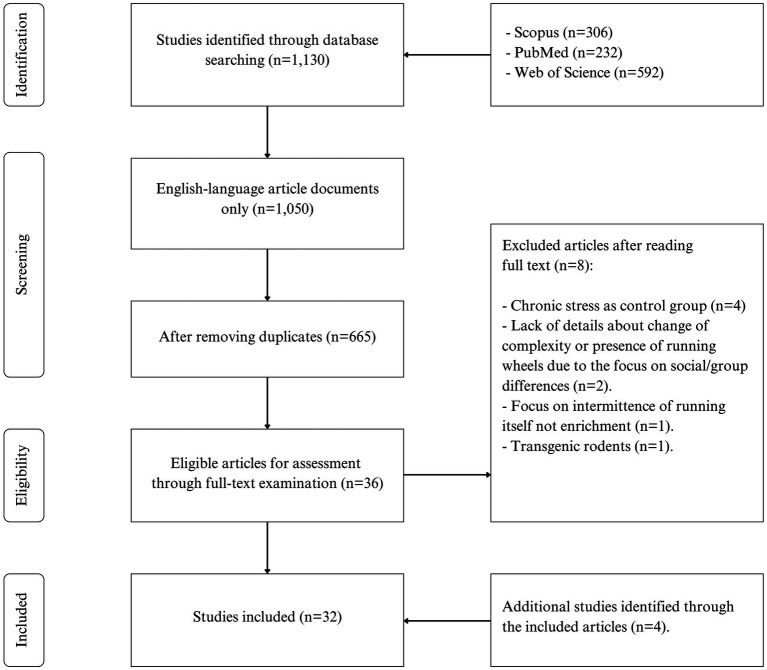
Comprehensive searches were conducted on three databases in English: PubMed, Web of Science, and Scopus. All literature published until December 2023 was screened and assessed for eligibility. A total of 32 studies with original data were included, and the process is reported in accordance with the PRISMA (Preferred Reporting Items for Systematic Reviews and Meta-Analyses) statement and checklist.
The studies evaluated various models of spatial complexity in rodents, including environmental enrichment, changes to in-cage elements, complex layouts, and navigational mazes featuring novelty and intermittent complexity. A regression equation was formulated to synthesize key factors influencing neurogenesis, such as duration, physical activity, frequency of changes, diversity of complexity, age, living space size, and temperature.
Findings underscore the cognitive benefits of spatial complexity interventions and inform future translational research from rodents to humans. Home-cage enrichment and models like the Hamlet complex maze and the Marlau cage offer insight into how architectural design and urban navigational complexity can impact neurogenesis in humans. In-space changing complexity, with and without physical activity, is effective for stimulating neurogenesis. While evidence on intermittent spatial complexity in humans is limited, data from the COVID-19 pandemic lockdowns provide preliminary evidence. Existing equations relating rodent and human ages may allow for the translation of enrichment protocol durations from rodents to humans.
海马体神经发生对于改善学习、记忆和空间导航至关重要。在啮齿动物中,栖息于并驾驭空间复杂性是刺激成年海马体神经发生(AHN)的关键,因为它们与人类具有相似的海马体神经可塑性特征。最近发现,人类的AHN会持续到生命的第十个十年,但会随着年龄增长而下降,并受到环境丰富化的影响。本系统综述调查了空间复杂性对啮齿动物神经发生和海马体可塑性的影响,并讨论了这些发现对人类干预措施的可转化性。
对三个英文数据库进行了全面检索:PubMed、科学网和Scopus。筛选并评估了截至2023年12月发表的所有文献的 eligibility。总共纳入了32项有原始数据的研究,并按照PRISMA(系统综述和Meta分析的首选报告项目)声明和清单报告了该过程。
这些研究评估了啮齿动物中各种空间复杂性模型,包括环境丰富化、笼内元素变化、复杂布局以及具有新颖性和间歇性复杂性的导航迷宫。制定了一个回归方程,以综合影响神经发生的关键因素,如持续时间、体力活动、变化频率、复杂性多样性、年龄、生活空间大小和温度。
研究结果强调了空间复杂性干预措施的认知益处,并为未来从啮齿动物到人类的转化研究提供了参考。笼内丰富化以及像哈姆雷特复杂迷宫和马尔劳笼这样的模型,为建筑设计和城市导航复杂性如何影响人类神经发生提供了见解。有或没有体力活动的空间变化复杂性对于刺激神经发生是有效的。虽然关于人类间歇性空间复杂性的证据有限,但来自新冠疫情封锁的数据提供了初步证据。现有的啮齿动物和人类年龄相关方程可能有助于将丰富化方案的持续时间从啮齿动物转化到人类。