Department of Microbiology and Immunology, Geisel School of Medicine at Dartmouth, Hanover, New Hampshire, USA.
mSystems. 2022 Dec 20;7(6):e0046822. doi: 10.1128/msystems.00468-22. Epub 2022 Oct 19.
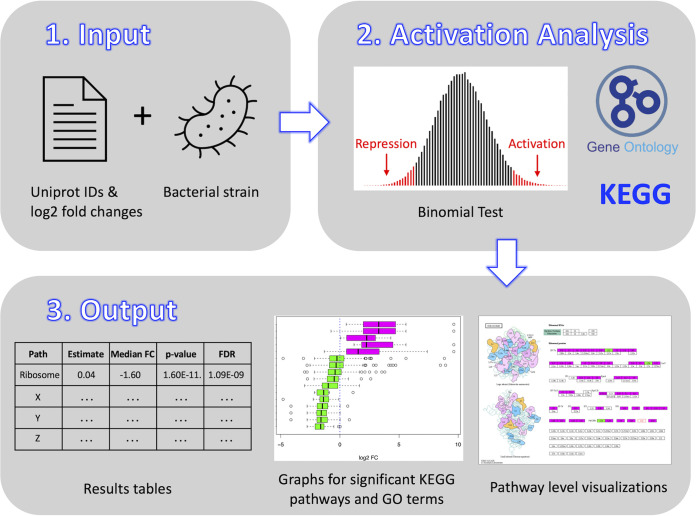
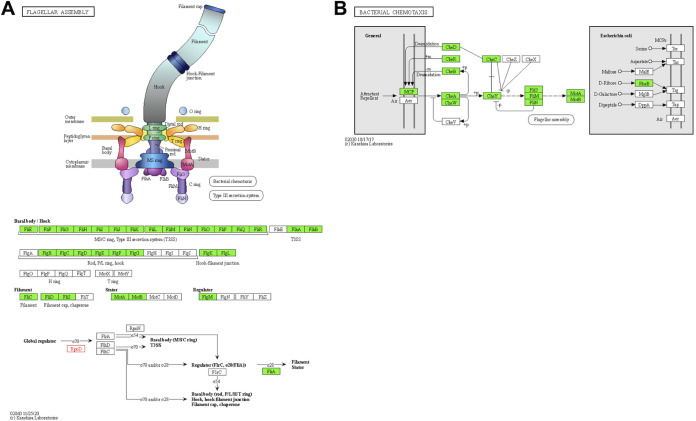
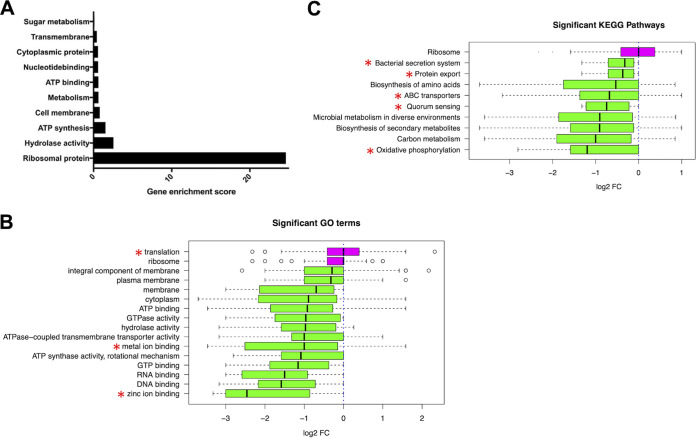
The last 20 years have witnessed an explosion in publicly available gene expression and proteomic data and new tools to help researchers analyze these data. Tools typically include statistical approaches to identify differential expression, integrate prior knowledge, visualize results, and suggest how differential expression relates to changes in phenotype. Here, we provide a simple web-based tool that bridges some of the gaps between the functionality available to those studying eukaryotes and those studying prokaryotes. Specifically, our Shiny web application ESKAPE Act PLUS allows researchers to upload results of high-throughput bacterial gene or protein expression experiments from 13 species, including the six ESKAPE pathogens, to our system and receive (i) an analysis of which KEGG pathways or GO terms are significantly activated or repressed, (ii) visual representations of the magnitude of activation or repression in each category, and (iii) detailed diagrams showing known relationships between genes in each regulated KEGG pathway and fold changes of individual genes. Importantly, our statistical approach does not require users to identify which genes or proteins are differentially expressed. ESKAPE Act PLUS provides high-quality statistics and graphical representations not available using other web-based systems to assess whether prokaryotic biological functions are activated or repressed by experimental conditions. To our knowledge, ESKAPE Act PLUS is the first application that provides pathway activation analysis and pathway-level visualization of gene or protein expression for prokaryotes. ESKAPE pathogens are bacteria of concern because they develop antibiotic resistance and can cause life-threatening infections, particularly in more susceptible immunocompromised people. ESKAPE Act PLUS is a user-friendly web application that will advance research on ESKAPE and other pathogens commonly studied by the biomedical community by allowing scientists to infer biological phenotypes from the results from high-throughput bacterial gene or protein expression experiments. ESKAPE Act PLUS currently supports analysis of 23 strains of bacteria from 13 species and can also be used to re-analyze publicly available data to generate new findings and hypotheses for follow-up experiments.
过去 20 年来,可公开获取的基因表达和蛋白质组学数据呈爆炸式增长,同时也涌现出了许多帮助研究人员分析这些数据的新工具。这些工具通常包括用于识别差异表达、整合先验知识、可视化结果以及提示差异表达与表型变化之间关系的统计方法。在这里,我们提供了一个简单的基于网络的工具,旨在弥合研究真核生物和研究原核生物的研究人员之间的部分差距。具体来说,我们的 Shiny 网络应用程序 ESKAPE Act PLUS 允许研究人员将来自 13 个物种(包括 6 种 ESKAPE 病原体)的高通量细菌基因或蛋白质表达实验结果上传到我们的系统,并获得以下结果:(i) 分析哪些 KEGG 途径或 GO 术语显著被激活或抑制;(ii) 可视化每个类别中激活或抑制的幅度;以及 (iii) 详细的图表,显示每个调控 KEGG 途径中基因之间的已知关系以及各个基因的倍数变化。重要的是,我们的统计方法不需要用户识别哪些基因或蛋白质存在差异表达。ESKAPE Act PLUS 提供了高质量的统计数据和图形表示,而其他基于网络的系统则无法提供这些内容,可用于评估实验条件是否激活或抑制了原核生物的生物学功能。据我们所知,ESKAPE Act PLUS 是第一个为原核生物提供途径激活分析和途径水平基因或蛋白质表达可视化的应用程序。ESKAPE 病原体是令人关注的细菌,因为它们会产生抗生素耐药性,并可能导致危及生命的感染,尤其是在免疫功能低下的易感人群中。ESKAPE Act PLUS 是一个用户友好的网络应用程序,它将通过允许科学家从高通量细菌基因或蛋白质表达实验的结果中推断生物学表型,来推进 ESKAPE 及其他生物医学研究界常见病原体的研究。ESKAPE Act PLUS 目前支持对来自 13 个物种的 23 种细菌进行分析,还可以用于重新分析公开可用的数据,以生成新的发现和后续实验的假说。