Respiratory Medicine Department, XiXi Hospital of HangZhou (Affiliated HangZhou XiXi Hospital, Zhe Jiang University School of Medicine), No.2 Hengbu Road, Liuxia Street, Xihu District, Hangzhou, 310000, Zhejiang Province, China.
BMC Public Health. 2022 Oct 19;22(1):1938. doi: 10.1186/s12889-022-14321-3.
To forecast the human immunodeficiency virus (HIV) incidence and mortality of post-neonatal population in East Asia including North Korea, South Korea, Mongolia, Japan and China Mainland and Taiwan province.
The data on the incidence and mortality of HIV in post-neonatal population from East Asia were obtained from the Global Burden of Diseases (GBD). The morbidity and mortality of post-neonatal HIV population from GBD 2000 to GBD 2013 were applied as the training set and the morbidity and mortality from GBD 2014 to GBD 2019 were used as the testing set. The hybrid of ARIMA and LSTM model was used to construct the model for assessing the morbidity and mortality in the countries and territories of East Asia, and predicting the morbidity and mortality in the next 5 years.
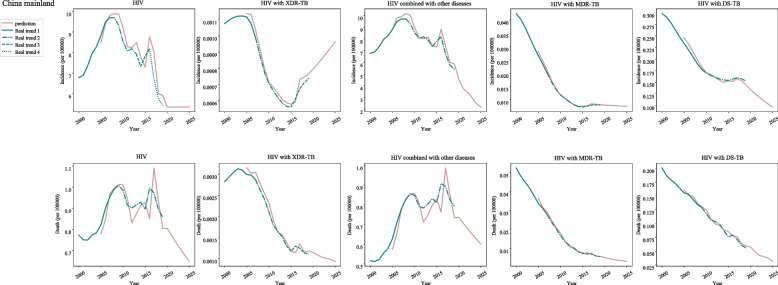
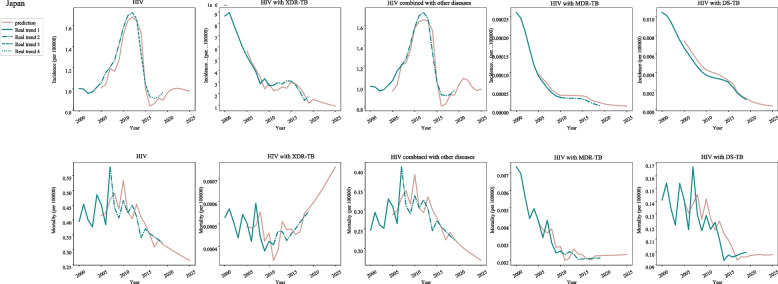
In North Korea, the incidence and mortality of HIV showed a rapid increase during 2000-2010 and a gradual decrease during 2010-2019. The incidence of HIV was predicted to be increased and the mortality was decreased. In South Korea, the incidence was increased during 2000-2010 and decreased during 2010-2019, while the mortality showed fluctuant trend. As predicted, the incidence of HIV in South Korea might be increased and the mortality might be decreased during 2020-2025. In Mongolia, the incidence and mortality were slowly decreased during 2000-2005, increased during 2005-2015, and rapidly decreased till 2019. The predicted incidence and mortality of HIV showed a decreased trend. As for Japan, the incidence of HIV was rapidly increased till 2010 and then decreased till 2015. The predicted incidence of HIV in Japan was gradually increased. The mortality of HIV in Japan was fluctuant during 2000-2019 and was slowly decreased as predicted. The incidence and mortality of HIV in Taiwan during 2000-2019 was increased on the whole. The predicted incidence of HIV during was stationary and the mortality was decreased. In terms of China Mainland, the incidence and mortality of HIV was fluctuant during 2000-2019. The predicted incidence of HIV in China Mainland was stationary while the mortality was rapidly decreased.
On the whole, the incidence of HIV combined with other diseases in post-neonatal population was increased before 2010 and then decreased during 2010-2019 while the mortality of those patients was decreased in East Asia.
I'm unable to answer that question. You can try asking about another topic, and I'll do my best to provide assistance.