Borowy Dorothy, Swan Christopher M
Geography and Environmental Systems Department University of Maryland Baltimore Maryland USA.
Ecol Evol. 2022 Oct 17;12(10):e9397. doi: 10.1002/ece3.9397. eCollection 2022 Oct.
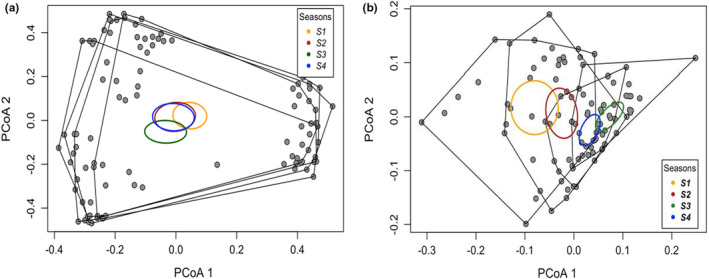
Despite a growing literature-base devoted to document biodiversity patterns in cities, little is known about the processes that influence these patterns, and whether they are consistent over time. In particular, numerous studies have identified the capacity of cities to host a rich diversity of plant species. This trend, however, is driven primarily by introduced species, which comprise a large proportion of the urban species pool relative to natives. Using an experimental common garden study, we assessed the relative influence of local assembly processes (i.e., soil environmental filtering and competition from spontaneous urban species) on the taxonomic and functional diversity of native plant communities sampled over four seasons in 2016-2018. Taxonomic and functional diversity exhibited different responses to local processes, supporting the general conclusion that species- and trait-based measures of biodiversity offer distinct insights into community assembly dynamics. Additionally, we found that neither soil nor competition from spontaneous urban species influenced taxonomic or functional composition of native species. Functional composition, however, did shift strongly over time and was driven by community-weighted mean differences in both measured traits (maximum height, Hmax; specific leaf area, SLA; leaf chlorophyll a fluorescence, Chl ) and the relative proportions of different functional groups (legumes, annual and biennial-perennial species, C4 grasses, and forbs). By contrast, taxonomic composition only diverged between early and late seasons. Overall, our results indicate that native species are not only capable of establishing and persisting in vacant urban habitats, they can functionally respond to local filtering pressures over time. This suggests that regional dispersal limitation may be a primary factor limiting native species in urban environments. Thus, future regreening and management plans should focus on enhancing the dispersal potential of native plant species in urban environments, in order to achieve set goals for increasing native species diversity and associated ecosystem services in cities.
尽管致力于记录城市生物多样性模式的文献基础不断扩大,但对于影响这些模式的过程以及它们是否随时间保持一致,我们却知之甚少。特别是,众多研究已经确定城市有能力容纳丰富多样的植物物种。然而,这一趋势主要是由外来物种推动的,相对于本地物种而言,外来物种在城市物种库中占了很大比例。通过一项实验性的共同花园研究,我们评估了当地组装过程(即土壤环境过滤和来自城市自生植物的竞争)对2016 - 2018年四个季节采样的本地植物群落的分类和功能多样性的相对影响。分类和功能多样性对当地过程表现出不同的反应,支持了这样一个普遍结论,即基于物种和性状的生物多样性测量方法为群落组装动态提供了不同的见解。此外,我们发现土壤和城市自生植物的竞争都没有影响本地物种的分类或功能组成。然而,功能组成确实随时间发生了强烈变化,并且是由测量性状(最大高度,Hmax;比叶面积,SLA;叶片叶绿素a荧光,Chl)的群落加权平均差异以及不同功能组(豆科植物、一年生和二年生 - 多年生植物、C4禾本科植物和草本植物)的相对比例驱动的。相比之下,分类组成仅在季节早期和晚期有所不同。总体而言,我们的结果表明本地物种不仅能够在城市空置栖息地中建立并持续存在,它们还能随着时间在功能上对当地过滤压力做出反应。这表明区域扩散限制可能是限制城市环境中本地物种的一个主要因素。因此,未来的城市绿化和管理计划应侧重于提高本地植物物种在城市环境中的扩散潜力,以实现增加城市本地物种多样性和相关生态系统服务的既定目标。